If you want to manufacture a modern smartphone lens, a massive telescope mirror, or a next-generation semiconductor wafer, traditional CNC machining simply isn’t good enough.
You have left the world of “microns” and entered the unforgiving realm of “nanometers.” At this microscopic scale, the beating heart of your machine tool—the high-speed spindle—must rotate with absolute, flawless perfection.
But perfection is physically impossible. Every spindle wobbles.
In ultra-precision manufacturing, the difference between a pristine, mirror-like optical finish and a scrapped part comes down to understanding the two distinct types of that wobble: Synchronous Runout and its chaotic, destructive sibling, Asynchronous Runout.
To conquer the latter, the industry has largely abandoned traditional mechanical bearings in favor of flying on a cushion of air.
Let’s dive into the invisible physics of high-speed spindles and explore the delicate balancing act of Air Bearing Stability.
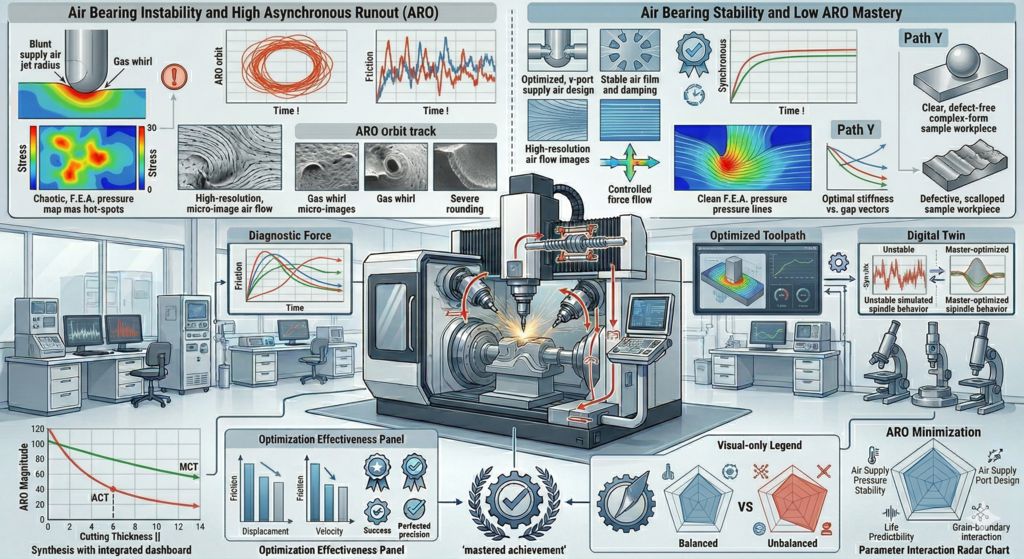
The Two Faces of Spindle Wobble
Runout is the term used to describe a spinning tool or shaft deviating from its true, perfect axis of rotation. Imagine a slightly bent drill bit wobbling as it spins—that is runout. But in high-speed precision spindles, this wobble is divided into two very different categories.
1. Synchronous Runout: The Predictable Wobble
Synchronous runout is tied perfectly to the rotation of the spindle. If the spindle shaft has a slight heavy spot, it will deflect in the exact same direction, at the exact same point in its 360-degree rotation, every single time.
Because it repeats flawlessly with every revolution, synchronous runout is actually quite manageable. A diamond turning lathe will simply cut a slightly different profile, but it will do so consistently. It affects the overall geometric accuracy of the part, but it usually leaves a smooth, predictable surface.
2. Asynchronous Runout: The Chaotic Flutter
This is the ultimate enemy of the ultra-precision machinist. Asynchronous runout happens at frequencies that do not match the spindle’s rotation.
If your spindle is spinning at 60,000 RPM, the tool tip isn’t just following a perfect circle; it is fluttering randomly in microscopic, unpredictable directions. Because this flutter doesn’t repeat consistently, the cutting tool gouges the material at random intervals.
You cannot balance it out, and you cannot program your CNC software to compensate for it. Asynchronous runout directly destroys your surface finish, leaving behind a cloudy, microscopically jagged surface instead of a perfect optical mirror.
Why Traditional Ball Bearings Fail
In a standard CNC machine, the spindle shaft rolls on ceramic or steel ball bearings. No matter how perfectly a manufacturer polishes those little spheres, they are never perfectly round. They have nanometer-scale peaks and valleys.
As the spindle spins, the balls roll inside their cages at a different speed than the shaft itself. The microscopic imperfections on the balls, the bearing races, and the cages all interact randomly.
This mechanical “rumble” translates directly into severe asynchronous runout. For true optical finishes, mechanical contact is no longer acceptable.
Enter the Air Bearing: Floating on Nothing
To eliminate the rumble of physical bearings, ultra-precision machines utilize Aerostatic Air Bearings.
In an air bearing spindle, there are no balls, no rollers, and no physical contact whatsoever. The rotating spindle shaft is suspended entirely by a microscopic cushion of highly pressurized, deeply filtered air.
Because the shaft is literally floating, the friction is practically zero. More importantly, because there are no physical balls rolling around, the mechanical source of asynchronous runout is almost completely eliminated. An air bearing spindle spins with a liquid-like smoothness that mechanical bearings can only dream of.
The Hidden Trap: Air Bearing Instability
While air bearings solve the mechanical rumble, they introduce a terrifying new problem: fluid dynamics. Air is a compressible gas, meaning it acts like a giant, invisible spring. If you don’t control that spring perfectly, the spindle becomes unstable.
When an air bearing loses its stability, it creates massive asynchronous runout, often ruining the part and potentially causing the spindle shaft to crash into the housing at 60,000 RPM. This instability usually manifests in two forms:
1. The Pneumatic Hammer Effect
Imagine blowing air into a paper bag. If you blow just right, the bag stays inflated. But if you restrict the exit and force too much air in, the bag starts to violently flutter and vibrate.
The same thing happens inside an air bearing. The pressurized air is fed into the microscopic gap between the shaft and the housing through tiny holes (restrictors). If the volume of the air pocket and the pressure drop across those restrictors aren’t perfectly tuned, the air pressure inside the gap will begin to rapidly oscillate.
The spindle shaft will violently bounce up and down on its air cushion, acting like a pneumatic jackhammer.
2. Half-Speed Whirl
As the spindle shaft spins at incredibly high speeds, it drags the surrounding cushion of air along with it due to the air’s natural viscosity. This creates a rotating wedge of high-pressure air that chases the shaft. Under certain high-speed conditions, this wedge of air actually overtakes the damping capability of the bearing, causing the entire shaft to orbit erratically around its center—usually at exactly half the speed of the spindle’s rotation.
Mastering the Invisible Cushion
To achieve the ultimate goal—near-zero asynchronous runout—spindle engineers must master the chaotic physics of this air gap. They do this through obsessive design:
Micro-Porous Media: Instead of using a few drilled holes to inject the air, the highest-end air bearings use a porous carbon material (like a microscopic sponge). The air bleeds evenly through millions of tiny pores, completely eliminating the pressure pockets that cause the pneumatic hammer effect.
Extreme Machining Tolerances: The gap between the spinning shaft and the stationary housing in an air bearing is often less than 10 microns (a fraction of a human hair). Machining the spindle components to these tolerances ensures the air cushion is stiff and incredibly stable.
Active Damping: Some modern ultra-precision machines use active magnetic dampers alongside the air bearings to instantly sense and cancel out any fluid-induced whirl before it can translate to the cutting tool.
The Bottom Line
When you look at a perfectly manufactured optical lens or a flawless silicon wafer, you are looking at the triumph over chaotic vibration.
By abandoning the physical constraints of rolling metal and mastering the fluid dynamics of pressurized air, manufacturers have conquered asynchronous runout, allowing us to machine parts where the only limit is the size of an atom.
Please visit About、Machined Parts webpages