In the world of precision machining, few debates are as fundamental as the choice between Climb Milling and Conventional Milling. It is a decision that every machinist faces the moment a tool touches a workpiece.
While modern CNC technology has made one method the clear favorite for most applications, understanding the underlying physics of both is essential for achieving the “holy grail” of manufacturing: maximum efficiency, extended tool life, and a flawless surface finish.
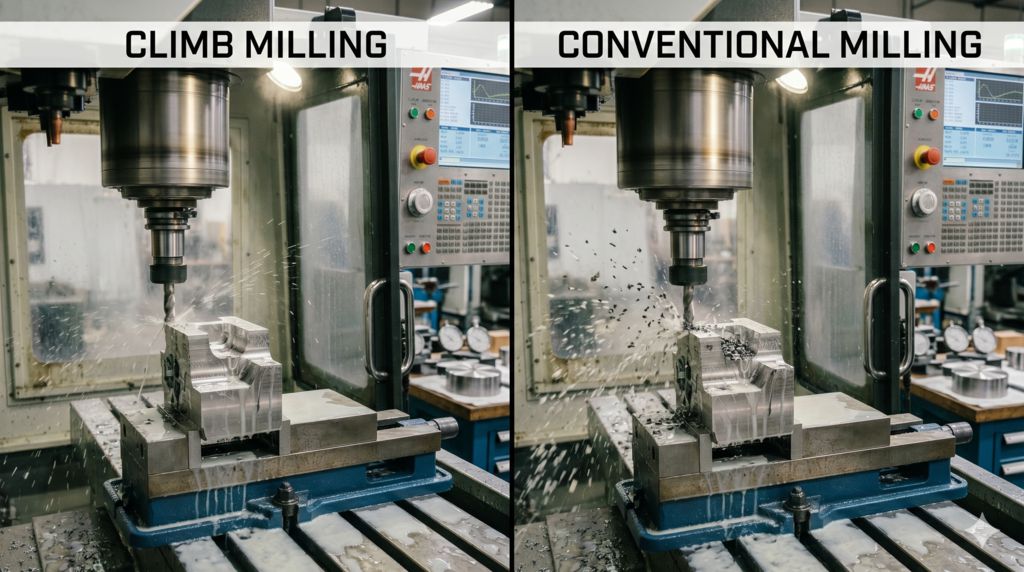
The Fundamental Difference: Tool Rotation vs. Feed Direction
To understand the conflict, we must look at the relationship between the cutter’s rotation and the direction of the table feed.
Climb Milling (Down Milling): In this method, the cutter rotates with the feed. Imagine a wheel “climbing” over the material. The tooth engages the workpiece at the maximum thickness and exits at zero thickness.
Conventional Milling (Up Milling): Here, the cutter rotates against the feed. The tooth starts at zero thickness and accelerates to its maximum thickness at the point of exit. It is a “scooping” motion that fights against the movement of the part.
Efficiency and Chip Formation: The “Thin-to-Thick” Trap
One of the most overlooked physical truths is how chips are formed. In Conventional Milling, the tool rubs against the surface before it actually starts cutting. This “rubbing zone” creates immense friction and work-hardening.
Because the chip starts at zero thickness, the tool tip undergoes significant heat buildup before it can penetrate the material. This is inefficient; you are spending energy to create heat rather than to remove metal.
In contrast, Climb Milling starts at the maximum chip thickness. The tool bites into the material immediately, transferring the heat of the cut into the chip itself rather than the tool or the workpiece. This lead to a much more efficient evacuation of energy and allows for higher feed rates.
Tool Life: A Battle of Friction and Impact
If you want your expensive carbide end mills to last, the physics overwhelmingly favor Climb Milling.
By engaging the material at the thickest point, the tool avoids the abrasive rubbing phase found in conventional milling. Rubbing is the primary enemy of tool edges, leading to rapid dulling and “built-up edge” (BUE).
However, there is a catch. Because Climb Milling starts with a high-impact “bite,” it requires a rigid setup. On older, manual machines with high backlash (mechanical play in the lead screws), climb milling can actually pull the workpiece into the cutter, leading to broken tools or catastrophic failure. In the modern era of pre-loaded ball screws and rigid CNC frames, this risk is largely mitigated, making Climb Milling the industry standard for tool longevity.
Surface Quality: The Quest for the Mirror Finish
Surface finish is often where the choice becomes most visible. Conventional Milling tends to lift the workpiece, and because the chips are thrown in front of the cutter, the tool often “recuts” the chips. This leads to a rougher, “scalloped” texture and can mar the surface.
Climb Milling exerts a downward force, effectively “pushing” the workpiece into the fixture. This increases stability and reduces vibration. Furthermore, since the chips are evacuated behind the cutter, the finished surface remains clean and untouched by debris. The result is a significantly smoother, more professional finish that often requires less post-processing.
When to Break the Rules: The Case for Conventional Milling
Despite the advantages of Climb Milling, Conventional Milling remains a vital tool in specific scenarios.
Castings and Scale: If you are machining a raw casting with a hard, abrasive outer “skin” or scale, Climb Milling will ruin your tool instantly as the edge hits the hard surface first. Conventional Milling allows the tool to start under the scale in the softer material and “pop” the scale off from the inside out.
Thin-Walled Parts: Sometimes the downward pressure of Climb Milling can cause thin parts to deflect or vibrate. In these niche cases, the upward “lifting” force of Conventional Milling may provide a more balanced stress distribution.
Conclusion: Making the Strategic Choice
For the modern machinist aiming for peak performance, Climb Milling is the default strategy. It offers lower heat, better finishes, and longer-lasting tools.
However, true mastery of the craft lies in knowing when the physics of the material—such as surface scale or extreme lack of rigidity—demand a return to the Conventional way. By balancing these two methods, you move beyond simple metal removal and into the realm of optimized precision engineering.
In addition, please visit CNC Turning Parts, Stamping Parts, Technical Data and Quality Inspection to get more information about us, if you have any question, please e-mail to Harry Yen hyen@unisontek.com.tw
Please watch our company YouTube channel Link and introduction Link