In the pursuit of sub-micron accuracy, machinists often obsess over spindle runout, thermal expansion, and high-end tool coatings. Yet, one of the most critical factors in turning operations is frequently overlooked because it is invisible to the naked eye: Tool Center Height.
When the cutting edge of a turning tool is not perfectly aligned with the horizontal centerline of the workpiece, a cascade of physical errors begins. What seems like a negligible offset—a mere "hair's breadth"—can become the primary reason for scrapped parts, broken inserts, and baffling dimensional inconsistencies.
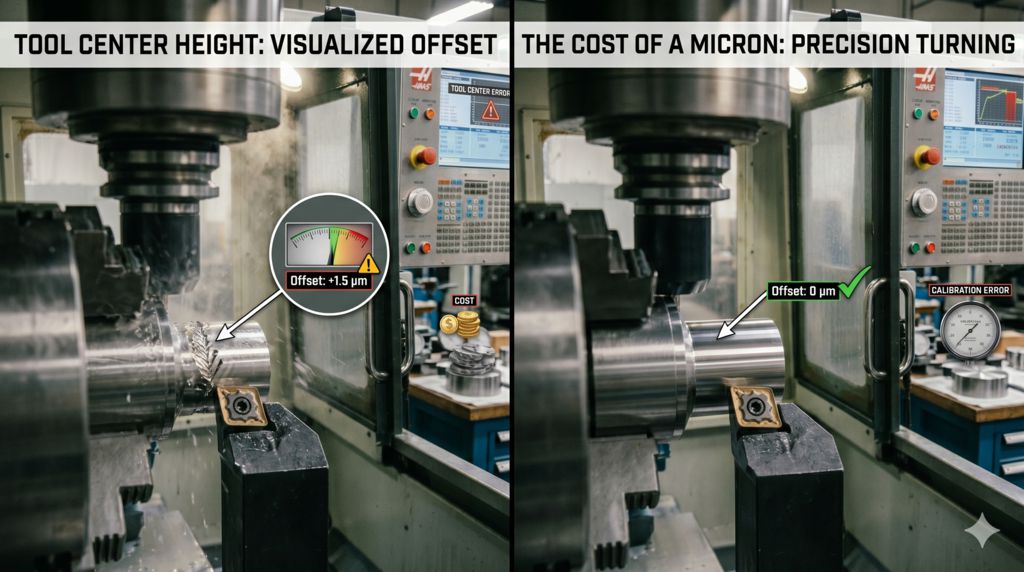
The Geometry of the Offset: Changing the Effective Angles
The primary "truth" of tool center height is that it fundamentally alters the tool's geometry relative to the workpiece. A tool is designed with a specific clearance angle and rake angle to optimize chip formation and prevent friction.
If the tool is above center, the effective clearance angle decreases. In extreme cases, the flank of the tool begins to rub against the workpiece instead of cutting it. This creates immense friction, localized heat, and a poor surface finish.
Conversely, if the tool is below center, the effective rake angle becomes more negative. The tool no longer "slices" the material smoothly; instead, it "plows" into it. This increases cutting forces and can lead to the tool being pulled further into the material, causing a catastrophic "dig-in."
The Dimensional Nightmare: The "Nipple" and Diameter Errors
One of the most obvious symptoms of a center height error occurs when facing a part to the center. If the tool is off-center, it leaves a small protrusion—often called a "nipple" or "tit"—at the center of the workpiece.
Beyond aesthetics, this offset creates a mathematical nightmare for diameter control. In precision turning, the machine assumes the tool is at $Y=0$. If the tool is actually at $Y+0.1mm$, the actual distance from the tool tip to the rotation axis is longer than the programmed coordinate.
As you approach smaller diameters, this error becomes non-linear. The smaller the part, the more significant the center height offset becomes as a percentage of the total diameter. This is why a setup might hold tolerance on a 50mm shaft but fail miserably on a 2mm pin.
The Silent Killer of Surface Integrity: Vibration and Chatter
Tool center height is a major contributor to chatter, the high-frequency vibration that leaves "tiger stripes" on a finished part.
When a tool is off-center, the cutting forces are no longer directed through the strongest part of the machine's tool post. Instead, the force creates a moment arm that encourages the tool to deflect or "bounce."
This instability is often misdiagnosed as a lack of machine rigidity or a dull insert. In reality, the tool is simply fighting the physics of the rotation. Aligning the tool to the exact center stabilizes the pressure, allowing the machine's dampening characteristics to work effectively and resulting in a mirror-like surface finish.
Impact on Tool Life: Uneven Wear and Micro-Chipping
Precision inserts are engineered to distribute heat and pressure across a specific edge preparation. When the center height is incorrect, the pressure distribution shifts.
An "above center" tool experiences rapid flank wear due to increased rubbing. A "below center" tool is prone to micro-chipping of the cutting edge because of the increased mechanical shock and unfavorable rake angles.
By ignoring center height, shops unknowingly increase their tooling costs by 20% to 30%, as inserts are changed prematurely due to "unexplained" wear patterns that are actually entirely preventable through proper alignment.
Conclusion: Respecting the Centerline
In the world of precision turning, "close enough" is the enemy of excellence. Tool center height is not a secondary adjustment; it is the foundation upon which all other turning physics are built.
Whether you are using a traditional shim, an adjustable tool holder, or an optical pre-setter, the time spent ensuring the tool tip meets the workpiece at exactly $0.000$ elevation is the most profitable minute a machinist can spend. By eliminating this invisible killer, you secure the stability, accuracy, and longevity required to push machining to its absolute limits.
In addition, please visit CNC Turning Parts, Stamping Parts, Technical Data and Quality Inspection to get more information about us, if you have any question, please e-mail to Harry Yen hyen@unisontek.com.tw
Please watch our company YouTube channel Link and introduction Link