In the world of high-end manufacturing, we often treat CNC machines as invincible titans of steel and granite. We program them with sub-micron commands, expecting them to repeat the same movement flawlessly for hours.
However, there is an invisible, creeping enemy that threatens this stability: Thermal Displacement. Just as a human body slows down and loses coordination during a heatstroke, a machine tool undergoes physical distortions as it warms up, leading to a phenomenon known as “thermal drift.” For a precision shop, ignoring this reality is the fastest way to turn high-value workpieces into expensive scrap metal.
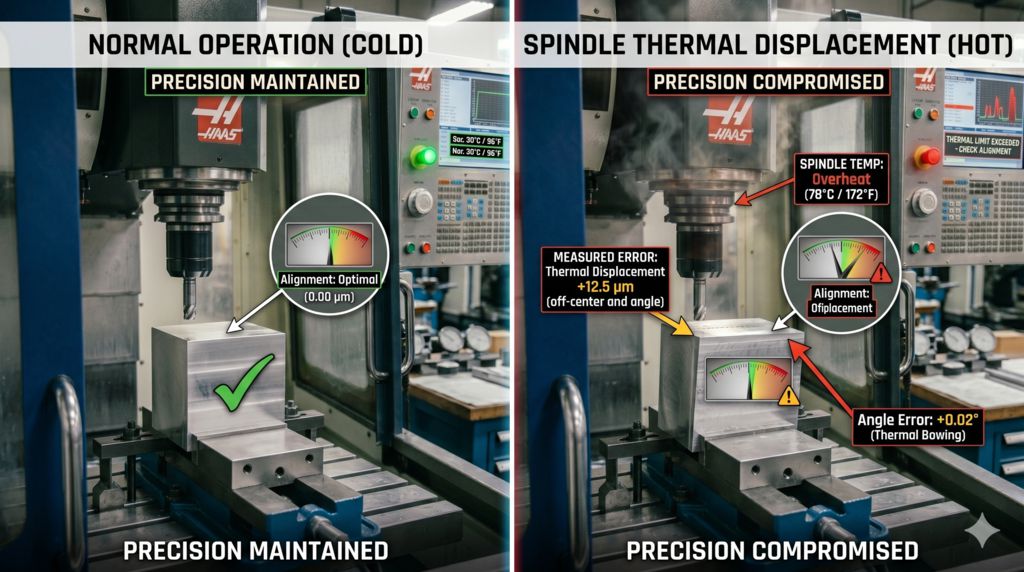
The Physics of the “Heatstroke”: Why Machines Move
The core of the problem lies in basic thermodynamics: materials expand when they get hot. A CNC machine is a complex assembly of different materials—steel, cast iron, aluminum—each with its own Coefficient of Thermal Expansion (CTE).
As the spindle rotates at thousands of revolutions per minute, the friction in the bearings generates immense localized heat. This heat doesn’t stay in the bearings; it migrates. It travels up the spindle housing and into the machine column.
Because the machine is rarely a perfectly symmetrical cube, it doesn’t expand uniformly. It tilts, twists, and elongates. A spindle might grow in length (the Z-axis) by 50 to 100 microns just by running at high speed for an hour. In a world where tolerances are measured in single-digit microns, this “heatstroke” is catastrophic.
The Z-Axis Creep: The Silent Accuracy Killer
The most common victim of thermal displacement is the Z-axis. As the spindle shaft heats up, it physically lengthens, moving the cutting tool closer to the workpiece than the computer realizes.
Imagine you are milling a pocket to a precise depth. You set your tool offset at 8:00 AM when the shop is cool and the machine is “cold.” By 10:00 AM, after two hours of continuous cutting, the spindle has expanded downward.
The machine still thinks it is at the programmed depth, but in reality, it is cutting deeper. This lead to inconsistent part dimensions across a single production run, creating a nightmare for Quality Control teams who find that parts made in the morning pass inspection, while parts made in the afternoon are out of spec.
Geometry Distortion: Beyond Simple Expansion
Thermal displacement isn’t just about length; it’s about geometric integrity. Most machine tools are C-frame or bridge-style structures. When one side of the column stays cooler than the side facing a window or a heat source, the machine “bows.”
This distortion introduces angular errors. Suddenly, a hole that was supposed to be perfectly perpendicular to the base is slightly tilted. The spindle axis and the table axis are no longer square.
Unlike a simple offset that can be corrected with a single coordinate change, geometric distortion is non-linear and incredibly difficult to compensate for without advanced real-time sensing technology.
Sources of Internal and External “Fever”
What causes this machine “fever”? It is a combination of internal and external factors:
Internal Factors:
Spindle Bearings: The primary source of heat in high-speed operations.
Axis Motors and Ball Screws: Constant rapid movement generates friction and electrical heat.
Hydraulic Systems: Hot oil circulating through the machine acts like a heating system.
External Factors:
Ambient Temperature: A shop floor that swings from 18°C at night to 30°C in the afternoon will see massive machine movement.
Coolant Temperature: If the coolant isn’t chilled, it can actually transfer heat into the workpiece and machine bed, compounding the problem.
Preventing the Meltdown: Strategies for Thermal Stability
How do world-class shops combat the “heatstroke” of their machines? It requires a multi-layered approach to thermal management:
Warm-up Cycles: Never start precision work on a cold machine. Running a 20-minute warm-up program helps the machine reach a “thermal plateau” where expansion stabilizes.
Spindle Chillers: High-end machines use active cooling systems that circulate chilled oil around the spindle bearings to whisk away heat before it can migrate.
Symmetry in Design: Modern machine builders use “thermal-symmetric” designs so that if expansion occurs, it happens uniformly, preserving the centerlines.
Real-time Compensation: Advanced CNC controllers use thermal sensors (thermocouples) placed around the machine to calculate the expected expansion and automatically shift the coordinate system in real-time to “mask” the error.
Conclusion: Respecting the Thermodynamics of Precision
In precision machining, the “limit” isn’t just how fast you can cut; it’s how well you can manage the energy you create. A machine is a living, breathing physical entity that reacts to its environment.
By acknowledging that your machine is susceptible to “heatstroke,” you move from being a reactive operator to a proactive engineer.
Understanding spindle thermal displacement allows you to build processes that remain stable from the first part to the last, ensuring that the only thing “hot” in your shop is the quality of your output.
In addition, please visit CNC Turning Parts, Stamping Parts, Technical Data and Quality Inspection to get more information about us, if you have any question, please e-mail to Harry Yen hyen@unisontek.com.tw
Please watch our company YouTube channel Link and introduction Link