In the macro-world of traditional machining, we treat metals as homogeneous, isotropic materials—essentially consistent blocks of matter that behave predictably according to the laws of classical mechanics.
However, as the manufacturing industry pushes toward the "micro" and "nano" scales, these assumptions shatter. When the undeformed chip thickness becomes smaller than the average grain size of the material, we enter the realm of the "Size Effect." In this space, the physics of cutting changes fundamentally, turning precision engineering into a complex dance with metallurgy and atomic-scale forces.
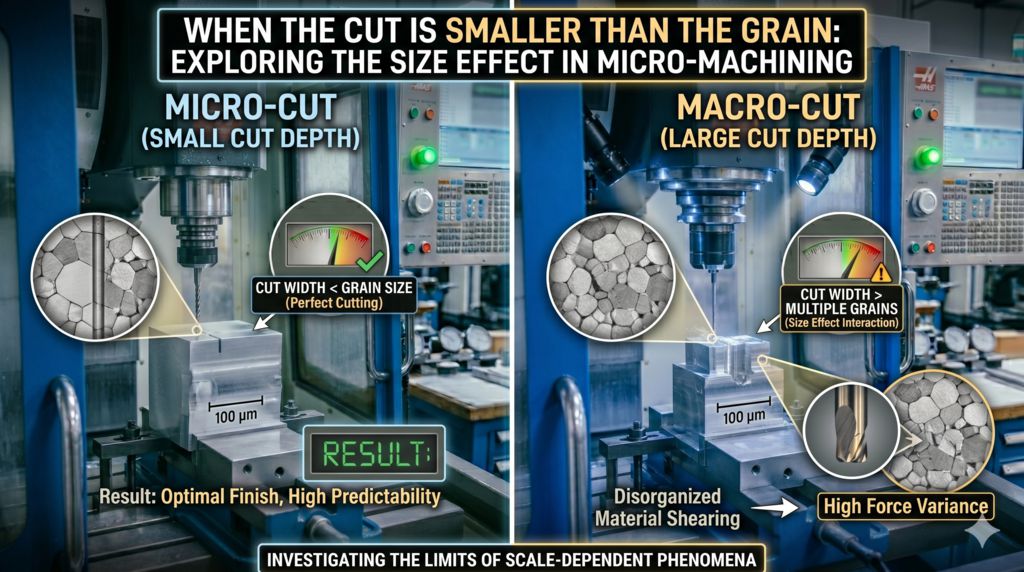
Breaking the Homogeneity Myth: Grain Boundaries Matter
In conventional milling or turning, a cutting tool engages thousands of crystalline grains simultaneously. Because the cut is so large, the "average" properties of these grains (their orientation, size, and boundaries) dictate the material's behavior.
In micro-machining, the scenario is drastically different. When your depth of cut is only a few micrometers, the tool might be cutting through a single grain or struggling to cross a single grain boundary.
At this scale, the material is no longer homogeneous. The specific crystal orientation of that individual grain determines the cutting force. If the tool hits a hard crystal plane, the force spikes; if it hits a soft one, the force drops. This leads to unpredictable vibrations and surface roughness that would be non-existent in macro-scale operations.
The Round Edge Effect: When Sharp is Not Sharp Enough
In macro-machining, we often treat the cutting edge as a perfectly sharp line. But in reality, every tool has an edge radius ($r_e$), no matter how finely it is ground.
In micro-machining, the ratio between the depth of cut ($h$) and the edge radius ($r_e$) becomes critical. When $h$ is much larger than $r_e$, the tool "slices" the material.
However, when the depth of cut is reduced to a scale smaller than the edge radius, the tool no longer cuts. Instead, it plows. The material is compressed and deformed under the rounded edge rather than being sheared off as a chip. This "plowing effect" dramatically increases friction, generates extreme heat, and leads to significant "spring-back" of the material after the tool passes.
The Minimum Chip Thickness (MCT) Barrier
One of the most vital physical truths in micro-machining is the Minimum Chip Thickness. You cannot simply "cut as thin as you want."
There is a critical threshold: if your programmed depth of cut is below the MCT, no chip will form. The material will simply deform elastically or plastically, rubbing against the tool until enough pressure builds up to finally "snap" and form a chip.
This leads to a "saw-tooth" force pattern. The machine is essentially loading a microscopic spring and then releasing it, over and over. This cycle is the primary cause of rapid tool wear and the "ghost" chatter often found in micro-scale milling.
Increased Specific Cutting Energy
A strange phenomenon occurs as we go smaller: the Specific Cutting Energy—the energy required to remove a unit volume of material—increases exponentially.
Why? Because at the micro-scale, the energy isn't just going into shearing the metal; a massive percentage is consumed by strain hardening and friction at the tool-workpiece interface.
Furthermore, as the cut gets smaller, the "dislocation density" within the metal becomes a factor. To create a chip, the tool must overcome the internal atomic obstacles (dislocations) of the crystal lattice. When the cutting zone is so small that it contains fewer dislocations, the material actually becomes stronger, requiring more force to deform. This is known as the "smaller is stronger" phenomenon in materials science.
Surface Integrity and Subsurface Damage
Because micro-machining involves so much "plowing" and high specific energy, the finished surface often hides a layer of subsurface damage.
The intense pressure and heat can create a "white layer" or a zone of high residual stress just beneath the surface. For medical implants or micro-electronics, this invisible damage can lead to premature fatigue failure or stress-corrosion cracking.
Achieving the "limit" of micro-machining requires not just a smaller tool, but a deep understanding of how to manage the thermal and mechanical stresses that occur when you are literally fighting the material's atomic structure.
Conclusion: A New Frontier of Physics
Micro-machining is not just "small-scale machining"; it is a different branch of physics altogether. Once the cutting thickness drops below the grain size, the rules of the shop floor change to the rules of the metallurgy lab.
Mastering the Size Effect requires a shift in mindset. Engineers must stop thinking about "removing metal" and start thinking about "managing grain-level deformation.
" Only by respecting these microscopic physical truths can we successfully manufacture the next generation of micro-fluidic devices, aerospace sensors, and life-saving medical technologies.
In addition, please visit CNC Turning Parts, Stamping Parts, Technical Data and Quality Inspection to get more information about us, if you have any question, please e-mail to Harry Yen hyen@unisontek.com.tw
Please watch our company YouTube channel Link and introduction Link