In the modern manufacturing landscape, the “Stronger, Lighter, Faster” mantra has pushed material science to its limits. Engineers are increasingly turning to superalloys, advanced ceramics, and hardened steels to meet the grueling demands of aerospace, medical, and automotive industries.
However, there is a catch: The better a material performs in the field, the harder it is to shape in the shop. Dealing with high-hardness and difficult-to-cut (DTC) materials is a high-stakes game where precision meets extreme resistance.
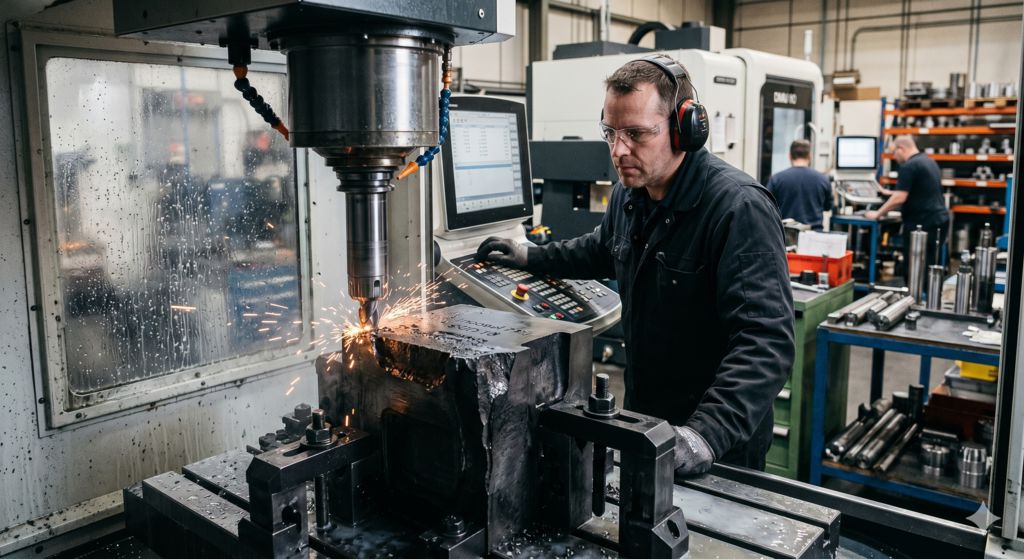
1. The “Hard” Reality: Why These Materials Resist
When we talk about high-hardness materials—such as Titanium alloys, Inconel, or hardened tool steels (above 45 HRC)—we aren’t just talking about “toughness.” We are talking about a unique set of physical properties that fight back against traditional machining.
- Work Hardening: Some materials, like stainless steel and certain nickel-based alloys, become even harder as they are being cut. If your feed rate or tool pressure isn’t perfect, the surface “skins over,” becoming nearly impenetrable.
- Extreme Thermal Resistance: These materials are designed to survive the heat of a jet engine. Paradoxically, this means they don’t dissipate heat well during machining. Instead of the heat leaving with the “chip,” it stays concentrated at the cutting edge, melting your tools.
- Abrasiveness: Materials like Metal Matrix Composites (MMCs) contain hard particles that act like sandpaper, grinding down carbide inserts in minutes.
2. The Triple Threat: Tool Life, Heat, and Vibration
Machining DTC materials presents a “Triple Threat” that can quickly turn a profitable job into a graveyard of broken inserts.
A. Accelerated Tool Wear
In standard machining, tools wear down gradually. With high-hardness materials, wear is aggressive. You’ll see cratering, chipping, and notch wear. Maintaining dimensional accuracy becomes a nightmare when your tool geometry changes every few passes.
B. The Heat Zone
Because these materials have low thermal conductivity, temperatures at the tool-tip interface can exceed 1000°C. Without advanced cooling strategies, the tool loses its “red hardness,” softens, and fails catastrophically.
C. Vibration and Chatter
Harder materials require higher cutting forces. These forces can trigger harmonic vibrations (chatter), leading to poor surface finishes and micro-cracks in the workpiece—a fatal flaw in mission-critical aerospace parts.
3. Overcoming the Obstacles: Modern Strategies
How do elite machine shops tackle these “un-machinable” materials? It comes down to a synergy of chemistry, geometry, and technology.
- Advanced Coatings: Standard TiAlN coatings often aren’t enough. Modern shops use AlTiN or Diamond-Like Carbon (DLC) coatings that act as thermal barriers and provide high lubricity.
- High-Pressure Coolant (HPC): Forget a simple drip. High-pressure systems (70 bar and above) blast coolant directly into the cutting zone, physically forcing the heat away and breaking chips more effectively.
- Ceramic and PCBN Tooling: When carbide fails, Polycrystalline Cubic Boron Nitride (PCBN) and ceramics take over. These materials actually perform better at higher temperatures, allowing for “Hard Turning” that replaces the need for slower grinding processes.
- Trochoidal Milling: Instead of “plowing” through the material, modern CAM paths use high-speed, low-width-of-cut movements. This reduces the time the tool spends in contact with the heat zone.
4. The Economic Impact
Choosing to work with high-hardness materials is a business decision as much as a technical one. While the tooling costs are significantly higher and cycle times are longer, the value of the finished component is often immense.
Success in this field requires a shift in mindset: You aren’t just “cutting metal”; you are managing a complex thermodynamic process.
Final Thoughts
The challenge of difficult-to-cut materials isn’t going away. As we look toward more efficient energy systems and deeper space exploration, materials will only get tougher. For manufacturers, mastering these “stubborn” metals isn’t just a hurdle—it’s a competitive advantage. If you can cut what others can’t, you own the market.