For decades, the manufacturing world was split into two fiercely competing camps. On one side stood Subtractive Manufacturing—the time-tested traditionalist. Armed with CNC mills, lathes, and drills, it takes a solid block of metal and aggressively chips away at it until the desired part emerges.
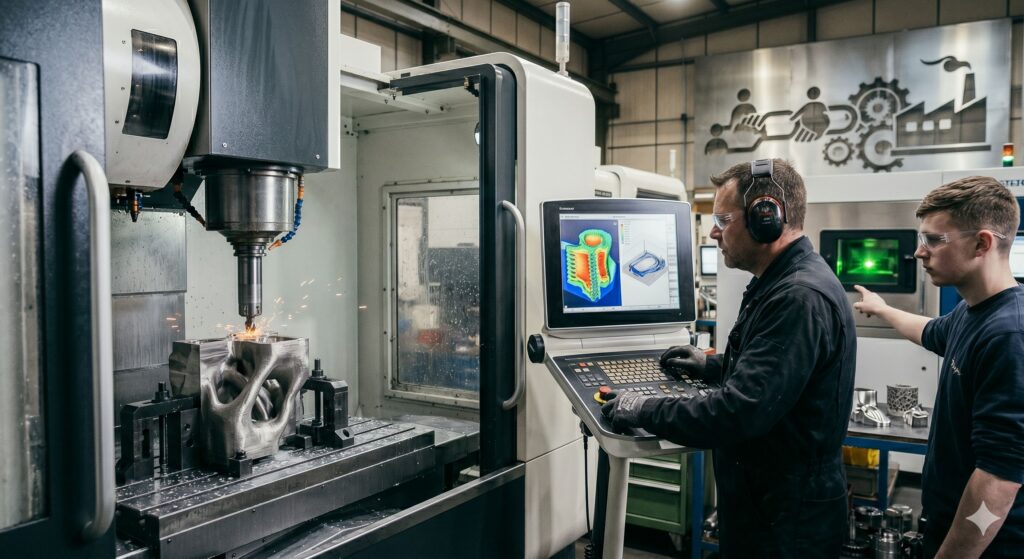
On the other side stood Additive Manufacturing (3D Metal Printing)—the disruptive newcomer. Instead of cutting away, it uses high-powered lasers or electron beams to meticulously fuse metal powder layer by layer, building complex geometries from the ground up.
For years, pundits debated which technology would “win.” But today, the conversation has completely changed. Forward-thinking machine shops have realized that these two methods shouldn’t be rivals. Instead, they are fusing them together to create a powerhouse production method known as Hybrid Manufacturing.
Here is a deep dive into why combining addition and subtraction is rewriting the rules of modern engineering.
1. The Core Paradox of 3D Metal Printing
To understand why hybrid manufacturing is necessary, we first need to look at the limitations of standalone 3D metal printing.
Metal AM is incredible at creating internal lattices, organic shapes, and lightweight structures that are physically impossible to make with a traditional drill or milling cutter. However, 3D printed metal parts share a dirty little secret: they come out of the printer looking like they were made of sand.
The surface finish of a raw 3D printed part is notoriously rough, and its dimensional tolerances are rarely precise enough for high-stakes applications. If you need a perfectly flat mating surface, a highly polished bearing journal, or a precise threaded hole, a 3D printer alone cannot give it to you.
2. Enter the Subtractive Solution
This is exactly where subtractive machining steps back into the spotlight. By taking a 3D-printed “near-net-shape” component and putting it onto a CNC milling machine, you get the best of both worlds.
The additive process handles the complex, lightweight internal structures, while the subtractive process steps in at the very end to shave off a fraction of a millimeter, ensuring a mirror-like finish and micro-level accuracy where it actually matters.
By marrying the two, manufacturers eliminate the biggest weaknesses of each individual technology:
- Less Material Waste: Traditional CNC machining can sometimes turn up to 80% of an expensive titanium block into useless metal chips. By 3D printing the rough shape first and only machining the critical edges, material waste drops to near zero.
- Design Freedom: CNC machines are limited by line-of-sight; a cutting tool cannot reach inside a enclosed metal sphere. Additive manufacturing doesn’t have this limitation, allowing for internal cooling channels that revolutionize aerospace and automotive engine designs.
3. The Two Faces of Hybrid Integration
How does this fusion actually happen on the shop floor? Currently, industries utilize two main approaches:
A. The Two-Machine Setup (Sequential Processing)
In this workflow, the part is completely built inside a dedicated 3D metal printer. Once completed, the part is removed, heat-treated to relieve internal stresses, and then transferred to a separate 5-axis CNC mill for final machining. This is highly flexible but requires careful alignment and setup time when moving the part between machines.
B. The All-in-One Hybrid Machine
This is the pinnacle of modern manufacturing technology. Companies have developed single machines that house both a 3D printing nozzle (often using Direct Energy Deposition, or DED) and a full CNC milling spindle in the same enclosure.
The machine can print a few layers of metal, immediately switch to a milling tool to smooth out an internal cavity that would be unreachable later, and then switch back to printing. It is an uninterrupted dance of creation and refinement.
4. Real-World Impact: Aerospace, Medical, and Tooling
The fusion of additive and subtractive manufacturing is no longer a sci-fi concept; it is actively transforming major industries.
- Aerospace: Jet engine fuel nozzles that used to require assembling 20 separate components can now be printed as a single, highly complex hybrid part, drastically reducing weight and points of failure.
- Medical Implants: Bone screws and hip implants can be printed with porous, rough surfaces on one side (allowing human bone to naturally grow into the implant) while using CNC machining to make the joint interface perfectly smooth and frictionless.
- Injection Molding: Mold makers can print internal, curved cooling channels right beneath the surface of a mold—slashing cycle times for plastic manufacturing—while maintaining the ultra-precise, polished surface needed for flawless plastic parts.
The Bottom Line
The future of manufacturing isn’t additive, nor is it subtractive. It is undeniably hybrid.
By letting go of the old ideological rivalry and embracing the fusion of these two technologies, engineers are no longer bound by the limitations of the past.
We can now design without boundaries and manufacture with absolute precision. The line between what we can imagine and what we can create has officially vanished.
Please get a free quote from Harry Yen hyen@unisontek.com.tw All of us are looking forward to your good news and invite you to visit our factory in Taiwan. Welcome to send any inquiry to us! Please watch presentation of our company on YouTube Link.