In the relentless pursuit of materials that are simultaneously ultra-lightweight and incredibly strong, material scientists engineered a masterpiece: Metal Matrix Composites (MMCs). By embedding high-strength ceramic particles—like silicon carbide or aluminum oxide—into a ductile metal base like aluminum or titanium, they created a material with the best of both worlds.
MMCs are the darlings of the aerospace, satellite, and high-performance automotive industries. They survive extreme temperatures, resist bending under immense loads, and weigh a fraction of traditional steels.
But on the machine shop floor, MMCs are known by a different name: The Ultimate Tool Killer.
Machining these materials is notoriously difficult. The very structural properties that make MMCs excellent in a rocket engine make them a nightmare for cutting tools. Here is a deep dive into the hidden mechanics of how MMCs destroy cutting tools, and how modern manufacturing is fighting back.
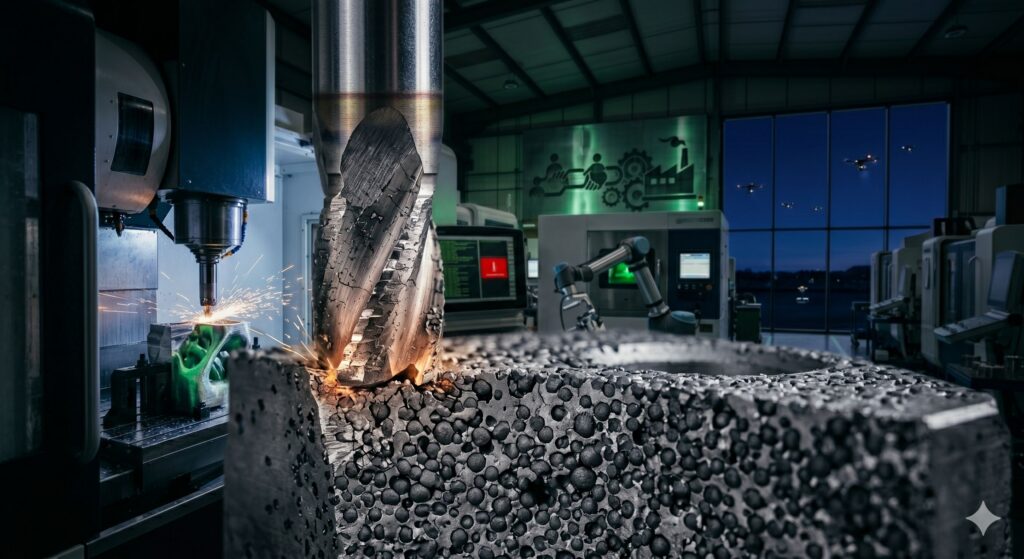
1. The Anatomy of the Threat: Why MMCs Break the Rules
To understand why MMCs cause such catastrophic tool wear, we have to look at what happens at a microscopic level during a cut.
Traditional metals are homogeneous; their properties are relatively uniform throughout. MMCs, however, are highly interrupted materials. As a cutting tool moves through an aluminum MMC, it isn’t just cutting soft aluminum. Every microsecond, the microscopic edge of the tool violently slams into thousands of jagged, ultra-hard ceramic reinforcement particles.
Instead of a smooth, continuous shearing action, machining an MMC is practically an act of micro-demolition. The soft metal matrix gets sliced away, but the hard ceramic particles refuse to cut. Instead, they scrape, gouge, and smash against the tool edge. It is the mechanical equivalent of trying to cut a block of concrete embedded with steel gravel using a standard wood saw.
2. The Primary Modes of Tool Destruction
Because of this unique structure, MMCs don’t cause standard tool wear. They subject cutting tools to an aggressive combination of destructive forces.
A. Severe Abrasive Wear (The Sandpaper Effect)
The most dominant form of wear when machining MMCs is abrasion. The embedded ceramic particles (like silicon carbide) are significantly harder than traditional cemented carbide tools. As the workpiece spins or moves against the tool, these hard particles act like industrial-grade sandpaper, physically grinding away the tool’s flank and rake faces. This rapidly rounds off the sharp cutting edge, turning a precision instrument into a blunt object.
B. Micro-Chipping and Impact Fatigue
Because the tool is constantly hitting hard particles and then dipping back into soft metal, it experiences rapid, cyclic impact loading. This continuous micro-hammering creates massive localized stresses. Over a short period, these stresses cause the cutting edge to suffer from micro-chipping, where tiny flakes of the tool material snap off, destroying the tool geometry entirely.
C. Adhesive Wear and Built-Up Edge (BUE)
While the ceramic particles are grinding the tool down, the soft matrix material (often aluminum) introduces a different problem. Under the intense pressure of the cut, the gummy aluminum likes to weld itself directly to the hot tool tip. This is known as a Built-Up Edge. When this temporary layer of aluminum eventually breaks away under the force of the machine, it frequently tears a microscopic piece of the cutting tool away with it, accelerating tool failure.
3. The Search for the Ultimate Armor: Tooling Materials that Survive
Standard high-speed steel (HSS) tools will melt or dull instantly when facing an MMC. Even standard uncoated tungsten carbide tools often last only a few seconds or minutes before becoming completely useless. To survive the onslaught, manufacturers must use extreme tooling materials.
- Polycrystalline Diamond (PCD): Currently, PCD is the undisputed king of MMC machining. Diamond is the hardest known material on Earth, making it incredibly resistant to the abrasive scraping of ceramic particles. While PCD tools are a massive financial investment upfront, their tool life when cutting MMCs can be hundreds of times longer than standard carbide.
- CVD Diamond-Coated Carbide: For complex tool geometries (like intricate twist drills or end mills) where solid diamond edges are physically impossible to engineer, manufacturers use Chemical Vapor Deposition (CVD). This process grows a microscopic layer of pure diamond directly onto a carbide tool skeleton, providing a tough core with an ultra-hard, abrasive-resistant armor.
- Alternative Advanced Ceramics: In some niche applications, cubic boron nitride (CBN) or specialized whisker-reinforced ceramic tools are used to match the hardness of the composite particles, though they remain secondary to diamond-based solutions.
4. Tactical Strategies for the Shop Floor
Beyond just buying expensive diamond tools, successfully machining MMCs requires operators to change how they cut.
- Optimizing Feed Rates: Machinists often intuitively want to slow down when a material is tough. With MMCs, however, slowing down the feed rate can actually worsen tool life. If the feed rate is too low, the tool spends more time rubbing against the abrasive particles rather than cleanly shearing the matrix, accelerating abrasive wear.
- Rigid Machine Setups: Because of the constant micro-impacts, any flexibility or play in the CNC machine’s spindle or fixture will amplify vibration. Absolute rigidity is mandatory to prevent premature tool chipping.
The Bottom Line
Metal Matrix Composites represent the vanguard of material science, offering performance metrics that were unimaginable a generation ago. Yet, their adoption remains bottlenecked by the sheer difficulty and cost of machining them.
Understanding that MMC tool wear is primarily an aggressive thermodynamic and abrasive battle allows machine shops to stop guessing and start engineering solutions. By pairing the unmatched hardness of diamond tooling with rigid, optimized cutting parameters, manufacturers can tame these tool killers and unlock the full potential of next-generation engineering.
Please get a free quote from Harry Yen hyen@unisontek.com.tw All of us are looking forward to your good news and invite you to visit our factory in Taiwan. Welcome to send any inquiry to us! Please watch presentation of our company on YouTube Link.