In high-precision manufacturing, a cutting tool is often treated as a disposable commodity. We order them by the dozen, swap them out when they dull, and focus heavily on the workpiece material itself.
But if you zoom into the microscopic point where the tool meets the metal, you’ll find one of the most violent environments engineered by humans. At that tiny interface, materials are subjected to forces that defy imagination: intense friction, sudden thermal spikes, and crushing mechanical pressures.
To survive this onslaught, a cutting tool cannot just be “hard.” It must be a masterpiece of advanced material science and internal stress control. Here is a deep dive into how modern tooling materials are pushed to their absolute boundaries, and how managing invisible internal stresses dictates the line between flawless precision and catastrophic failure.
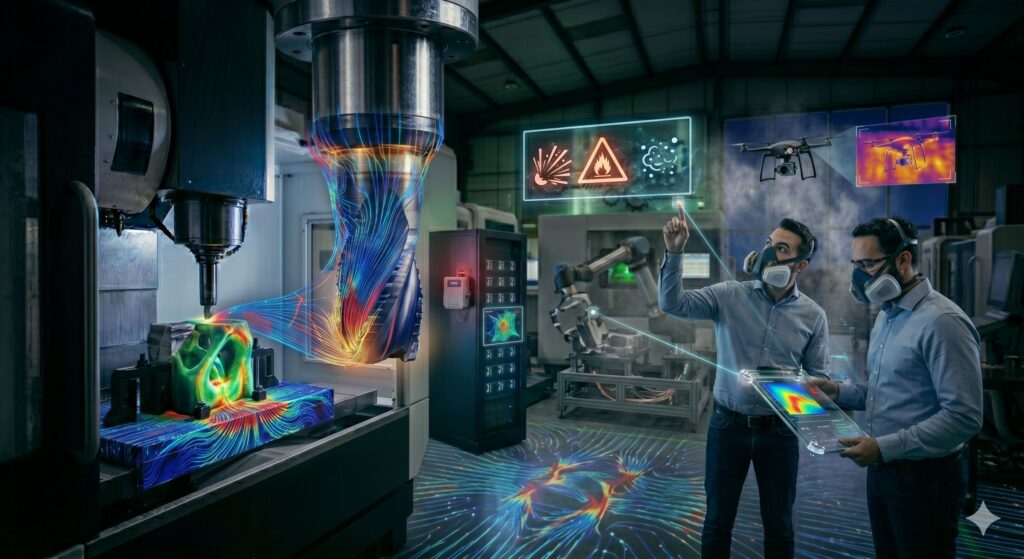
1. The Material Gauntlet: Choosing the Right Weapon
Before we can control the stress inside a tool, we have to select the substrate material capable of standing up to the job. Modern manufacturing relies on a strict hierarchy of cutting materials, each engineered for specific battlegrounds:
- Cemented Carbide: The workhorse of modern industry. Made by binding ultra-hard tungsten carbide particles together with a metallic cobalt matrix, it offers an exceptional balance of hardness and toughness.
- Advanced Ceramics: Silicon nitride and alumina-based ceramics can withstand blistering temperatures that would instantly melt carbide. They are ideal for high-speed machining of heat-resistant superalloys, though they are notoriously brittle.
- PCBN (Polycrystalline Cubic Boron Nitride): Second only to diamond in hardness, PCBN is the material of choice for turning hardened steels. It resists chemical reactions at high temperatures, allowing it to shave off hard metals like butter.
- PCD (Polycrystalline Diamond): The ultimate material for non-ferrous, highly abrasive materials. However, diamond suffers a fatal flaw: it cannot be used on steel because the carbon in the diamond reacts chemically with the iron at high temperatures, causing the tool to literally dissolve.
2. The Invisible War: Thermal and Mechanical Stress
When a tool engages with a workpiece, it is instantly subjected to two distinct types of stress that try to tear it apart from the inside out:
Mechanical Stress (The Crushing Force)
As the tool forces its way through solid metal, the resistance creates massive physical pressure on the cutting edge. This pressure tries to bend, chip, or snap the tool tip. If the tool material lacks structural toughness, this mechanical stress leads to instant micro-chipping.
Thermal Stress (The Fire and Ice Effect)
Because modern CNC machines cut at incredible speeds, the friction generates immense heat—often exceeding 1000°C at the tool tip.
The real danger, however, is thermal shock. When an end mill rotates, it plunges into the hot cutting zone and then spins out into the cool air or a blast of coolant, thousands of times a minute.
This rapid cycling between extreme hot and cold causes the tool material to expand and contract violently. This thermal stress creates microscopic cracks that slowly crawl across the tool edge until a piece breaks off.
3. Controlling the Stress: The Art of Tool Armor
To prevent these stresses from destroying the tool, engineers don’t just rely on the raw substrate; they manipulate the tool’s internal and external stress profiles using advanced engineering tactics.
Engineered Residual Compressive Stress
Just like the human body can handle a crushing force better than being pulled apart, cutting tools thrive under compression but fail under tension.
Before a tool even goes to work, manufacturers use a process called micro-blasting or specialized shot peening on the cutting edge.
This creates a controlled layer of compressive residual stress on the tool’s surface. This internal “squeezing” force acts as a protective shield. When the external mechanical forces try to pull the tool edge apart during a cut, they must first overcome this engineered compression, drastically extending the tool’s lifespan.
The Role of PVD and CVD Coatings
Applying a microscopic coating (such as Titanium Aluminum Nitride, or TiAlN) onto a tool is a high-tech exercise in stress management.
- PVD (Physical Vapor Deposition): This method applies coatings at lower temperatures, which naturally leaves the coating in a state of high compressive stress. PVD-coated tools are incredibly tough and highly resistant to micro-chipping, making them perfect for interrupted cuts like milling.
- CVD (Chemical Vapor Deposition): Applied at much higher temperatures, CVD coatings are thicker and provide unparalleled thermal protection. However, as the tool cools down after coating, the difference in contraction rates can leave the coating with tensile stress (micro-cracks). Managing this cooldown cycle is critical to ensuring the tool doesn’t fail prematurely.
4. Edge Preparation: The Final Frontier
The final layer of stress control happens at the macroscopic geometry of the cutting edge itself. A perfectly sharp, razor-thin edge sounds ideal, but in high-hardness machining, a razor edge concentrates mechanical stress into a dangerously small area, causing it to snap instantly.
Modern tools undergo Edge Preparation, where high-precision brushes or lasers intentionally round off or chamfer the cutting edge by a few microns.
By creating a slight radius (known as an edge hone), engineers distribute the cutting forces over a larger surface area. This subtle geometric shift drastically lowers localized mechanical stress, transforming a fragile edge into an industrial battering ram.
The Bottom Line
A cutting tool is far more than a sharp piece of metal or ceramic. It is a highly engineered thermodynamic barrier designed to survive a relentless internal war of forces.
By mastering the balance of substrate selection, coating technologies, and engineered internal stresses, tool manufacturers aren’t just making tools last longer—they are enabling the entire manufacturing industry to cut faster, hold tighter tolerances, and machine the “impossible” materials that drive the future of technology.
Next time you see a CNC machine effortlessly throwing off glowing hot metal chips, remember the invisible battle raging inside the tool tip.
Please get a free quote from Harry Yen hyen@unisontek.com.tw All of us are looking forward to your good news and invite you to visit our factory in Taiwan. Welcome to send any inquiry to us! Please watch presentation of our company on YouTube Link.