Picture this scenario: You are machining a high-precision bearing bore on a high-end CNC milling machine.
Your CAM software generated a flawless circular toolpath, your cutting tool is perfectly sharp, and the machine sounds fantastic. You pull the finished part out, clean it off, and run your finger inside the bore.
Instead of a glass-smooth, perfect cylinder, you feel four microscopic bumps perfectly spaced at the 12, 3, 6, and 9 o’clock positions.
You check the code—it’s a perfect circle. You check the tool—it’s running true. So, what is leaving those four little marks?
Welcome to one of the most stubborn physical challenges in precision manufacturing: Quadrant Protrusion (often called the Quadrant Glitch or Reversal Spike), caused by the chaotic reality of Nonlinear Friction in machine feed systems.
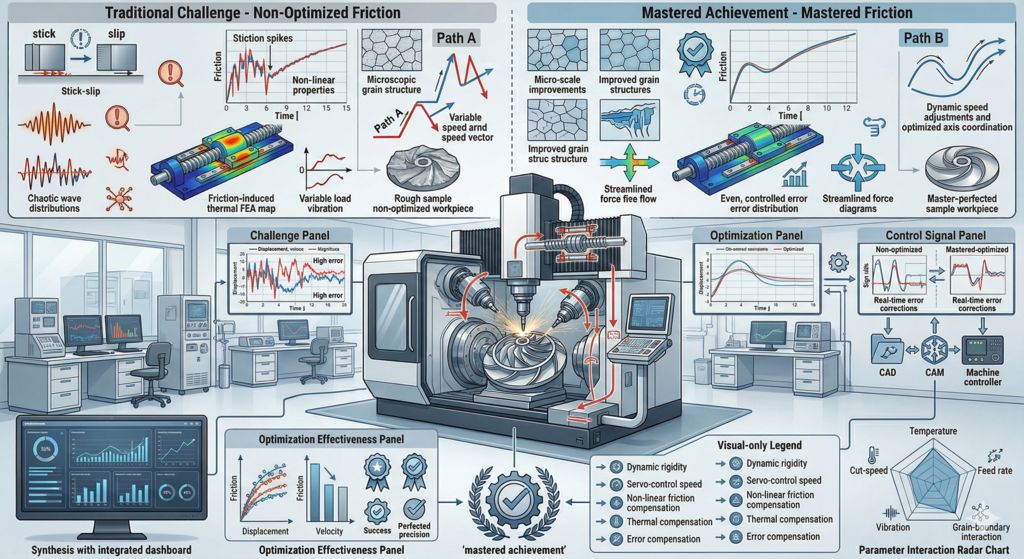
The Anatomy of a Circle and the “Zero-Velocity” Trap
To understand why these bumps happen, we have to look at how a CNC machine actually draws a circle. A standard milling machine does not have a dedicated “circle-making” axis. Instead, it creates a curve by coordinating the movement of two linear axes—the X-axis and the Y-axis—at the exact same time.
As the cutter travels around a circular path, the axes are constantly changing speeds.
At the very top of the circle (12 o’clock), the X-axis is moving at its maximum speed, but the Y-axis has to come to a complete, dead stop before immediately reversing direction to head back down.
At 3 o’clock, the Y-axis is moving at maximum speed, and the X-axis must stop and reverse.
These points of reversal—where an axis crosses from one quadrant of the coordinate system into the next and momentarily hits zero velocity—are the danger zones. And the invisible enemy waiting at these exact locations is friction.
The Real Enemy: Stick-Slip and Stiction
If you have ever tried to push a heavy, loaded cardboard box across a concrete floor, you already intuitively understand the physics of the Quadrant Glitch.
When you first lean into the box, it refuses to budge. You have to push harder and harder until suddenly it breaks free and slides forward. Once the box is moving, it takes significantly less effort to keep it sliding.
This happens because friction is not a constant force. It changes depending on movement:
Static Friction (Stiction): The massive gripping force between two surfaces when they are completely at rest.
Dynamic Friction: The much lower, smoother resistance you feel once the surfaces are already sliding against each other.
Inside your CNC machine, a massive cast-iron table is riding on linear guideways, driven by a steel ball screw. When the Y-axis comes to that dead stop at the 12 o’clock position, it enters the realm of static friction. The guideways and ball screw essentially “grab” the table.
When the servo motor tries to reverse direction, the table does not move immediately. The motor has to build up a surge of torque to overcome the stiction. When the stiction finally breaks, the table violently snaps forward. This microscopic “jump” pushes the cutting tool slightly too far into the metal, leaving a tiny, highly visible bump on your workpiece.
Backlash vs. Friction: Knowing the Difference
Many machinists misdiagnose quadrant marks as “backlash” and try to fix it by simply typing a mechanical backlash compensation number into the CNC controller. This rarely solves the problem, and can sometimes make it worse. Here is why they are different:
| The Issue | The Root Cause | The Physical Result | The Standard Fix |
| Mechanical Backlash | Physical wear or clearance (“slop”) between the ball screw threads and the ball nut. | A flat spot or a delay when the axis reverses direction. | Static backlash compensation (the software adds distance to the move). |
| Nonlinear Friction | The harsh transition from static friction to dynamic friction at zero velocity. | A physical spike or “protrusion” sticking out into the circular cut. | Dynamic Friction Compensation (injecting a precise torque spike). |
You can have a brand-new, perfectly pre-loaded, zero-backlash ball screw and still suffer from severe quadrant protrusion simply because of the “stick-slip” friction in the heavy iron components.
The Software Savior: Nonlinear Friction Compensation
Because the “stick-slip” phenomenon is a physical reality of heavy machinery rubbing against itself, we cannot completely eliminate it mechanically. Instead, modern CNC manufacturers fight physics with software.
This advanced technology is generally known as Nonlinear Friction Compensation (or Quadrant Error Compensation). Here is how modern machine controllers outsmart stiction:
1. Predicting the Stop
The CNC controller’s “look-ahead” capability analyzes the toolpath and knows exactly when and where an axis is going to hit zero velocity. It does not wait to react to the error; it anticipates it.
2. The Torque Injection
A fraction of a millisecond before the axis tries to reverse direction, the controller commands the servo amplifier to send a massive, precisely calculated micro-spike of electrical current to the servo motor.
3. Punching Through the Stiction
This instantaneous surge of torque acts like a heavy hammer blow. It violently shatters the grip of the static friction just as the axis is trying to move. Because the motor already has the extra power it needs to overcome the stiction, the axis does not “jump” or snap. It seamlessly transitions from stopping to reversing with glass-like smoothness.
4. Fading Out
The millisecond the axis is moving again, the controller instantly drops the torque back down to normal levels to handle the much lighter dynamic friction, preventing the machine from overshooting the target.
The Bottom Line
Quadrant protrusion is a harsh reminder that CNC machines are not just perfect digital computers; they are massive analog beasts bound by the laws of mechanical physics.
By understanding the chaotic nature of nonlinear friction, machinists can leverage advanced control software to bridge the gap between heavy iron and absolute microscopic perfection.
Please visit About、Machined Parts