For the last decade, the manufacturing world has been buzzing with a single, persistent question. With metal 3D printers becoming faster, cheaper, and more capable every year, is traditional CNC machining destined for the scrap heap?
Will the factory of the future just be a room full of glowing lasers melting powder, completely devoid of spinning end mills and flying metal chips?
The short answer is: No. 3D printing will not replace CNC machining. The long answer is much more fascinating.
Instead of a death match where one technology destroys the other, we are witnessing an evolution where two completely opposite processes are learning to perfectly complement each other.
Let’s break down the physics, the economics, and the reality of why both technologies are here to stay.
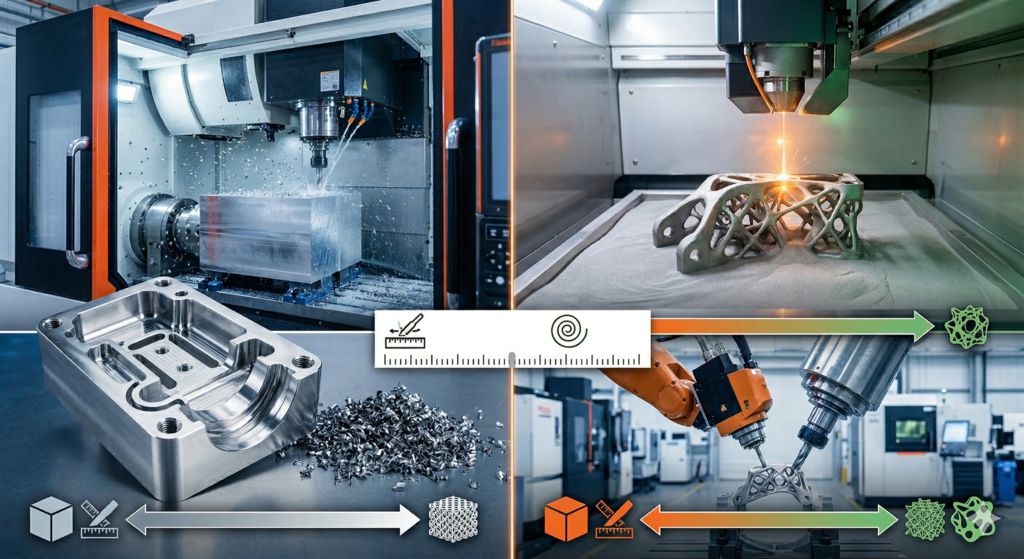
The Core Difference: Sculpting vs. Stacking
To understand why neither technology can completely replace the other, we have to look at how they fundamentally manipulate matter.
CNC Machining (Subtractive Manufacturing): Think of a classic sculptor staring at a block of marble. You start with a solid block of raw material (a billet) and use incredibly rigid, high-speed cutting tools to violently carve away everything that isn’t the final part.
3D Printing (Additive Manufacturing): Think of building a house out of Lego bricks. You start with nothing, and a machine carefully deposits material (melted plastic, laser-fused metal powder, or wire) layer by layer until the part is built from the ground up.
Because they approach part creation from opposite directions, they naturally possess completely different strengths and weaknesses.
Where 3D Printing Shines: The Rule Breaker
Additive manufacturing broke all the traditional rules of engineering. It allows designers to create parts that are literally impossible to cut on a CNC machine.
1. „Complexity is Free“
In CNC machining, a complex part with deep pockets and weird angles requires custom fixtures, multiple machine setups, and hours of programming. In 3D printing, the laser doesn’t care how complex the shape is. You can print hollow bones with internal lattice structures to save weight, or fuel nozzles with winding, internal cooling channels that a drill bit could never reach.
2. Rapid Prototyping
If you need one single prototype of a new bracket by tomorrow morning, 3D printing wins every time. There is no need to order a specific size of raw stock, figure out how to clamp it in a vise, or program complex toolpaths. You simply send the CAD file to the printer and walk away.
3. Minimal Material Waste
When machining aerospace components from expensive titanium or Inconel, it is common to turn 80% or 90% of the raw block into metal chips (scrap). 3D printing only uses the material required to build the part, drastically reducing the cost of raw materials in exotic applications.
Why CNC Machining is Still King: The Uncompromising Master
If 3D printing is so magical, why are CNC machine sales still booming? Because when it comes to the final, uncompromising demands of industrial manufacturing, CNC machining holds advantages that physics won’t easily let 3D printing overcome.
1. Absolute Precision and Tolerances
A high-end metal 3D printer can hold tolerances of perhaps a few thousandths of an inch. A high-end CNC machine can hold tolerances of a few microns (a fraction of a human hair). When you are making parts for a jet engine or a medical joint replacement, „close enough“ is a catastrophic failure.
2. Pristine Surface Finishes
Because 3D printing builds parts in layers, the final part almost always has a rough, stair-stepped surface texture. A CNC machine, using advanced tool geometries, can slice through metal to leave a flawless, mirror-like finish right off the machine, requiring zero manual polishing.
3. Material Integrity and Strength
A solid billet of cold-rolled steel has a continuous, highly predictable crystalline grain structure. It is equally strong in all directions (isotropic). 3D printed parts are made of thousands of tiny welded layers.
The bond between the layers is often slightly weaker than the layers themselves, meaning the part can snap easier in one specific direction (anisotropic). When a part must survive immense physical stress, nothing beats a solid block of forged or billet metal.
4. High-Volume Economics
3D printing is fantastic for making one part. But if you need to make 50,000 aluminum brackets, 3D printing is agonizingly slow and incredibly expensive. A well-programmed multi-axis CNC machine or a Swiss lathe can spit out a perfectly finished part every few seconds.
The Showdown: A Quick Comparison
| Feature | 3D Printing (Additive) | CNC Machining (Subtractive) |
| Best Used For | Prototyping, complex organic geometries, one-offs. | High volume, extreme precision, heavy-duty functional parts. |
| Internal Geometries | Limitless (can print enclosed hollow cavities). | Limited (cutting tools need physical access to the space). |
| Material Strength | Good, but often has directional weaknesses (layer lines). | Excellent; retains the structural integrity of the raw billet. |
| Surface Finish | Generally rough; usually requires post-processing. | Excellent; can achieve optical-grade mirror finishes. |
| Waste Generation | Very low (uses only what is needed). | High (carves away bulk material). |
The Golden Rule of Modern Manufacturing: If you can easily machine the part, you should almost always machine it. You only 3D print a metal part if its geometry makes it impossible to manufacture any other way.
The Future is a Partnership, Not a Takeover
The most advanced machine shops in the world aren’t choosing between Additive and Subtractive; they are combining them.
We are entering the era of the Hybrid Workflow. Engineers are now using 3D printers to quickly build the bulky „near-net shape“ of a complex part, and then instantly transferring that part into a 5-axis CNC machine to perfectly mill the critical mating surfaces, bore the precision holes, and polish the outer skin.
3D printing isn’t the death of CNC machining; it is its new best friend. Together, they are allowing us to build lighter, stronger, and more complex mechanisms than humanity has ever seen.
Please visit About、Machined Parts webpages.