You’ve just purchased a multi-million-dollar, state-of-the-art 5-axis CNC machining center. The foundation is poured to perfection, the climate control in the facility is dialed in, and the machine has been leveled by factory experts.
You load a massive block of aerospace-grade titanium, run a complex continuous 5-axis toolpath, and inspect the final part.
The features machined in the exact center of the table are flawless. But the features machined out near the far edges of the work envelope? They are out of tolerance.
How can a machine be perfectly accurate in the center, but lose its mind at the edges? You have just collided with the most complex geometric puzzle in modern manufacturing: Volumetric Error.
To fix this, the industry is moving away from the old methods of calibrating machines one axis at a time, and embracing a revolutionary software-driven approach known as Volumetric Error Calibration and Dynamic Decoupling.
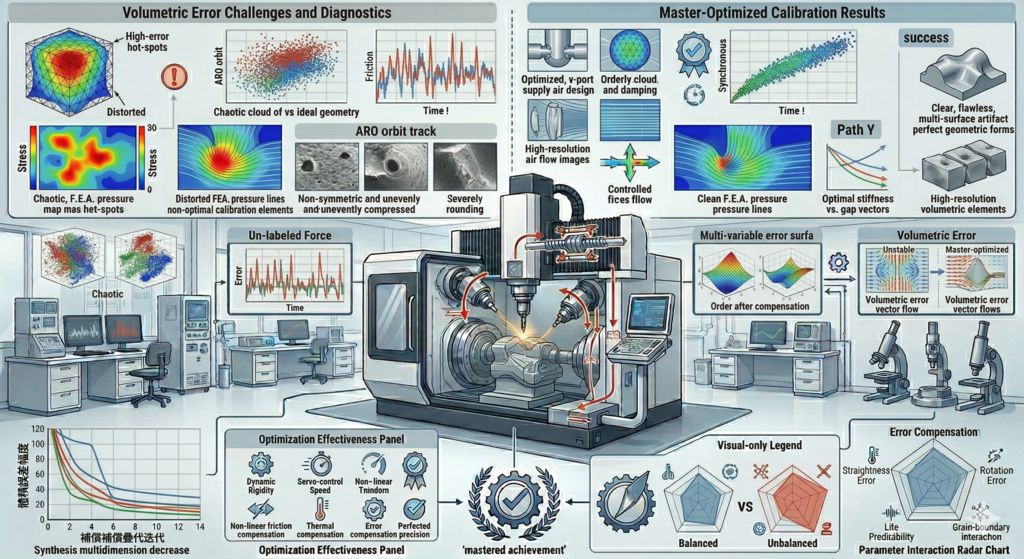
The 43 Ghosts in the Machine: What is Volumetric Error?
We like to think of a CNC machine’s axes as perfectly straight lines and perfect circles. In reality, heavy iron castings bow, linear guideways have microscopic waves, and assembly tolerances stack up.
If you take a standard 3-axis machine (X, Y, Z), it doesn’t just have three potential errors. Every single time an axis moves, it can deviate in six different ways:
Positioning: Moving slightly too far or too short.
Straightness (Horizontal): Drifting left or right.
Straightness (Vertical): Bowing up or down.
Pitch: Tilting forward or backward like a braking car.
Yaw: Twisting side-to-side like a drifting car.
Roll: Rotating along its own length like a barrel roll.
When you add up the 6 errors for X, Y, and Z, plus the 3 squareness errors between them, a “simple” 3-axis machine actually has 21 independent geometric errors.
When you upgrade to a full 5-axis machine, adding two heavy rotary tables or a tilting spindle head, that number explodes. A standard 5-axis machine has 43 or more distinct geometric errors.
Volumetric Error is the terrifying result of all these tiny imperfections stacking together. It is the physical difference between where the CNC controller thinks the very tip of the cutting tool is in 3D space, and where it actually is.
The Flaw of Traditional Calibration
Historically, when a machine was inaccurate, a metrology technician would bring in a laser interferometer. They would shoot the laser down the X-axis and correct the positioning. Then they would do the Y-axis. Then the Z-axis.
This 1D, single-axis approach is fundamentally flawed for modern 5-axis machining. Why? Because errors are coupled.
Imagine the X-axis guideway has a microscopic sag in the middle (a pitch error). If the Z-axis spindle is lowered all the way down, that slight pitch at the top of the machine gets magnified into a massive swing at the bottom of the tool tip. If you only calibrate the X-axis in a straight line, you completely ignore how its pitch destroys the accuracy of the Z-axis.
You cannot fix a 3D spatial problem with a 1D linear solution.
The Breakthrough: Dynamic Decoupling
To truly fix a machine, you have to map the entire 3D volume of the work envelope at once. But if the tool tip is off by 15 microns in the top right corner of the machine, how do you know who to blame? Is the X-axis sagging? Is the Y-axis twisting? Is the rotary table tilted?
This is where Dynamic Decoupling comes in.
Decoupling is essentially unbaking a cake. It uses incredibly advanced software algorithms to look at the total combined error at the tool tip and mathematically separate it back out into the individual 43 errors that caused it.
How the Magic Happens:
Spatial Tracking: Instead of measuring straight lines, technicians place a device like a LaserTracer or an automated tracking interferometer on the machine table.
The Random Dance: The CNC machine drives a reflective target in the spindle to hundreds of random, chaotic points throughout the entire 3D work envelope. The laser tracks it the entire time.
The Decoupling Algorithm: The tracking software compares the programmed 3D coordinates against the actual physical coordinates measured by the laser. By analyzing how the errors change as the machine moves through space, the software “decouples” the data, isolating the exact pitch, yaw, roll, and squareness of every single axis.
The 3D Compensation Matrix: Finally, the software generates a massive, three-dimensional compensation map. It injects this map directly into the CNC controller’s brain.
From that moment on, as the machine moves through space, the controller is constantly running microscopic adjustments in the background.
If it knows the Y-axis naturally twists slightly at the far end of its travel, it automatically tells the X and Z axes to shift by a few microns to perfectly cancel out the twist.
The Real-World Impact on the Shop Floor
The shift from linear calibration to volumetric decoupling changes the economics of high-precision manufacturing.
| Feature | Traditional Linear Calibration | Volumetric Error Calibration |
| Time Required | 3 to 5 days (tearing down the machine repeatedly). | 4 to 8 hours (fully automated laser tracking). |
| Accuracy Scope | Only guarantees accuracy along the specific lines tested. | Guarantees accuracy anywhere inside the entire 3D work volume. |
| Rotary Integration | Often ignores how rotary axes interact with linear axes. | Perfectly harmonizes rotary pivot points with linear movements. |
| Part Quality | Center of the table is good; edges are unpredictable. | “First part, good part” regardless of where the vise is bolted down. |
Pro Tip: Volumetric compensation is incredibly powerful, but it cannot fix mechanical slop. If your machine has worn-out ball screws, ruined bearings, or physical looseness, the software matrix will fail. Volumetric calibration requires a mechanically sound machine to work its magic.
The Bottom Line
We are asking massive, heavy iron machines to maneuver cutting tools with the precision of a watchmaker.
By abandoning the old single-axis mindset and embracing the power of spatial decoupling, manufacturers can finally force the physical iron to match the perfection of the digital CAD model, unlocking the true potential of 5-axis machining.
Please visit About、Machined Parts webpages