In the modern industrial landscape, precision machining is often perceived as a realm of digital perfection. We watch high-speed CNC centers and laser-guided measurements, assuming that “precision” is merely a matter of programmed coordinates.
However, beneath the sterile hum of the laboratory-grade workshop lies a violent, chaotic, and fascinating world of physics. To move from simple “cutting” to the true “limits” of manufacturing, one must confront the physical truths that governed the process long before the first line of code was written.
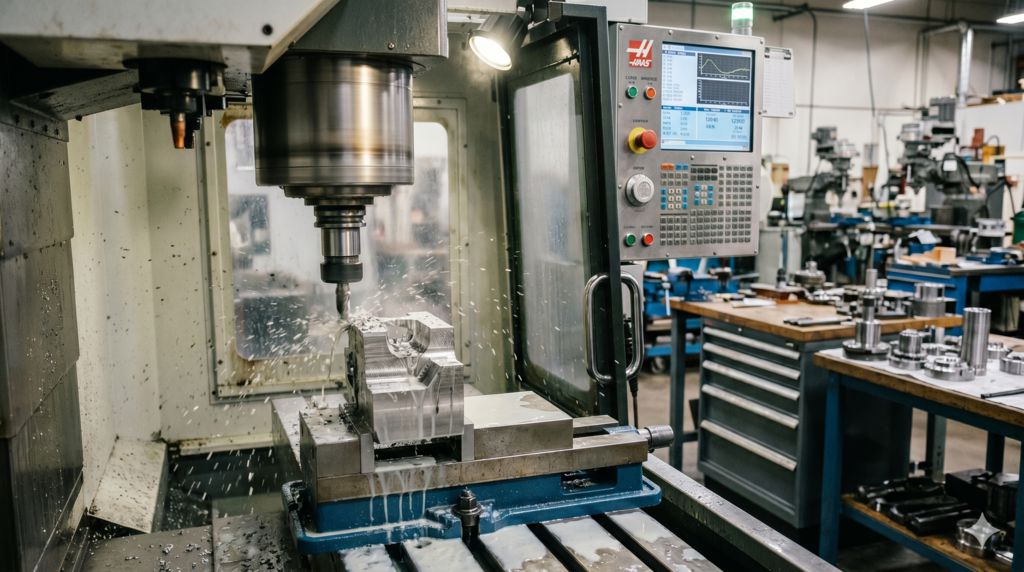
The Illusion of “Cutting”: A Struggle of Atomic Bonds
The term “cutting” is, in many ways, a linguistic convenience that masks a brutal reality. In precision machining, we are not slicing material like a knife through soft wax; we are intentionally inducing controlled structural failure.
At the microscopic level, the tool tip acts as a wedge that exerts massive pressure on the workpiece, forcing the metal beyond its yield strength. This creates a localized zone of plastic deformation known as the shear plane.
The “truth” here is that we are tearing the material apart. If the shear angle is not perfectly managed, the material doesn’t just fall away; it resists, creating “built-up edges” (BUE) where the workpiece atoms essentially fuse to the tool atoms under intense heat and pressure. This microscopic welding instantly ruins the intended geometry and surface finish of a high-precision component.
The Thermal Paradox: Precision is a Slave to Entropy
Precision is a slave to thermodynamics. In high-speed machining, nearly 97% of the mechanical energy used is converted directly into heat. While we use advanced coolants to manage this, the physical truth is that the “point of contact” remains a thermal frontier.
As a material heats up, it expands—a phenomenon known as thermal drift. In the realm of micron-level precision, even the heat from a technician’s hand or the friction of a spindle bearing can expand a steel component by several micrometers.
The “limit” here isn’t the machine’s ability to move; it is the environment’s inability to stay still. True precision machining is less about the tool’s sharpness and more about thermal equilibrium management. If the temperature isn’t stabilized, the dimensions are merely a snapshot in time, doomed to change as the part cools.
The Vibration Ghost: Regenerative Chatter
Perhaps the most elusive physical truth in the machine shop is harmonic resonance. Every tool, holder, and machine frame has a natural frequency. When the frequency of the tool’s impacts matches the natural frequency of the setup, a phenomenon called chatter occurs.
This isn’t just a noise issue. Chatter is a self-exciting vibration that creates invisible “waves” on the surface of the part. In a cruel twist of physics, these waves influence the next pass of the tool, causing the vibration to grow exponentially.
To reach the “limit” of precision, engineers must navigate these “stability lobes,” choosing speeds and feeds that essentially play the machine like a tuned instrument, ensuring the physics of vibration work for the finish rather than against it.
Elasticity: The Metal That Bends
We often treat steel and titanium as “rigid” bodies, but at the scale of precision machining, every material behaves like a stiff spring. This is the truth of tool deflection.
When a tool pushes against a workpiece, the workpiece pushes back with equal force (Newton’s Third Law). Even a solid carbide end mill—one of the stiffest materials available—will flex by a few microns under load.
If a programmer ignores this elasticity, the part will always be “out of spec,” not because the machine missed its mark, but because the material physically retreated from the tool during the cut. Compensating for this “spring-back” or “push-off” is what separates a standard technician from a master of precision.
Tribology and the Chemistry of the Cut
Finally, we must consider the chemistry of the interface. The interaction between the tool coating (such as AlTiN or Diamond) and the workpiece is a study in tribology.
At the limit of precision, the lubricant is not just “grease”; it is a chemical barrier that prevents atomic diffusion. Without this invisible layer, the carbon in a diamond tool might dissolve into a ferrous workpiece at high temperatures, causing the tool to literally evaporate into the part it is trying to shape.
Modern coatings are designed to manage these chemical truths, creating a microscopic environment where physics and chemistry cooperate to maintain an edge.
Conclusion: Respecting the Material
The journey from “cutting” to the “limit” is a transition from being a programmer to being a physicist. It requires an acknowledgment that we are operating in a world of friction, heat, atomic bonds, and kinetic energy.
The ultimate truth of precision machining is that the machine is never in total control. The material—with its grain structures, its thermal expansion coefficients, and its stubborn elasticity—always has the final say.
Only by understanding and respecting these physical realities can we hope to push the boundaries of what is humanly possible to build.
In addition, please visit CNC Turning Parts, Stamping Parts, Technical Data and Quality Inspection to get more information about us, if you have any question, please e-mail to Harry Yen hyen@unisontek.com.tw
Please watch our company YouTube channel Link and introduction Link