In the world of precision CNC machining, there is a common, almost intuitive belief: if you want a better surface finish and a longer-lasting tool, you should take a lighter cut and slow down your feed rate. It makes sense, right? Taking a microscopic “dusting” pass feels like it should be incredibly gentle on your expensive carbide end mills.
Unfortunately, at the microscopic level, physics stops playing by our intuitive rules.
When you reduce your depth of cut to the extreme, you cross an invisible threshold where your razor-sharp cutting tool stops acting like a knife and starts acting like a blunt snowplow.
This transition introduces two of the most destructive forces in modern manufacturing: the Minimum Chip Thickness barrier and the resulting Plowing Effect.
If you are struggling with unpredictable tool wear, sudden tool breakage, or work-hardened surfaces during finish passes, understanding these two concepts is the key to saving your tools and your parts.
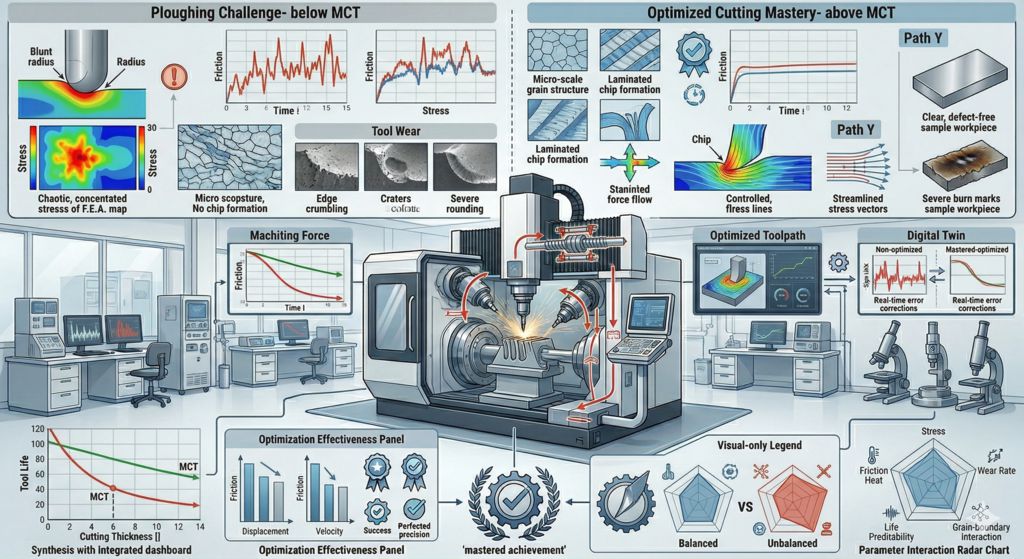
The Myth of the Infinitely Sharp Tool
To understand why light cuts can be so destructive, we first need to look at the cutting tool itself.
When you hold a brand-new, premium carbide end mill, the cutting edge feels razor-sharp. However, if you place that exact same edge under a high-powered electron microscope, you will see that it is not a perfect, infinitely sharp point. It actually has a microscopic curve to it, known as the cutting edge radius.
Even the most precisely ground carbide tools have an edge radius of a few micrometers. This tiny curve is completely irrelevant when you are taking a heavy roughing cut. But what happens when your programmed depth of cut is actually smaller than the physical curve of the tool’s edge?
The Threshold: Minimum Chip Thickness
This brings us to the concept of Minimum Chip Thickness.
The minimum chip thickness is the absolute smallest depth of cut your tool can take and still physically shear a piece of metal away. It is the dividing line between cutting and rubbing.
Because of the microscopic curve on the tool’s edge, the tool cannot bite into the material if the cut is too shallow. Instead of the sharp face of the flute driving into the metal, the rounded bottom of the edge simply slides over the top of the workpiece.
Depending on the specific material you are cutting, the minimum chip thickness is usually a percentage of the tool’s edge radius. If you program a feed rate or a radial step-over that drops below this critical threshold, you stop machining and immediately trigger the Plowing Effect.
The Plowing Effect: Slicing a Tomato with a Baseball Bat
Imagine trying to slice a ripe tomato, but instead of using a sharp chef’s knife, you use a baseball bat. You can swing as hard as you want, but you aren’t going to get clean slices. You are just going to smash, push, and tear the tomato.
This is exactly what the Plowing Effect does to metal. When your cut is below the minimum chip thickness, the tool engages in a chaotic, three-stage process:
Elastic Rubbing: The rounded edge of the tool presses down onto the metal. The metal squishes downward (elastic deformation) and then bounces right back up after the tool passes. No chip is formed, but intense friction is generated.
Plastic Plowing: As the tool pushes harder, it begins to permanently deform the metal. It plows the material forward and to the sides—much like a boat pushing water—creating microscopic, jagged burrs along the edge of the cut.
Inefficient Shearing: Eventually, enough pressure builds up that a tiny, torn chip is finally violently ripped away, but at a massive energy cost.
The Death Spiral of Tool Life
So, why does the Plowing Effect absolutely destroy your cutting tools? It comes down to heat, friction, and material adhesion.
How to Defeat the Plowing Effect
You cannot change the laws of physics, but you can adjust your machining strategies to ensure you stay on the right side of the minimum chip thickness threshold.
Feed It Harder: The most effective fix is often the most counter-intuitive. If your tool is burning up on a finish pass, increase your feed per tooth (chipload). You must force the tool to bite deep enough to get past its own edge radius and start cleanly shearing a chip.
Invest in Sharper Tools: If you absolutely must take a microscopic cut (such as in micro-milling or optical lens manufacturing), standard carbide will not work. You need tools with a significantly smaller edge radius, such as highly polished, uncoated carbide, or Single-Crystal Diamond tools, which can be ground to unimaginably sharp points.
Climb Milling is King: In conventional milling, the cutter starts at zero thickness and gradually bites deeper, guaranteeing that every single flute will rub and plow before it finally cuts. Climb milling does the exact opposite; the flute enters the material at maximum thickness, instantly shearing a chip and completely bypassing the rubbing phase.
The Bottom Line
The next time you are setting up a delicate finish pass and you are tempted to drop your feed rate to a crawl to “protect” the tool, remember the Plowing Effect.
CNC machining relies on the efficient removal of heat through the chip. If your cut is too thin to form a proper chip, that heat goes straight into your tool, and your tool goes straight into the scrap bin.
Please visit About、Machined Parts webpages