In the world of manufacturing and metalworking, we put raw materials through an absolute gauntlet. We bend them with heavy presses, slice through them with high-speed CNC mills, heat them past their melting points during welding, and rapidly cool them in quenching tanks.
When a part successfully exits this intense journey, it may look perfectly still, dimensionally accurate, and structurally sound on the outside. But beneath its metallic skin, a violent, invisible tug-of-war is often taking place.
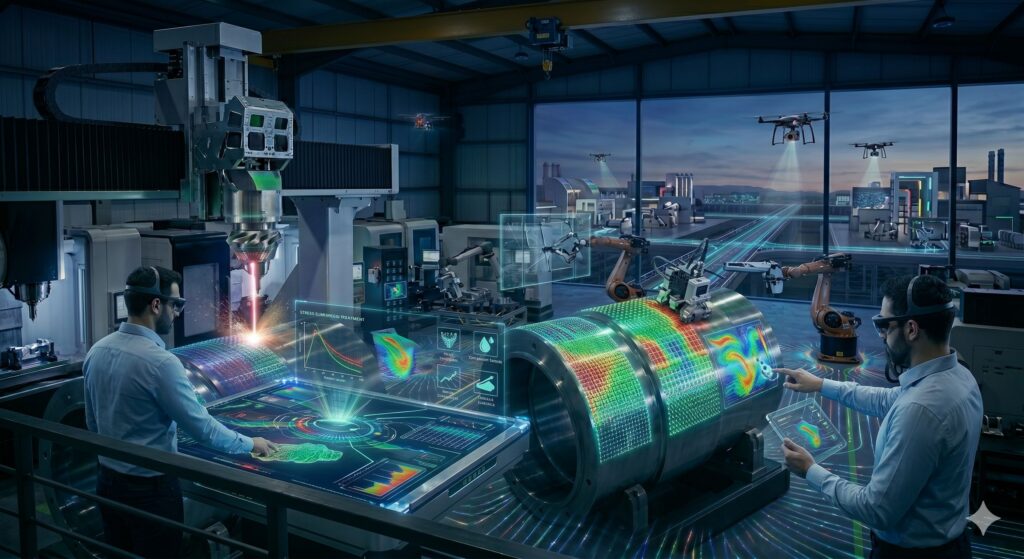
This hidden tension is known as Residual Stress—the ghost forces trapped inside a material long after the external loads and manufacturing processes are gone.
If left unmanaged, these internal stresses can warp your parts during final machining, compromise tolerances, or cause catastrophic structural failure out in the field.
To build high-performance components that last, engineers must master the dual art of managing and eliminating these invisible strains.
1. The Two Faces of Residual Stress
Before we can manage residual stress, we need to understand what it looks like. Residual stress generally categorizes into two main types, acting either as a hidden villain or an engineered hero:
- Tensile Residual Stress (The Threat): This occurs when the internal atoms are constantly pulling away from each other. Think of it like a micro-crack constantly being yanked open from the inside. Tensile stress lowers the material’s fatigue life, making it incredibly easy for a tiny crack to form and propagate under normal operating conditions.
- Compressive Residual Stress (The Shield): This is the exact opposite. Here, the internal atoms are being squeezed tightly together. Compressive stress acts as a protective armor. If a crack tries to form on the surface, the compressive forces push the lips of the crack shut, preventing it from growing.
Because raw manufacturing processes almost always introduce destructive tensile stresses, the primary goal of stress management is either to eliminate these forces completely or convert them into protective compressive stresses.
2. Active Management: Preventing Stress at the Source
The most cost-effective way to manage residual stress is to minimize its creation during the initial manufacturing phases. This requires a deep understanding of thermal and mechanical limits:
Optimizing CNC Cutting Parameters
When a dull cutting tool aggressively “plows” through a metal block rather than cleanly shearing it, it creates severe friction and deforms the surface layer. This mechanical stretching leaves behind high tensile residual stress. Keeping tools sharp, optimizing feed rates, and utilizing advanced tool paths—like trochoidal milling—drastically reduces this mechanical friction.
Advanced Thermal Control
During welding or heavy grinding, extreme localized heat causes the metal to expand. As it cools, the surrounding cold metal prevents it from shrinking back naturally, trapping massive tensile stresses in the weld joint.
Using pre-heating techniques, controlled cooling blankets, and high-pressure coolant delivery systems can smooth out these extreme temperature spikes, minimizing stress formation.
3. The Elimination Tactics: Relieving the Internal Tension
When prevention isn’t enough, manufacturers must deploy specialized post-processing techniques to physically relax the atomic lattice of the material. Here are the primary methods used to eliminate trapped stress:
Thermal Stress Relieving (The Warm Bath)
This is the most traditional and widely used method. The completed metal part is placed inside a specialized industrial furnace and heated to a precise temperature—typically just below its critical transformation point.
The part is held at this temperature for several hours. The thermal energy allows the tightly strained atomic bonds to vibrate, loosen, and rearrange themselves into a relaxed, stress-free state. The furnace is then cooled down at an ultra-slow, controlled rate to ensure no new stresses are accidentally introduced.
Vibrational Stress Relief (VSR)
For massive structures—like a 20-ton welded steel ship hull or a large wind turbine base—putting the component into a furnace is physically impossible. That is where VSR steps in.
A specialized sub-harmonic vibrator is clamped directly onto the metal structure. The machine vibrates the part at its natural resonant frequency. These controlled, high-frequency mechanical waves travel through the metal, causing micro-plastic deformations at the atomic level that effectively “shake” the trapped residual stresses loose without altering the part’s physical dimensions.
4. Turning the Tide: Shifting from Tension to Compression
Sometimes, simply eliminating stress isn’t enough; high-performance components need an extra layer of active protection. Engineers use mechanical surface treatments to intentionally force the material’s surface into a highly beneficial state of compression.
Shot Peening
Imagine a high-speed stream of tiny metallic or ceramic round beads continuously hammering the surface of a metal part. Each bead acts like a miniature ball-peen hammer, creating a tiny microscopic dent on the surface.
To accommodate these millions of tiny dents, the metal layer directly beneath the surface expands, forcing the outermost skin into a permanent state of high compressive residual stress. This technique is mandatory for critical rotating parts like aerospace turbine blades and automotive gearboxes.
Controlled Burnishing
Instead of blasting the part with beads, burnishing uses a ultra-smooth, rolling ceramic or diamond ball to apply localized pressure across the surface of a rotating component.
This mechanically smooths out surface roughness while simultaneously driving deep, uniform compressive stresses into the material’s skin, dramatically increasing its resistance to fatigue failure.
The Bottom Line
Residual stress is an inescapable byproduct of shaping the physical world. Every time we cut, heat, or bend a material, we leave a molecular footprint behind.
However, ignoring these invisible forces is a recipe for operational disaster.
By implementing a strict regimen of stress prevention on the CNC machine, utilizing thermal or vibrational relief to relax stubborn welds, and using shot peening to weaponize compressive stress, manufacturers can ensure their parts don’t just look perfect on the shop floor—but possess the hidden internal stability required to survive the toughest conditions imaginable.
Please get a free quote from Harry Yen hyen@unisontek.com.tw All of us are looking forward to your good news and invite you to visit our factory in Taiwan. Welcome to send any inquiry to us! Please watch presentation of our company on YouTube Link.