You have invested in a state-of-the-art 5-axis CNC machining center. The linear rails are perfectly straight, the spindle is laser-aligned, and your CAM software has generated a flawless, continuous multi-axis toolpath. You hit cycle start, watch the trunnion table perform a beautiful mechanical ballet, and wait for a perfect aerospace component to emerge.
But when you pull the part out and put it on the Coordinate Measuring Machine (CMM), the blended surfaces have visible steps, and the true-position tolerances are completely blown.
What happened? You are dealing with the most elusive and frustrating challenge in multi-axis manufacturing: Rotary Kinematic Error.
When you add rotary axes to a machine, you aren’t just adding new directions to move; you are adding an exponential layer of geometric chaos. Let’s explore what these errors are, why they ruin parts, and how modern Dynamic Kinematic Optimization allows the machine to cure its own inaccuracies.
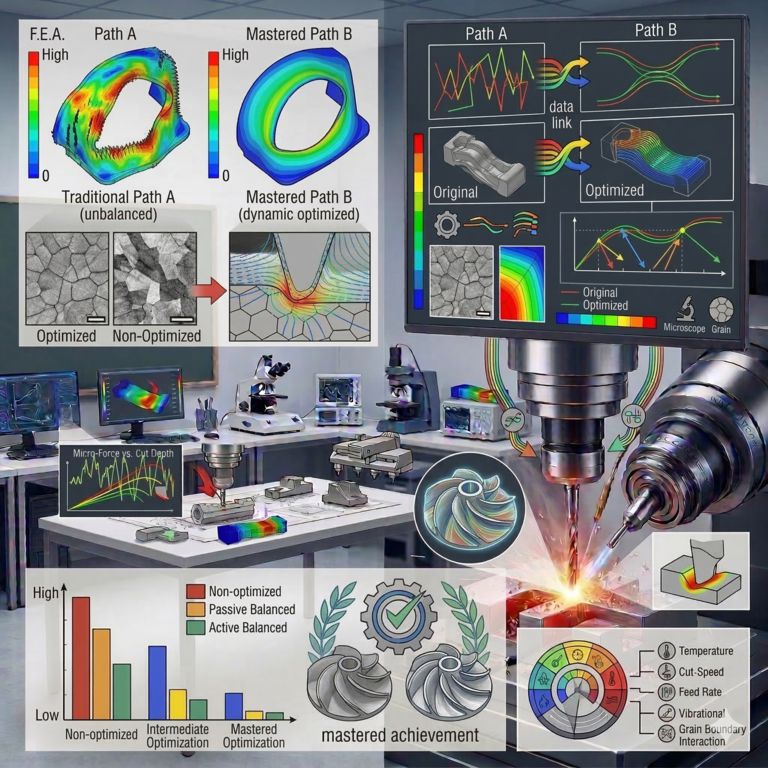
The Illusion of the Perfect Pivot
In a standard 3-axis machine (X, Y, Z), the geometry is relatively straightforward. The axes move in straight lines at perfect right angles to each other.
But 5-axis machines introduce rotary axes (like a tilting B-axis spindle or a rotating C-axis platter). For the CNC controller to accurately calculate where the tip of your cutting tool is in 3D space, it relies on a digital map of the machine’s physical pivot points. The controller assumes that the physical center of rotation for that heavy iron trunnion table is exactly where the digital map says it is.
In reality, the physical pivot point and the digital pivot point almost never perfectly align. This mismatch is the Kinematic Error.
These errors are caused by several real-world factors:
Assembly Tolerances: Even the best machine builders cannot perfectly align massive iron castings down to the sub-micron level.
Minor Collisions: A tiny bump with a tool holder might not break anything, but it can shift the rotary centerline by a hair.
Foundation Settling: The concrete floor under the machine shifts microscopically over time, tweaking the machine geometry.
Thermal Growth: As the machine heats up throughout the day, the metal expands, physically pushing the center of rotation away from its cold starting point.
The Amplification Effect: Why Tiny Errors Cause Massive Damage
You might think that a microscopic misalignment of a rotary axis isn’t a big deal. However, rotary errors are deceptive because they compound over distance.
Imagine holding a laser pointer. If you twitch your wrist by just a fraction of a degree, the laser dot on the wall thirty feet away will jump by several feet.
The same principle applies inside your CNC machine. If the center of your tilting A-axis is off by just a few microns, or if the axis is tilted by a fraction of a degree, that error is magnified by the distance from the pivot point to the cutting tool. By the time the trunnion tilts 90 degrees to machine the side of your part, a completely invisible error at the base of the trunnion has transformed into a massive gouge on your workpiece.
Pro Tip: In continuous 5-axis machining, where multiple axes are moving simultaneously to follow a complex curved surface, kinematic errors will manifest as ugly “facets” or stepping marks precisely where the rotary axes change direction.
The Old Way vs. The Smart Way
Historically, correcting these errors was a dark art. A highly skilled technician would spend hours or even days inside the machine enclosure with dial indicators, perfectly ground test bars, and granite squares. They would manually sweep the rotary platters, calculate the offsets, and manually type the new pivot center numbers into the CNC parameters.
It was tedious, required immense skill, and worst of all, it was a static fix. The moment the machine heated up or the seasons changed, the manual calibration was useless.
Enter Dynamic Kinematic Optimization.
How Dynamic Optimization Actually Works
Today, machine tool builders and control manufacturers have automated this entire process, turning a multi-day headache into a ten-minute automated cycle that the operator can run every morning.
Here is how the machine dynamically calibrates itself:
The Artifact: The operator magnetically mounts a perfectly round, ultra-precise “Kinematic Sphere” (a calibration ball) to the machine table.
The Probe: A high-precision touch probe is loaded into the machine spindle.
The Automated Dance: The CNC controller takes over. It tilts and rotates the machine table to dozens of different, extreme angles. At every single angle, the spindle probe reaches out and touches the calibration sphere.
The Calculation: Because the controller knows the sphere is perfectly round and stationary relative to the platter, it expects to find the sphere in the exact same mathematical location regardless of how the table is tilted. When the probe finds the sphere sitting slightly off-center at a 45-degree tilt, the controller instantly knows the physical pivot point is wrong.
The Real-Time Fix: The CNC’s internal brain crunches the data from all the probe hits to map out the exact centerlines, tilt errors, and squareness of the rotary axes. It then automatically overwrites its own digital kinematic map to perfectly match the physical reality of the machine.
The True ROI of Kinematic Optimization
Investing in automated kinematic calibration software and hardware transforms a shop’s capabilities.
| Benefit | The Impact on the Shop Floor |
| Seamless Surface Blends | Eliminates the mismatch lines when machining from different sides of the part, slashing manual polishing time. |
| Combating Thermal Drift | Operators can run a quick 5-minute calibration cycle after the machine warms up, completely neutralizing thermal expansion errors. |
| Scrap Reduction | Guarantees that the first part off the machine is structurally accurate, which is critical when cutting exotic, high-dollar aerospace alloys. |
| Operator Empowerment | Removes the need for an expensive, outside metrology expert to realign the machine after a minor tool crash. |
When you are chasing single-digit micron tolerances on parts that will fly in space or be implanted into the human body, guessing where your rotary axes are is not an option.
Dynamic Kinematic Error Optimization ensures that your machine’s digital brain and its physical iron are working in perfect, flawless harmony.
Please visit About、Machined Parts web page