For decades, the holy grail of modern manufacturing was hyper-efficiency. Global supply chains were engineered like clockwork: parts were sourced from whichever country offered the lowest labor costs, inventories were kept stripped down to the bare minimum via “Just-In-Time” logistics, and factories specialized in doing one single task at maximum volume.
But over the past few years, that clockwork has repeatedly broken down. Geopolitical tensions, sudden shipping bottlenecks, changing trade policies, and unexpected global disruptions have exposed a massive flaw in the traditional model—extreme efficiency often breeds extreme fragility.
Today, the competitive landscape has shifted. The most successful machine shops and fabrication plants are no longer just the ones that can cut a part the cheapest. They are the ones that can adapt the fastest. The true test of a modern manufacturing facility lies in its operational flexibility and its regional resilience.
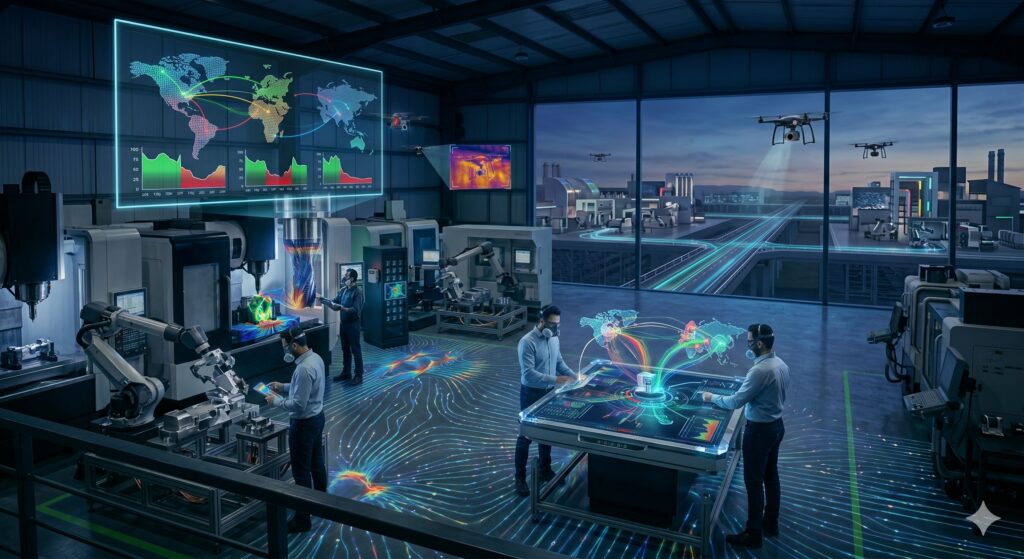
1. Defining the Pillars of the Agile Factory
When we talk about flexibility in a machine shop, we aren’t just talking about a worker changing a tool insert quickly. True manufacturing agility relies on structural adaptability across three distinct areas:
- Mix Flexibility: The ability of a facility to rapidly switch between producing entirely different types of products on the same line without experiencing days of costly downtime.
- Volume Flexibility: The capacity to scale production up or down seamlessly to match volatile market demands without destroying the factory’s profit margins.
- Routing Flexibility: The operational freedom to divert a job from a malfunctioning machine, a stalled work center, or an affected regional facility to another viable alternative instantly.
Achieving this level of agility requires a complete departure from the “set-it-and-forget-it” manufacturing mindset of the past. It demands an infrastructure engineered for continuous change.
2. The Digital Toolkit Driving Operational Fluidity
How do forward-thinking factories break free from the rigidity of traditional production? They leverage an ecosystem of smart, adaptive technologies that make flexibility a push-button reality.
High-Mix, Low-Volume (HMLV) Automation
In the past, automation was reserved for high-volume automotive lines making millions of identical parts. Today, advanced CNC machining centers utilize flexible robotic cell tenders equipped with smart vision systems.
These systems can autonomously load entirely different metal blanks into a machine, swap out their own grippers, and update their cutting programs on the fly. This allows a shop to run varied, small-batch orders overnight without a single human operator present.
Modular Tooling and Quick-Change Fixturing
Every minute a multi-million dollar machine sits idle during a job setup is lost revenue. Agile shops utilize zero-point clamping systems and modular fixturing.
Instead of spending hours manually aligning heavy vises and clamps for a new job, operators can drop a pre-configured sub-plate into the machine and lock it into place with micro-level accuracy in less than sixty seconds.
Cloud-Based Manufacturing Execution Systems (MES)
Agility requires data visibility. Modern cloud-based MES software tracks the live load of every machine on the floor.
If a vital machine unexpectedly breaks down, the software doesn’t just log the error—it instantly recalculates the entire shop’s schedule, dynamically rerouting pending jobs to alternative workstations to keep delivery deadlines on track.
3. Regional Resilience: The Rise of Nearshoring and Local Ecosystems
While operational flexibility handles the internal chaos of a factory, Regional Resilience protects it from the external shocks of global logistics.
The industry is undergoing a massive shift away from deep-ocean, centralized manufacturing and moving toward decentralized regional hubs.
This strategy—often called nearshoring or regionalization—focuses on placing manufacturing capabilities closer to the end consumer.
Building regional resilience provides several powerful advantages:
- Drastically Reduced Lead Times: Shipping a component across a regional border via freight truck takes days; shipping it across an ocean via container vessel takes weeks or months. Regionalized manufacturing allows companies to react to sudden market changes in near real time.
- Insulation from Geopolitical Shocks: Relying on a highly globalized supply chain means your business can be paralyzed by an overseas trade dispute or port strike. A localized supply network keeps your production insulated from international turbulence.
- Sustainability and Carbon Reduction: Shorter transport routes mean less fuel consumption. For corporations looking to meet strict green manufacturing guidelines, shortening the physical distance between the raw material supplier, the fabricator, and the customer is the lowest-hanging fruit.
4. The Cultural Shift: Upskilling for an Unpredictable Future
Technology and geography are vital, but the ultimate vanguard of a factory’s resilience is its people.
Rigid factories rely on highly specialized labor—workers who know how to operate one specific manual lathe and nothing else. If that worker is absent, that capability vanishes.
Agile factories invest heavily in cross-training and upskilling.
A resilient workforce consists of multi-functional technicians who can program a CNC mill in the morning, troubleshoot an automated robotic cell in the afternoon, and oversee quality inspection control before their shift ends. This workforce flexibility ensures that human resource bottlenecks never stall the factory floor.
The Bottom Line
The era of predictable, static manufacturing is over. The global economy has entered an era of volatility, where disruption is no longer a rare anomaly, but a constant operational variable.
For modern manufacturing facilities, building flexibility and regional resilience isn’t an expensive luxury or an administrative checkbox—it is a survival mechanism. The future belongs to the quick, the adaptable, and the localized. By transforming your shop floor into an agile, responsive ecosystem, you don’t just survive the next supply chain crisis; you turn adaptability into your greatest competitive weapon.