Walk into any modern advanced manufacturing facility, and you will hear a distinct sound. It is the high-pitched, jet-engine whine of High-Speed Cutting (HSC).
Running spindles at 20,000, 30,000, or even 40,000 RPM, HSC allows machine shops to hog out aluminum in seconds and slice through hardened tool steels with incredible efficiency.
But sometimes, that smooth whine turns into a terrifying, ear-piercing scream. The machine shakes, the cutting tool shatters, and the surface of your expensive aerospace part looks like a rippled potato chip.
This is the dark side of high-speed machining. You have just encountered Process-Induced Vibration (commonly known as chatter), and if you don’t suppress it, it will destroy your spindle.
Let’s dive into the physics of why high-speed cutting creates such violent harmonics and, more importantly, how modern technology suppresses these forced vibrations to keep the spindle safe.
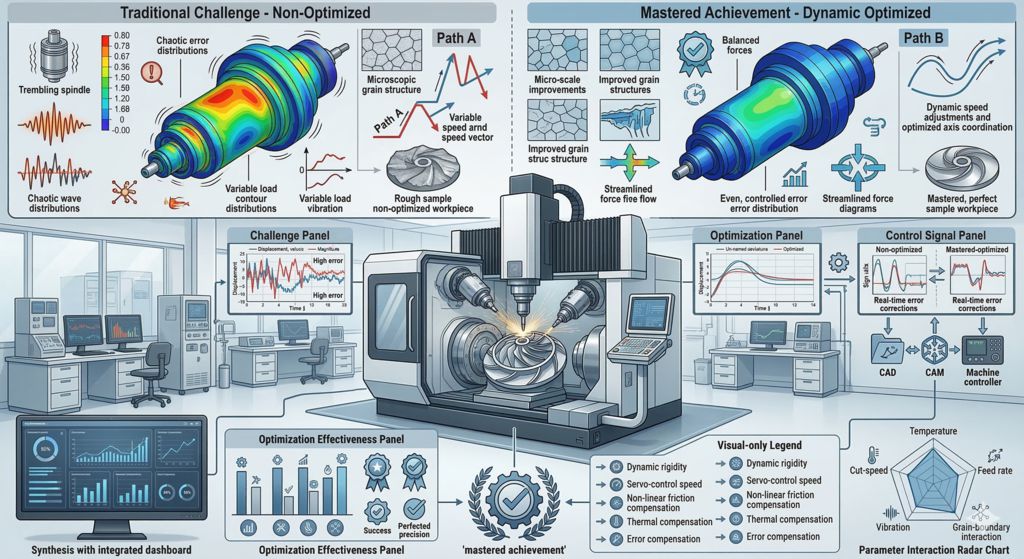
The Anatomy of the Scream: What is Process-Induced Vibration?
When a cutting tool shears metal, it does not do so smoothly. Every time a flute on an end mill strikes the material, it creates a microscopic impact. These impacts happen thousands of times per second, generating massive cutting forces that push back against the tool.
Because the tool and the machine spindle are made of physical matter, they are not infinitely rigid. When that cutting force hits, the tool deflects slightly. As the flute exits the cut, the tool snaps back. This creates a natural vibration.
Under normal conditions, this vibration is tiny and harmless. However, process-induced vibration turns deadly when it becomes regenerative.
Imagine pushing a child on a swing. If you push them at the exact right moment in their natural arc, they go higher and higher. The same thing happens in a CNC machine:
The first flute cuts a microscopic wavy pattern into the metal due to slight deflection.
The second flute comes around. If the RPM and the natural frequency of the tool align perfectly, the second flute will hit the “peak” of the wave left by the first flute.
This causes a bigger deflection, leaving a deeper wave for the third flute.
Within milliseconds, the vibration amplifies exponentially. The tool begins violently bouncing off the workpiece rather than cutting it.
The Victim: Why Forced Vibration Destroys Spindles
While broken end mills are annoying, the real casualty of process-induced vibration is the machine’s spindle.
The spindle is the beating heart of a CNC machine, relying on ultra-precise ceramic bearings to rotate at massive speeds with zero runout. When severe regenerative chatter occurs, the vibration travels directly up the tool holder and into the spindle shaft.
This creates Forced Vibration. The spindle bearings are suddenly subjected to thousands of pounds of lateral force, hammering them back and forth at incredibly high frequencies. Over time, this causes:
Brinelling: Microscopic dents in the bearing races.
Overheating: Increased friction as the bearings fight the chaotic movement.
Catastrophic Failure: A ruined spindle cartridge that costs tens of thousands of dollars and weeks of machine downtime to replace.
Taming the Beast: Strategies for Spindle Forced Vibration Suppression
To safely utilize High-Speed Cutting, manufacturers must break the cycle of resonance. Here are the primary strategies engineers use to suppress forced vibrations and protect the spindle.
1. Variable Geometry Tooling (Breaking the Rhythm)
The simplest and most effective way to stop regenerative chatter is to prevent the rhythmic pushing of the “swing.” Tool manufacturers do this by altering the geometry of the end mill itself.
Variable Pitch: The flutes are not spaced evenly (e.g., instead of exactly 90 degrees apart on a 4-flute tool, they might be spaced at 88, 92, 89, and 91 degrees).
Variable Helix: The twist angle of the flutes changes along the length of the tool.
Because the flutes hit the material at irregular intervals, they never strike the “waves” left by the previous flute in a rhythmic pattern. The vibration is constantly disrupted before it can build up enough energy to threaten the spindle.
2. Spindle Speed Variation (SSV)
If you can’t change the tool, you can change the machine’s behavior. Spindle Speed Variation (SSV) is a software feature inside the CNC controller.
Instead of locking the spindle at exactly 15,000 RPM, SSV tells the spindle to constantly oscillate. It might smoothly ramp up to 15,500 RPM, then drop down to 14,500 RPM, and back up again every few seconds.
By constantly moving the frequency target, the machine prevents the cutting harmonics from ever locking into a destructive resonance loop.
3. Finding the “Sweet Spot” (Stability Lobes)
Counter-intuitively, slowing the machine down is not always the answer to vibration. In High-Speed Cutting, there are specific “sweet spots” where the frequency of the tool impacts actually perfectly cancels out the vibration of the machine.
Engineers map out the dynamic stiffness of the spindle using acoustic sensors and a tap-test hammer. This creates a “Stability Lobe Diagram”—a visual map showing pockets of high RPM where the spindle is perfectly stable.
Often, increasing the spindle speed from 12,000 RPM to an optimized 16,000 RPM will instantly cause a screaming machine to fall dead silent.
4. Active Spindle Damping Systems
For the absolute pinnacle of high-speed machining, we enter the realm of active suppression. Modern “smart” spindles feature built-in accelerometers that monitor vibration in real-time.
When the sensors detect the early frequencies of forced vibration building up, the CNC controller activates piezoelectric actuators wrapped around the spindle bearings.
These actuators instantly push back against the spindle shaft with the exact opposite force of the vibration, canceling out the chatter before the operator even hears it.
The Verdict
High-Speed Cutting is a balancing act between incredible productivity and catastrophic mechanical failure.
By understanding the chaotic nature of process-induced vibration and utilizing advanced suppression techniques—from clever tool geometries to active piezoelectric damping—manufacturers can safely push their spindles to the absolute limit, achieving mirror-like surface finishes in record time.
Please visit Contact、Machined Parts web page