Imagine being handed a 100-pound solid block of aerospace-grade aluminum and being told to machine it down until it weighs just 5 pounds. The final part will be a complex web of deep pockets, flying buttresses, and walls as thin as a credit card.
In the aerospace and high-performance automotive industries, this is a daily reality. These monolithic structural parts are designed to be incredibly strong yet impossibly light. But manufacturing them is an absolute nightmare.
When you remove 95% of a metal block’s mass, you are removing its structural rigidity. The part becomes a delicate, vibrating tuning fork.
Worst of all, it becomes the ultimate victim of Residual Stress. If you approach a thin-walled part with traditional machining strategies, it will twist, bow, and warp the moment you unclamp it.
To survive this, modern machinists don’t just cut metal; they practice a delicate mechanical martial art known as Residual Stress Balancing.
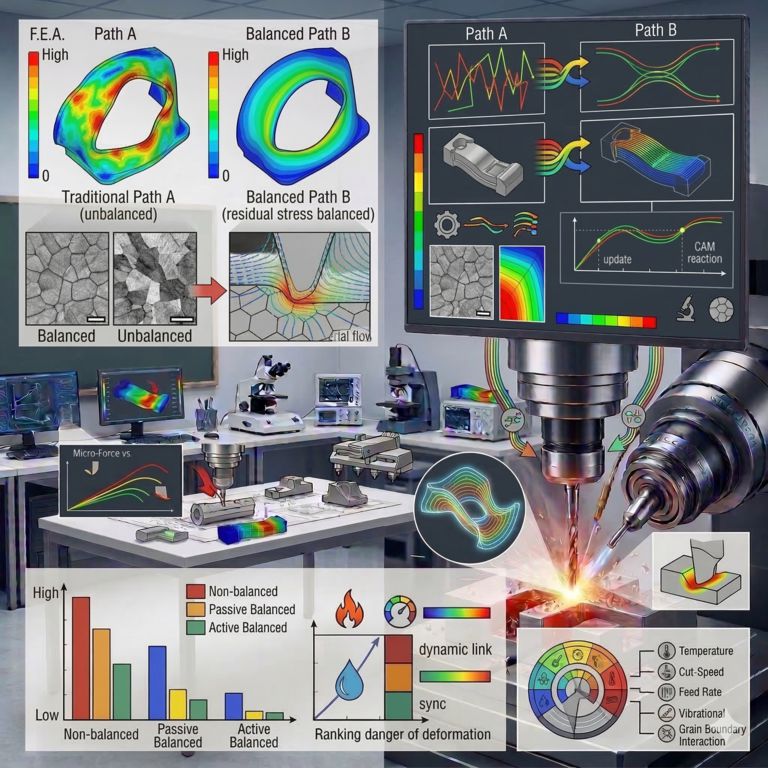
The Anatomy of the Warp
We’ve discussed residual stress before—those invisible, locked-in forces created when the raw metal was originally forged, rolled, or heat-treated.
In a thick, chunky part, the sheer mass of the remaining metal is usually strong enough to overpower these internal stresses and keep the part relatively straight. But in a thin-walled component, you are carving away the “muscle” that holds the part flat.
Think of a piece of raw metal like a perfectly balanced tug-of-war. The outer skin is pulling outward (tension), and the deep core is pushing inward (compression). They are locked in a stalemate. When your end mill strips away the tensile skin on the left side of a thin wall, you destroy the stalemate. The right side is still pulling, but the left side is gone. The wall immediately bows in the direction of the remaining stress.
If you can’t magically erase all the stress from the raw material, what do you do? You balance it.
The Strategy of Symmetry: How to Balance the Invisible
The core philosophy of residual stress balancing is simple in theory but incredibly complex in execution: If the left side of the wall pulls with 10 units of force, you must ensure the right side of the wall pulls with exactly 10 units of force. Here are the specific, high-level machining strategies used to achieve this perfect equilibrium.
1. The “Flip and Skim” (Alternating Material Removal)
The worst thing you can do to a thin-walled part is to completely finish one side, flip it over, and then machine the other side. By the time you flip it, the part has already warped so severely that your CNC machine will be cutting a curved surface without knowing it.
Instead, programmers use a highly iterative approach:
Rough out 40% of the material on Side A.
Flip the part and rough out 40% on Side B.
Flip it back to Side A and take a semi-finish pass.
Flip to Side B for a semi-finish pass.
By removing the stressed layers symmetrically and gradually, the part never experiences a massive imbalance. It stays centered as the stress is slowly bled out of the material.
2. Waterline Milling (The Step-Down Method)
When machining a tall, extremely thin rib (like a heat sink fin or an aircraft bulkhead), you cannot machine one side of the rib all the way down to the floor, and then cut the other side. The thin wall will simply bend away from the cutter, leaving the top of the wall much thicker than the bottom.
To balance the cutting forces and the stress, engineers use alternating waterline toolpaths. The tool traces the left side of the wall down a few millimeters, then hops over the wall and traces the right side down a few millimeters.
It zig-zags back and forth, stepping down gradually. The thick, unmachined metal at the bottom of the rib provides rigid support for the delicate, thin wall being created at the top.
3. Managing the Machining-Induced Stress
It’s not just the raw material that has stress; your cutting tool actually injects new stress into the part. A dull tool plows into the metal, intensely compressing the top atomic layers and generating massive heat. On a wall that is only 1mm thick, this newly injected stress is enough to warp the part permanently.
To combat this, the balancing strategy dictates:
Hyper-Sharp Tools: Using polished, high-positive rake angle cutters (like single-crystal diamond or highly polished carbide) to slice cleanly rather than plow.
Climb Milling Only: Conventional milling rubs the material before it cuts, creating heat and stress. Climb milling slices instantly, directing the heat into the chip rather than the thin wall.
Symmetrical Feed Rates: Ensuring that the cutting speeds, feeds, and chip loads are perfectly identical on both sides of the wall, so the machining-induced stress is perfectly mirrored.
The Final Act: Adaptive Workholding
Even with perfect toolpaths, a thin-walled part will still undergo micro-warping during the roughing phase. This is where your clamping strategy becomes the final line of defense.
If a part has warped slightly after roughing, and you clamp it down hard in a steel vise for the finishing pass, you are forcing the bent part perfectly flat. The machine will cut a beautiful, perfectly flat surface. But the second you release the vise, the part will spring right back to its bent shape, ruining your tolerances.
The Golden Rule of Thin-Walls: Never clamp a warped part flat.
Modern fixtures use “adaptive clamping” for the final finish pass. This might involve using low-tension vacuum chucks, custom-poured polyurethane potting compounds that encase the part without squeezing it, or hydraulic clamps that gently lock into place precisely where the warped part is resting in free space.
The machine cuts the part in its natural, relaxed state, ensuring that when it comes off the machine, it stays exactly as it was cut.
The Mindset Shift
Machining extreme thin-walled structures requires a complete shift in a manufacturer’s mindset. You can no longer think of machining as simply “removing what you don’t want.”
You have to think of it as carefully carving away layers of tension, constantly anticipating how the material will react, breathe, and move. By mastering residual stress balancing, engineers turn an unpredictable nightmare into a repeatable, high-precision science.
Please visit Machined Parts、About