Imagine a factory floor bathed in total darkness. There are no overhead lights, no climate control adjusting for human comfort, and no sound except for the rhythmic hum of synchronized machinery. Inside, robotic arms precision-weld components, autonomous vehicles ferry materials between stations, and computer systems monitor the entire operation in real time.
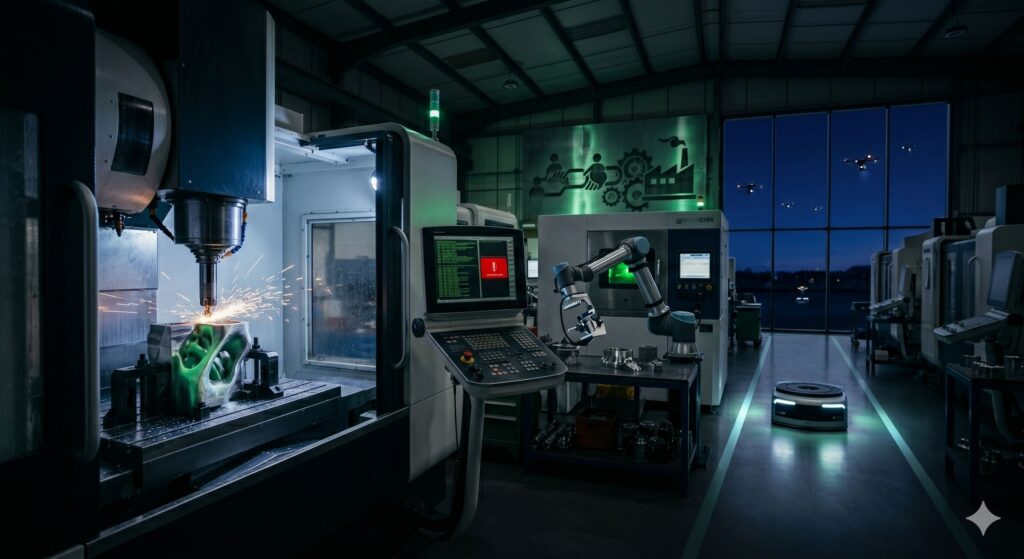
This isn’t a scene from a science fiction movie; it is Lights-Out Manufacturing.
As industries face shrinking labor pools, rising operational costs, and an insatiable global demand for goods, the concept of the fully automated, unmanned factory has transitioned from a futuristic dream into a competitive necessity.
Here is a deep dive into what lights-out manufacturing really looks like, the technology driving it, and what it means for the future of production.
1. Decoding “Lights-Out”: What Does It Actually Mean?
The term “lights-out” stems from a simple premise: if a factory requires no human presence on the shop floor to operate, you can literally turn off the lights and let the machines run themselves.
However, true lights-out manufacturing is rarely an all-or-nothing affair. Instead, it typically exists in three distinct Tiers:
- The Extended Shift (The “Ghost” Night): A factory operates normally with a human workforce during the day. Before leaving at 5:00 PM, workers load raw materials into the machines and program them to run unattended through the night.
- The Hybrid Plant: Certain complex or dangerous sectors of a factory are completely automated and partitioned off, running 24/7 without human intervention, while other assembly or packaging sectors remain human-operated.
- The Fully Autonomous Facility: The ultimate goal—a self-contained ecosystem where raw materials enter at one end, finished goods exit at the other, and humans only step in for high-level oversight or emergency maintenance.
2. The Digital Ecosystem Behind the Darkness
To successfully run a factory without eyes on the ground, you need a highly sophisticated network of technologies that act as the nervous system, brain, and muscles of the operation.
Advanced Robotics and Machine Vision
Standard robotic arms can repeat the exact same movement infinitely. But in a lights-out environment, robots need to adapt. Equipped with Machine Vision (cameras and AI sensors), modern robots can identify randomly oriented parts in a bin, detect imperfections, and adjust their grip or path dynamically without human guidance.
The Industrial Internet of Things (IIoT)
In a lights-out facility, every machine is packed with hundreds of smart sensors. These sensors constantly monitor variables like vibration, temperature, and acoustic pitch.
Predictive Maintenance Over Reactive Repairs
If a machine breaks down in a traditional shop, a worker presses the emergency stop button. In a lights-out shop, a breakdown could stall production for hours before anyone notices. Therefore, these factories rely on Predictive Maintenance. AI algorithms analyze the sensor data to predict when a bearing or cutting tool is about to fail, automatically scheduling a replacement before the disaster happens.
3. The Big Benefits: Beyond Just Saving Electricity
While saving money on the power bill by turning off the lights is a nice perk, the true economic and operational advantages of lights-out manufacturing go much deeper.
- Unmatched Productivity: Humans need breaks, shift changes, vacations, and sleep. Machines do not. Lights-out manufacturing unlocks true 24/7/365 production capabilities, drastically accelerating time-to-market.
- Flawless Consistency: Human workers, no matter how skilled, experience fatigue and distraction, leading to errors. Automated systems perform tasks with identical precision every single time, drastically reducing scrap rates and maximizing quality control.
- Eliminating Safety Hazards: By removing humans from environments with extreme heat, toxic fumes, heavy lifting, or sharp cutting tools, industrial workplace injuries can be virtually eliminated.
4. The Hidden Challenges: Why It Isn’t Easy
If lights-out manufacturing is so incredible, why hasn’t every factory adopted it? The reality is that removing the human element introduces a brand-new set of complex challenges.
- The “Rigidity” Problem: Humans are incredibly adaptable. If a part arrives slightly bent, a human worker can straighten it or adjust their technique instantly. Automated systems struggle with unexpected anomalies. A single misplaced part or jammed conveyor belt can freeze an entire production line if the system isn’t programmed to handle that specific error.
- Massive Upfront Capital: Transforming a standard facility into an autonomous one requires a staggering financial investment in robotics, software integration, and employee upskilling. For small to medium enterprises, the initial cost can be a barrier to entry.
- The Vulnerability to Cyber Threats: When your entire factory is connected to the cloud and driven by software, it becomes a target for hackers. A cyberattack on a lights-out facility could halt global supply chains or damage machinery remotely.
The Bottom Line: Where Do Humans Fit In?
The rise of lights-out manufacturing often sparks fear about the total automation of human labor. However, history shows us that automation doesn’t destroy jobs; it completely redefines them.
In the lights-out era, the role of the factory worker shifts from mundane, repetitive, and physically grueling tasks to high-value intellectual roles. We still need human engineers to design the products, data analysts to optimize the AI algorithms, and highly skilled technicians to maintain and upgrade the robotic fleet.
The lights may be out on the factory floor, but the human minds behind the curtain are brighter than ever.