For decades, the path to growing a manufacturing business followed a strict, financially grueling script. If a machine shop wanted to take on higher-value contracts—like aerospace components or intricate medical devices—they had to invest massive amounts of upfront capital. They needed to purchase high-end 5-axis CNC mills, specialized EDM wire cutters, and warehouses full of expensive, specialized cutting tools.
For small to medium-sized enterprises (SMEs), this high barrier to entry was often a death sentence for ambition. Equipment sat on a showroom floor, entirely out of financial reach.
But a quiet revolution is taking place on the modern shop floor. Borrowing successful concepts from software services and consumer sharing apps, the industrial world is embracing Shared Tooling Networks and Advanced Equipment Leasing Models.
Industry is shifting from an ownership mindset to a utilization mindset. Here is how asset sharing is democratizing manufacturing and altering production economics.
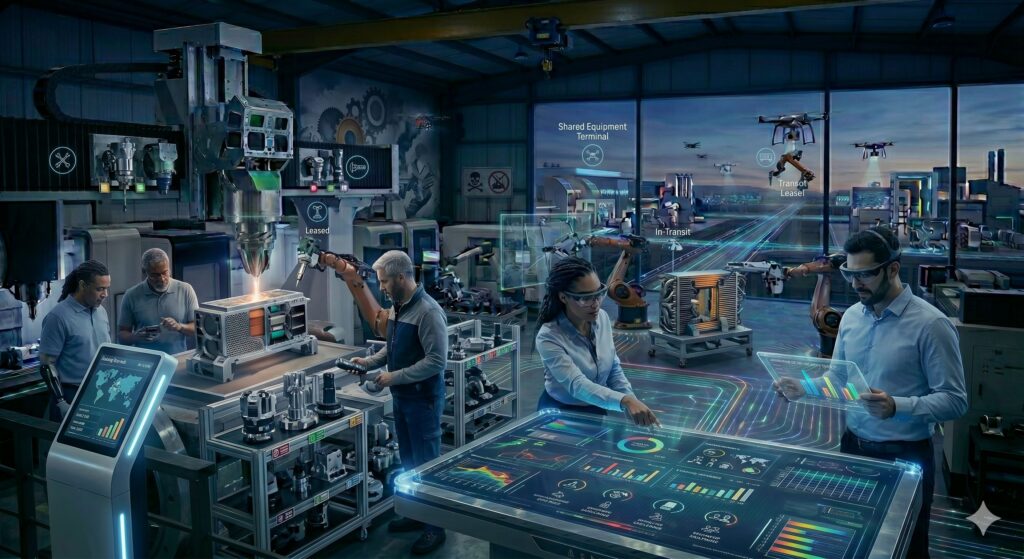
1. The Flaw of Idle Iron: Why Ownership is Overrated
To understand the shift, we have to look at the traditional balance sheet of a machine shop. A top-tier industrial machine can easily cost hundreds of thousands of dollars.
When a shop buys that machine outright, they are gambling that they will have a constant, uninterrupted stream of specific contracts to keep that machine running 24/7.
The reality, however, is often much different. Many highly specialized machines sit idle for weeks at a time between custom jobs.
An idle machine doesn’t make money; it depreciates, eats up valuable floor space, and ties up precious capital that could be used for hiring talent or buying raw materials. Ownership creates rigidity. If the market suddenly shifts from automotive to electronics, a shop owner is left holding the bill for legacy machinery that is no longer optimal.
2. Shared Tooling Networks: Industrial Airbnb for Manufacturers
One of the newest entries into the industrial sharing economy is the concept of shared tooling networks or open-access manufacturing hubs.
Instead of every small shop in a city buying their own rare, expensive diagnostic equipment or specialized heavy-duty cutting gear, local manufacturing clusters are creating co-op style hubs.
Through secure digital platforms, a shop can rent time on a high-precision coordinate measuring machine (CMM) or a heavy metal 3D printer located at a regional hub just a few miles away.
- The Benefit: Small shops can bidding on complex contracts that require high-end validation, without actually owning the million-dollar validation equipment.
- The Ecosystem: It fosters a localized, collaborative ecosystem where regional shops support one another, maximizing the utilization of the region’s total mechanical capacity.
3. Reimagining the Lease: Equipment-as-a-Service (EaaS)
While shared hubs handle part-time or specialized needs, what happens when a shop needs a machine on their own floor but still can’t afford the upfront capital? This is where traditional equipment leasing has evolved into Equipment-as-a-Service (EaaS).
In a traditional lease, you pay a fixed monthly fee to use a machine for a set number of years, regardless of how much you actually use it. EaaS completely flips this model on its head by utilizing the Internet of Things (IoT).
Under an EaaS model, the machine manufacturer installs the CNC mill or laser cutter on your shop floor for a minimal setup fee. The machine is embedded with smart sensors that track exactly how many hours it cuts or how many parts it produces. You are then billed strictly based on actual machine utilization.
- During a Boom: When your shop is flooded with orders and running three shifts, you pay more because the machine is generating high revenue for you.
- During a Slowdown: If the market dips and the machine sits quiet, your monthly operational expenses drop automatically, protecting your cash flow from a sudden crunch.
4. Shifting from Capital Expense to Operational Agility
Embracing shared tooling and dynamic leasing shifts equipment procurement from a Capital Expenditure (CapEx) to an Operational Expenditure (OpEx). This accounting shift transforms how a manufacturing business behaves.
When machinery is an operational expense tied directly to active production jobs, a shop becomes incredibly agile. They can quickly ramp up production to handle a massive, short-term contract by leasing temporary robotic cells, and then return them when the contract concludes.
Furthermore, responsibility for maintenance, software updates, and eventual machine obsolescence shifts back to the equipment manufacturers. If a tool wear sensor indicates a spindle is failing, the service provider handles the repair as part of the operational contract, minimizing unexpected repair bills for the shop owner.
The Bottom Line
The future of manufacturing isn’t about who owns the biggest, heaviest pieces of iron. It is about who can orchestrate assets the most efficiently.
By breaking down the traditional walls of machine ownership and replacing them with flexible leasing models and shared tooling networks, the industrial world is opening the door to unprecedented innovation.
Small shops can now punch far above their weight class, large factories can de-risk expansion, and the entire manufacturing supply chain becomes more resilient, fluid, and sustainable. The factory of tomorrow doesn’t own its future—it subscribes to it.