When we think about industrial workplace hazards, our minds immediately picture the obvious dangers: heavy rotating machinery, sharp cutting tools, high-voltage electrical panels, or towering forklifts. We naturally focus on the large, visible risks.
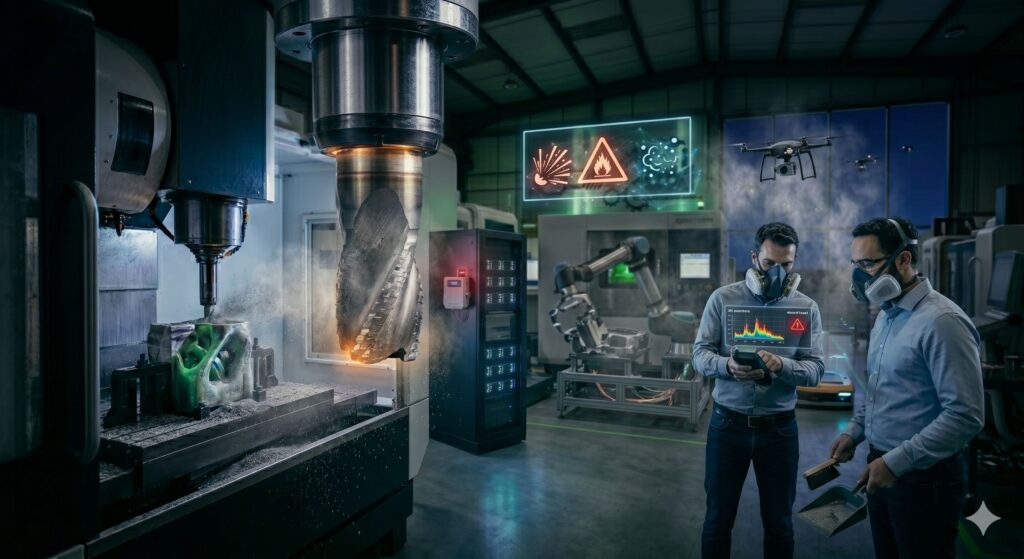
But in many modern machine shops and processing facilities, the deadliest threat is completely silent, microscopic, and floating right in front of our eyes. It is Metal Micro-Dust.
As manufacturing technologies advance—especially with the rise of high-speed grinding, metal polishing, and metal 3D printing—facilities are generating finer metal particles than ever before.
Under the right conditions, these innocent-looking piles of dust can transform into highly volatile explosives. Here is a deep dive into the hidden science of metal dust explosions, workplace safety hazards, and how to protect your shop from a catastrophic event.
1. The Science of the Blast: How Dust Becomes an Explosive
How can a solid, heavy piece of metal like aluminum or titanium suddenly explode? The answer lies in surface area and chemistry.
When a solid block of aluminum is exposed to an open flame, it doesn’t catch fire because its mass is too large; the heat quickly dissipates throughout the bulk metal.
However, when that same block of aluminum is machined into micro-dust, its surface-area-to-mass ratio explodes. Each microscopic particle becomes completely surrounded by oxygen.
To trigger a devastating dust explosion, five specific elements must come together. Fire safety professionals call this the Dust Deflagration Pentagon:
- Fuel: The combustible metal micro-dust (e.g., aluminum, magnesium, titanium, or iron).
- Oxygen: Present naturally in the surrounding shop air.
- Ignition Source: A spark from a grinding wheel, a static discharge, or a hot motor surface.
- Dispersion: The dust must be kicked up into the air, creating a floating cloud.
- Confinement: The dust cloud must be enclosed within a room, a duct system, or a machine enclosure.
If you remove just one of these five elements, an explosion cannot happen. But if all five align, the results are catastrophic.
2. The Deadly Chain Reaction: Primary vs. Secondary Explosions
What makes dust explosions uniquely dangerous compared to gas leaks is their ability to create a domino effect. Dust explosions almost always occur in two distinct stages:
The Primary Blast
An ignition source sparks a small dust cloud inside a piece of machinery, such as a dust collector or a milling enclosure. This initial explosion is usually relatively small, but it creates a powerful pressure wave that ripples through the entire factory building.
The Secondary Blast
The pressure wave from the primary blast shakes the factory infrastructure, instantly dislodging months of accumulated dust sitting on top of overhead rafters, light fixtures, and suspended ceilings. This creates a massive, building-wide dust cloud.
The flame from the primary explosion then ignites this newly airborne cloud.
The secondary explosion is typically many times larger than the first, tearing through structures, destroying facilities, and placing human lives in extreme danger.
3. Beyond Explosions: Toxic Hazards and Long-term Health Risks
While explosions are the most dramatic risk, metal micro-dust poses a slow-burning, daily threat to the human respiratory system.
When workers inhale microscopic metal particles, the smallest fractions bypass the nasal passages and travel deep into the lungs.
Over time, exposure to materials like cobalt, nickel, beryllium, and hexavalent chromium can lead to chronic illnesses, including occupational asthma, pulmonary fibrosis (scarring of the lung tissue), and even lung cancer.
Furthermore, certain metals can be absorbed into the bloodstream, leading to systemic heavy metal poisoning that damages the nervous system and kidneys.
4. Shielding the Shop: Modern Prevention and Safety Strategies
Mitigating the risk of metal dust hazards requires moving far beyond standard housekeeping. It demands an engineered approach to safety.
Implement Specialized Wet Dust Collectors
Traditional dry vacuum systems can actually trigger explosions by creating static electricity as metal dust flies through the plastic hoses.
For reactive metals like aluminum and magnesium, shops must use Wet Dust Collectors. These systems pull the airborne dust through a water curtain, instantly submerging the metal particles and rendering them completely inert.
Rigorous Housekeeping and Overhead Cleaning
Since secondary explosions rely on accumulated dust, keeping horizontal surfaces clean is vital. Facilities must implement regular cleaning schedules that focus specifically on elevated, hidden areas like rafters and ductwork. Crucially, workers should never use compressed air to blow dust off machines or clothing, as this forcefully disperses the dust into the air, creating the exact hazard they are trying to avoid.
Anti-Static Environments and Intrinsically Safe Equipment
To eliminate ignition sources, zones with high dust accumulation must utilize specialized electrical equipment. This includes explosion-proof lighting, sealed motors, and anti-static flooring. Workers should also be equipped with static-dissipative footwear and clothing to prevent accidental static discharges.
The Bottom Line
Metal micro-dust is the ultimate hidden hazard of modern manufacturing. It is a byproduct that cannot be entirely avoided, but it can absolutely be managed.
By understanding the mechanics of the Dust Deflagration Pentagon and treating dust control not as an afterthought, but as a critical operational pillar, manufacturers can protect their physical assets and, most importantly, ensure that their workforce goes home safely at the end of every shift. In the industrial world, cleanliness isn’t just about aesthetics—it is a matter of survival.
Please get a free quote from Harry Yen hyen@unisontek.com.tw All of us are looking forward to your good news and invite you to visit our factory in Taiwan. Welcome to send any inquiry to us! Please watch presentation of our company on YouTube Link.