When we think of a metalworking factory, our minds naturally conjure up images of brute force and high energy. We picture massive CNC mills spinning carbide tools at thousands of RPMs, intense friction generating white-hot heat, sparks flying during heavy grinding, and cutting fluids sloshing around the machine bed. It is an industry built entirely on mechanical violence and massive energy consumption.
But in the quietest corners of advanced manufacturing research, a radical alternative is emerging. Scientists and engineers are replacing heavy machinery, lasers, and harsh chemicals with a tool borrowed straight from nature: Bacteria.
This process is known as Bio-Machining (or microbiological machining). By harnessing the natural, metal-eating metabolisms of specific microscopic organisms, manufacturers are discovering they can shape, etch, and mill precision metal components at a microscopic scale with zero heat, minimal energy, and near-zero environmental waste. Here is a look inside the living factories of tomorrow.
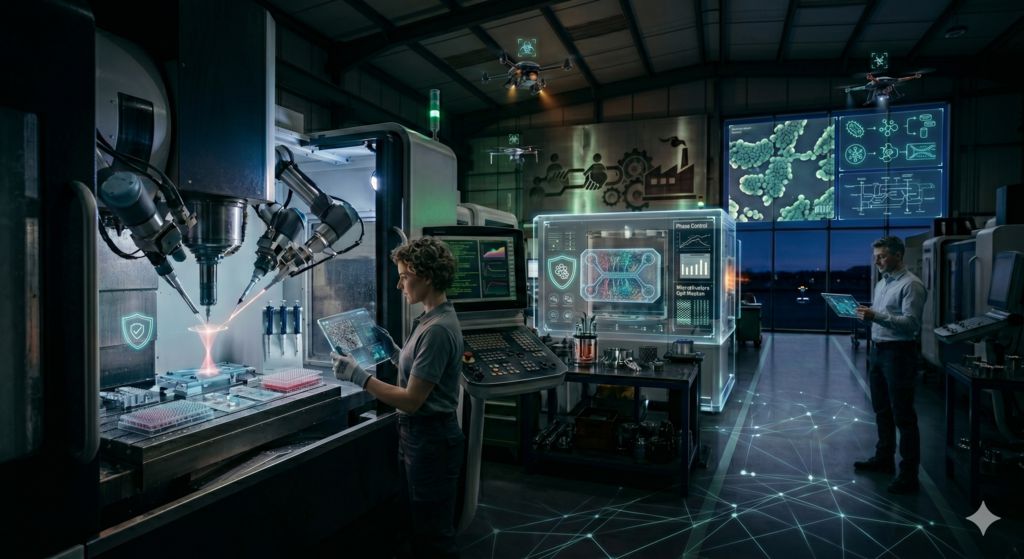
1. The Mechanics: How Bacteria Become the Cutting Tools
To understand bio-machining, we have to look at the natural world, specifically at a class of organisms called chemolithotrophs (literally meaning “stone-eaters”). The most famous workhorses in this field are bacteria like Acidithiobacillus ferrooxidans.
These bacteria do not survive on organic sugars like humans do. Instead, they thrive in highly acidic environments and survive by chemically oxidizing inorganic metals, such as iron, copper, and titanium. They essentially eat electrons from the metal, causing the solid metal to dissolve into a liquid solution.
In a bio-machining setup, a raw metal workpiece is prepared by applying a protective, non-biological coating called a “maskant” over the areas that need to remain untouched—very similar to how chemical etching or semiconductor manufacturing works.
The part is then submerged in a bio-reactor fluid filled with billions of these specialized bacteria.
As the bacteria come into contact with the exposed metal, they begin their metabolic process, quietly and precisely eroding the metal away, atom by atom.
2. The Biological Advantage: Why Choose Bacteria Over Blades?
Why would a modern manufacturer choose a slow-moving bacterial bath over a high-speed CNC machine? Bio-machining unlocks a unique set of structural and environmental advantages that traditional tools simply cannot match.
A. Absolute Zero Thermal and Mechanical Stress
As explored in our previous articles on metallurgy, traditional machining puts metals through a thermodynamic gauntlet. The heat and physical force of a spinning blade create a “Heat-Affected Zone” (HAZ) and leave behind trapped tensile residual stresses that can warp the part or cause it to crack prematurely under fatigue.
Because bio-machining is a purely natural chemical process that happens at room temperature, it exerts zero mechanical force and zero thermal stress on the workpiece. The atomic lattice of the metal remains completely uncompromised, making it ideal for ultra-fragile components used in medical sensors or aerospace electronics.
B. Machining the “Un-Machinable”
When materials become incredibly hard—such as titanium alloys or nickel-based superalloys—they quickly destroy expensive carbide and diamond cutting tools.
Bacteria, however, do not care about the hardness of a material; they only care about its chemical composition. A bacterium can dissolve an ultra-hard hardened steel alloy just as easily as it can dissolve soft copper, eliminating the problem of tool wear entirely.
C. The Ultimate Green Manufacturing
Traditional machining produces hazardous chemical wastewater, spent petroleum-based cutting oils, and a massive carbon footprint from high-voltage machinery. Bio-machining is incredibly eco-friendly.
The bacteria operate at room temperature, requiring minimal electricity. Furthermore, the liquid byproduct containing the dissolved metal can be easily processed to recover and recycle the metal ions, turning a waste stream back into a valuable raw material bank.
3. The Micro-Control Challenge: Taming the Microbes
While bio-machining sounds like the perfect sustainable dream, implementing it on a commercial shop floor presents severe biological and micro-control challenges.
- The Speed Barrier: Traditional CNC machines can shape a part in a matter of seconds or minutes. Bio-machining is a slow, steady biological process.
Material removal rates are measured in microns per hour. It is currently restricted to ultra-precise micro-machining, shallow surface etching, or deburring miniature components where patience is a virtue. - Bioreactor Optimization: Bacteria are living creatures, and they are incredibly picky about their working conditions. If the fluid bath becomes too hot, too cold, or loses its precise acidity balance, the bacteria will stop eating or die.
Maintaining the perfect biological equilibrium requires a network of smart sensors, automated nutrient feeding systems, and constant pH monitoring. - Biological Boundary Control: Ensuring the bacteria only eat exactly where they are supposed to requires flawless maskant application. At a microscopic scale, ensuring the bacteria do not migrate beneath the protective layer to cause “undercutting” requires advanced fluid dynamic control within the bioreactor.
The Bottom Line
The boundary between biology and heavy industry is permanently dissolving. Bio-machining proves that the future of manufacturing doesn’t necessarily belong to the loudest, heaviest, or most energetic machines—it may very well belong to the quietest and smallest organisms on the planet.
While you won’t see bacteria replacing heavy industrial stamping presses or roughing mills anytime soon, their role in micro-electronics, medical implants, and green aerospace finishing is expanding rapidly.
By learning to collaborate with nature instead of trying to conquer it with sheer mechanical force, modern manufacturing is carving out a cleaner, gentler, and hyper-precise path into the future of engineering.
In addition, please visit CNC Turning Parts, Stamping Parts, Technical Data and Quality Inspection to get more information about us, if you have any question, please e-mail to Harry Yen hyen@unisontek.com.tw
Please watch our company YouTube channel Link and introduction Link