In the high-stakes world of precision manufacturing, there is an invisible phantom that haunts every measurement and every cut: temperature. You might possess the most expensive Swiss-made micrometer or a German-engineered Coordinate Measuring Machine (CMM), but if your facility’s temperature is fluctuating, your data is essentially fiction.
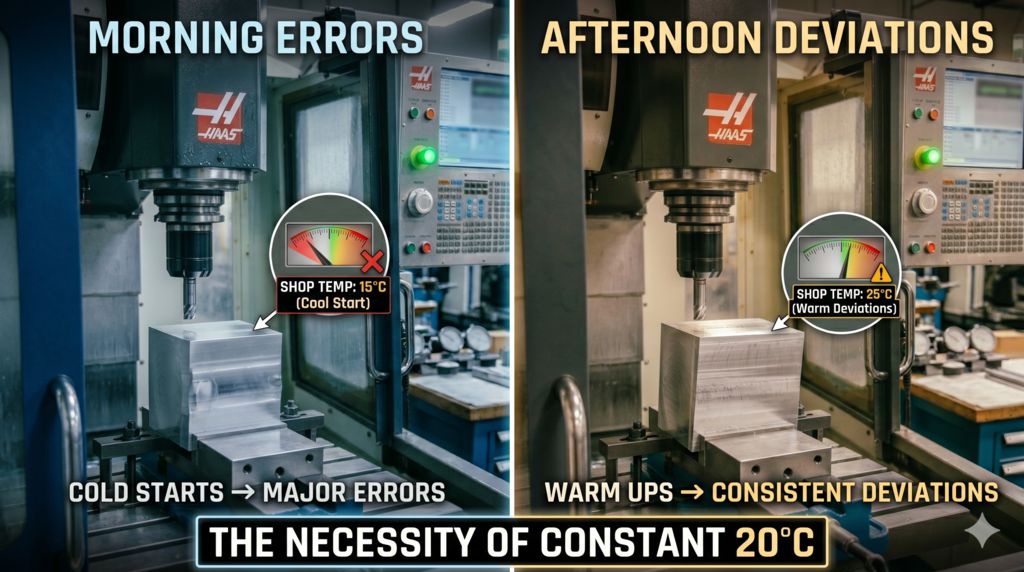
Machinists often joke about the “morning-afternoon gap,” where a part measured at 8:00 AM passes inspection with flying colors, but the same part measured at 3:00 PM is rejected. This isn’t human error or a faulty gauge; it is the fundamental physics of thermal expansion in action.
The International Standard: Why Exactly 20°C (68°F)?
To ensure that a “millimeter” in Tokyo is the exact same length as a “millimeter” in Berlin, the international community established ISO 1 in 1951. This standard designated 20°C (68°F) as the universal reference temperature for all dimensional measurements.
This number wasn’t chosen at random. It represents a comfortable working environment for human operators that is also technically and economically feasible to maintain. More importantly, it provides a universal baseline.
Every blueprint for a high-precision aerospace or medical component assumes the dimensions are valid at exactly 20°C. If your shop floor is sitting at 25°C, you are working in a distorted reality where every physical object has “grown” beyond its design intent.
The Coefficient of Thermal Expansion: Metal is a Moving Target
We tend to think of steel, aluminum, and carbide as rigid, unchanging materials. In reality, at the microscopic level, they behave like sponges that soak up heat and expand. This physical behavior is governed by the Coefficient of Thermal Expansion (CTE).
For example, a common grade of steel expands by roughly 11.5 micrometers per meter for every degree Celsius of temperature change. While 11.5 microns sounds negligible, consider a 500mm shaft.
If the temperature rises from a cool morning of 18°C to a warm afternoon of 26°C—an 8-degree swing—that shaft will grow by nearly 46 microns. In a world where tolerances are often ±5 microns, an 8-degree shift creates an error nearly nine times larger than the allowable limit. The part didn’t gain mass, but its geometry drifted right out of specification.
The Measurement Paradox: The Tool vs. The Workpiece
The problem becomes even more complex when the measuring tool and the workpiece are made of different materials. This is known as the “differential expansion” problem.
If you use a stainless steel gauge to measure an aluminum part, they will expand and contract at vastly different rates. Aluminum is nearly twice as sensitive to heat as steel.
In a non-climatized room, the measurement paradox occurs: your gauge is expanding, and your part is expanding, but they aren’t doing it in sync. This makes it mathematically impossible to “calculate away” the error reliably. Maintaining a constant 20°C removes these variables, ensuring that both the “ruler” and the “object” stay at their calibrated lengths.
Beyond Expansion: The Stability of the Machine Tool
It isn’t just the parts that suffer; the machines themselves are victims of temperature swings. A CNC machine’s bridge, spindle, and ball screws are all subject to thermal movement.
If a factory’s HVAC system fails, the machine’s “geometry” begins to warp. The X-axis and Y-axis might lose their perfect 90-degree squareness as the frame expands unevenly. The spindle might tilt by a few arc-seconds as one side of the machine column absorbs more ambient heat than the other.
When a facility maintains a strict 20°C environment, it isn’t just for the sake of the inspector—it’s to ensure the machine remains a stable, predictable platform. Constant temperature leads to repeatability, which is the heartbeat of modern mass production.
The Hidden Cost of Environmental Neglect
Many shop owners hesitate at the electricity bill required to keep a massive facility at a constant 20°C year-round. However, the “hidden costs” of a non-climatized shop are far higher:
Scrap Rates: Massive rejection rates during afternoon shifts or seasonal weather changes.
Inspection Disputes: Endless arguments between the production floor and the QC lab because their temperatures don’t match.
Machine Downtime: The constant need to recalibrate and adjust offsets to “chase” the temperature throughout the day.
A precision shop without climate control is like a professional runner trying to race in shifting sand. You can put in the effort, but the ground is always moving beneath you.
Conclusion: 20°C as a Competitive Advantage
In the modern manufacturing market, precision is the primary currency. Maintaining a constant 20°C is not a luxury; it is a fundamental technical necessity.
By stabilizing the environment, you eliminate the largest source of “unexplained” errors in the machining process. It ensures that the part you measure in the morning is the same part you measure in the afternoon, providing the reliability and trust that high-end clients demand. In the world of microns, temperature isn’t just weather—it is geometry.
In addition, please visit CNC Turning Parts, Stamping Parts, Technical Data and Quality Inspection to get more information about us, if you have any question, please e-mail to Harry Yen hyen@unisontek.com.tw
Please watch our company YouTube channel Link and introduction Link