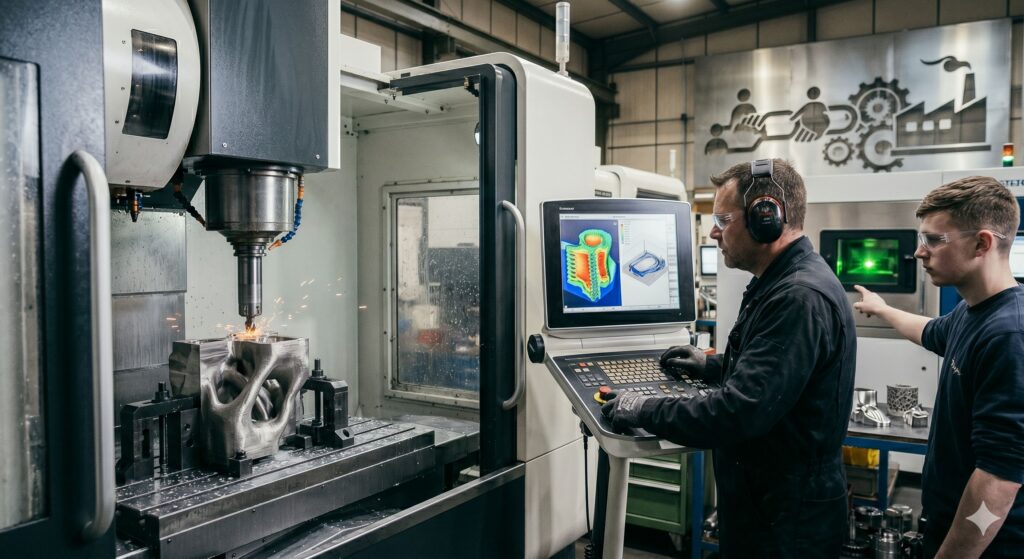
Demystifying Volumetric Error Calibration in 5-Axis CNC

You’ve just purchased a multi-million-dollar, state-of-the-art 5-axis CNC machining center. The foundation is poured to perfection, the climate control in the facility is dialed in, and the machine has been leveled by factory experts.

You load a massive block of aerospace-grade titanium, run a complex continuous 5-axis toolpath, and inspect the final part.

The features machined in the exact center of the table are flawless. But the features machined out near the far edges of the work envelope? They are out of tolerance.

How can a machine be perfectly accurate in the center, but lose its mind at the edges? You have just collided with the most complex geometric puzzle in modern manufacturing: Volumetric Error.

To fix this, the industry is moving away from the old methods of calibrating machines one axis at a time, and embracing a revolutionary software-driven approach known as Volumetric Error Calibration and Dynamic Decoupling.

The 43 Ghosts in the Machine: What is Volumetric Error?

We like to think of a CNC machine's axes as perfectly straight lines and perfect circles. In reality, heavy iron castings bow, linear guideways have microscopic waves, and assembly tolerances stack up.

If you take a standard 3-axis machine (X, Y, Z), it doesn't just have three potential errors. Every single time an axis moves, it can deviate in six different ways:

  1. Positioning: Moving slightly too far or too short.

  2. Straightness (Horizontal): Drifting left or right.

  3. Straightness (Vertical): Bowing up or down.

  4. Pitch: Tilting forward or backward like a braking car.

  5. Yaw: Twisting side-to-side like a drifting car.

  6. Roll: Rotating along its own length like a barrel roll.

When you add up the 6 errors for X, Y, and Z, plus the 3 squareness errors between them, a "simple" 3-axis machine actually has 21 independent geometric errors.

When you upgrade to a full 5-axis machine, adding two heavy rotary tables or a tilting spindle head, that number explodes. A standard 5-axis machine has 43 or more distinct geometric errors.

Volumetric Error is the terrifying result of all these tiny imperfections stacking together. It is the physical difference between where the CNC controller thinks the very tip of the cutting tool is in 3D space, and where it actually is.


The Flaw of Traditional Calibration

Historically, when a machine was inaccurate, a metrology technician would bring in a laser interferometer. They would shoot the laser down the X-axis and correct the positioning. Then they would do the Y-axis. Then the Z-axis.

This 1D, single-axis approach is fundamentally flawed for modern 5-axis machining. Why? Because errors are coupled.

Imagine the X-axis guideway has a microscopic sag in the middle (a pitch error). If the Z-axis spindle is lowered all the way down, that slight pitch at the top of the machine gets magnified into a massive swing at the bottom of the tool tip. If you only calibrate the X-axis in a straight line, you completely ignore how its pitch destroys the accuracy of the Z-axis.

You cannot fix a 3D spatial problem with a 1D linear solution.


The Breakthrough: Dynamic Decoupling

To truly fix a machine, you have to map the entire 3D volume of the work envelope at once. But if the tool tip is off by 15 microns in the top right corner of the machine, how do you know who to blame? Is the X-axis sagging? Is the Y-axis twisting? Is the rotary table tilted?

This is where Dynamic Decoupling comes in.

Decoupling is essentially unbaking a cake. It uses incredibly advanced software algorithms to look at the total combined error at the tool tip and mathematically separate it back out into the individual 43 errors that caused it.

How the Magic Happens:

  1. Spatial Tracking: Instead of measuring straight lines, technicians place a device like a LaserTracer or an automated tracking interferometer on the machine table.

  2. The Random Dance: The CNC machine drives a reflective target in the spindle to hundreds of random, chaotic points throughout the entire 3D work envelope. The laser tracks it the entire time.

  3. The Decoupling Algorithm: The tracking software compares the programmed 3D coordinates against the actual physical coordinates measured by the laser. By analyzing how the errors change as the machine moves through space, the software "decouples" the data, isolating the exact pitch, yaw, roll, and squareness of every single axis.

  4. The 3D Compensation Matrix: Finally, the software generates a massive, three-dimensional compensation map. It injects this map directly into the CNC controller's brain.

From that moment on, as the machine moves through space, the controller is constantly running microscopic adjustments in the background.

If it knows the Y-axis naturally twists slightly at the far end of its travel, it automatically tells the X and Z axes to shift by a few microns to perfectly cancel out the twist.


The Real-World Impact on the Shop Floor

The shift from linear calibration to volumetric decoupling changes the economics of high-precision manufacturing.

FeatureTraditional Linear CalibrationVolumetric Error Calibration
Time Required3 to 5 days (tearing down the machine repeatedly).4 to 8 hours (fully automated laser tracking).
Accuracy ScopeOnly guarantees accuracy along the specific lines tested.Guarantees accuracy anywhere inside the entire 3D work volume.
Rotary IntegrationOften ignores how rotary axes interact with linear axes.Perfectly harmonizes rotary pivot points with linear movements.
Part QualityCenter of the table is good; edges are unpredictable."First part, good part" regardless of where the vise is bolted down.

Pro Tip: Volumetric compensation is incredibly powerful, but it cannot fix mechanical slop. If your machine has worn-out ball screws, ruined bearings, or physical looseness, the software matrix will fail. Volumetric calibration requires a mechanically sound machine to work its magic.

The Bottom Line

We are asking massive, heavy iron machines to maneuver cutting tools with the precision of a watchmaker.

By abandoning the old single-axis mindset and embracing the power of spatial decoupling, manufacturers can finally force the physical iron to match the perfection of the digital CAD model, unlocking the true potential of 5-axis machining.

Please visit AboutMachined Parts webpages

Understanding Asynchronous Runout and Air Bearing Stability in High-Speed Spindles

If you want to manufacture a modern smartphone lens, a massive telescope mirror, or a next-generation semiconductor wafer, traditional CNC machining simply isn't good enough.

You have left the world of "microns" and entered the unforgiving realm of "nanometers." At this microscopic scale, the beating heart of your machine tool—the high-speed spindle—must rotate with absolute, flawless perfection.

But perfection is physically impossible. Every spindle wobbles.

In ultra-precision manufacturing, the difference between a pristine, mirror-like optical finish and a scrapped part comes down to understanding the two distinct types of that wobble: Synchronous Runout and its chaotic, destructive sibling, Asynchronous Runout.

To conquer the latter, the industry has largely abandoned traditional mechanical bearings in favor of flying on a cushion of air.

Let's dive into the invisible physics of high-speed spindles and explore the delicate balancing act of Air Bearing Stability.

The Two Faces of Spindle Wobble

Runout is the term used to describe a spinning tool or shaft deviating from its true, perfect axis of rotation. Imagine a slightly bent drill bit wobbling as it spins—that is runout. But in high-speed precision spindles, this wobble is divided into two very different categories.

1. Synchronous Runout: The Predictable Wobble

Synchronous runout is tied perfectly to the rotation of the spindle. If the spindle shaft has a slight heavy spot, it will deflect in the exact same direction, at the exact same point in its 360-degree rotation, every single time.

Because it repeats flawlessly with every revolution, synchronous runout is actually quite manageable. A diamond turning lathe will simply cut a slightly different profile, but it will do so consistently. It affects the overall geometric accuracy of the part, but it usually leaves a smooth, predictable surface.

2. Asynchronous Runout: The Chaotic Flutter

This is the ultimate enemy of the ultra-precision machinist. Asynchronous runout happens at frequencies that do not match the spindle's rotation.

If your spindle is spinning at 60,000 RPM, the tool tip isn't just following a perfect circle; it is fluttering randomly in microscopic, unpredictable directions. Because this flutter doesn't repeat consistently, the cutting tool gouges the material at random intervals.

You cannot balance it out, and you cannot program your CNC software to compensate for it. Asynchronous runout directly destroys your surface finish, leaving behind a cloudy, microscopically jagged surface instead of a perfect optical mirror.


Why Traditional Ball Bearings Fail

In a standard CNC machine, the spindle shaft rolls on ceramic or steel ball bearings. No matter how perfectly a manufacturer polishes those little spheres, they are never perfectly round. They have nanometer-scale peaks and valleys.

As the spindle spins, the balls roll inside their cages at a different speed than the shaft itself. The microscopic imperfections on the balls, the bearing races, and the cages all interact randomly.

This mechanical "rumble" translates directly into severe asynchronous runout. For true optical finishes, mechanical contact is no longer acceptable.


Enter the Air Bearing: Floating on Nothing

To eliminate the rumble of physical bearings, ultra-precision machines utilize Aerostatic Air Bearings.

In an air bearing spindle, there are no balls, no rollers, and no physical contact whatsoever. The rotating spindle shaft is suspended entirely by a microscopic cushion of highly pressurized, deeply filtered air.

Because the shaft is literally floating, the friction is practically zero. More importantly, because there are no physical balls rolling around, the mechanical source of asynchronous runout is almost completely eliminated. An air bearing spindle spins with a liquid-like smoothness that mechanical bearings can only dream of.


The Hidden Trap: Air Bearing Instability

While air bearings solve the mechanical rumble, they introduce a terrifying new problem: fluid dynamics. Air is a compressible gas, meaning it acts like a giant, invisible spring. If you don't control that spring perfectly, the spindle becomes unstable.

When an air bearing loses its stability, it creates massive asynchronous runout, often ruining the part and potentially causing the spindle shaft to crash into the housing at 60,000 RPM. This instability usually manifests in two forms:

1. The Pneumatic Hammer Effect

Imagine blowing air into a paper bag. If you blow just right, the bag stays inflated. But if you restrict the exit and force too much air in, the bag starts to violently flutter and vibrate.

The same thing happens inside an air bearing. The pressurized air is fed into the microscopic gap between the shaft and the housing through tiny holes (restrictors). If the volume of the air pocket and the pressure drop across those restrictors aren't perfectly tuned, the air pressure inside the gap will begin to rapidly oscillate.

The spindle shaft will violently bounce up and down on its air cushion, acting like a pneumatic jackhammer.

2. Half-Speed Whirl

As the spindle shaft spins at incredibly high speeds, it drags the surrounding cushion of air along with it due to the air's natural viscosity. This creates a rotating wedge of high-pressure air that chases the shaft. Under certain high-speed conditions, this wedge of air actually overtakes the damping capability of the bearing, causing the entire shaft to orbit erratically around its center—usually at exactly half the speed of the spindle's rotation.


Mastering the Invisible Cushion

To achieve the ultimate goal—near-zero asynchronous runout—spindle engineers must master the chaotic physics of this air gap. They do this through obsessive design:

  • Micro-Porous Media: Instead of using a few drilled holes to inject the air, the highest-end air bearings use a porous carbon material (like a microscopic sponge). The air bleeds evenly through millions of tiny pores, completely eliminating the pressure pockets that cause the pneumatic hammer effect.

  • Extreme Machining Tolerances: The gap between the spinning shaft and the stationary housing in an air bearing is often less than 10 microns (a fraction of a human hair). Machining the spindle components to these tolerances ensures the air cushion is stiff and incredibly stable.

  • Active Damping: Some modern ultra-precision machines use active magnetic dampers alongside the air bearings to instantly sense and cancel out any fluid-induced whirl before it can translate to the cutting tool.

The Bottom Line

When you look at a perfectly manufactured optical lens or a flawless silicon wafer, you are looking at the triumph over chaotic vibration.

By abandoning the physical constraints of rolling metal and mastering the fluid dynamics of pressurized air, manufacturers have conquered asynchronous runout, allowing us to machine parts where the only limit is the size of an atom.

Please visit AboutMachined Parts webpages

How Minimum Chip Thickness and the "Plowing Effect" Destroy Tool Life

In the world of precision CNC machining, there is a common, almost intuitive belief: if you want a better surface finish and a longer-lasting tool, you should take a lighter cut and slow down your feed rate. It makes sense, right? Taking a microscopic "dusting" pass feels like it should be incredibly gentle on your expensive carbide end mills.

Unfortunately, at the microscopic level, physics stops playing by our intuitive rules.

When you reduce your depth of cut to the extreme, you cross an invisible threshold where your razor-sharp cutting tool stops acting like a knife and starts acting like a blunt snowplow.

This transition introduces two of the most destructive forces in modern manufacturing: the Minimum Chip Thickness barrier and the resulting Plowing Effect.

If you are struggling with unpredictable tool wear, sudden tool breakage, or work-hardened surfaces during finish passes, understanding these two concepts is the key to saving your tools and your parts.

The Myth of the Infinitely Sharp Tool

To understand why light cuts can be so destructive, we first need to look at the cutting tool itself.

When you hold a brand-new, premium carbide end mill, the cutting edge feels razor-sharp. However, if you place that exact same edge under a high-powered electron microscope, you will see that it is not a perfect, infinitely sharp point. It actually has a microscopic curve to it, known as the cutting edge radius.

Even the most precisely ground carbide tools have an edge radius of a few micrometers. This tiny curve is completely irrelevant when you are taking a heavy roughing cut. But what happens when your programmed depth of cut is actually smaller than the physical curve of the tool's edge?


The Threshold: Minimum Chip Thickness

This brings us to the concept of Minimum Chip Thickness.

The minimum chip thickness is the absolute smallest depth of cut your tool can take and still physically shear a piece of metal away. It is the dividing line between cutting and rubbing.

Because of the microscopic curve on the tool's edge, the tool cannot bite into the material if the cut is too shallow. Instead of the sharp face of the flute driving into the metal, the rounded bottom of the edge simply slides over the top of the workpiece.

Depending on the specific material you are cutting, the minimum chip thickness is usually a percentage of the tool's edge radius. If you program a feed rate or a radial step-over that drops below this critical threshold, you stop machining and immediately trigger the Plowing Effect.


The Plowing Effect: Slicing a Tomato with a Baseball Bat

Imagine trying to slice a ripe tomato, but instead of using a sharp chef's knife, you use a baseball bat. You can swing as hard as you want, but you aren't going to get clean slices. You are just going to smash, push, and tear the tomato.

This is exactly what the Plowing Effect does to metal. When your cut is below the minimum chip thickness, the tool engages in a chaotic, three-stage process:

  1. Elastic Rubbing: The rounded edge of the tool presses down onto the metal. The metal squishes downward (elastic deformation) and then bounces right back up after the tool passes. No chip is formed, but intense friction is generated.

  2. Plastic Plowing: As the tool pushes harder, it begins to permanently deform the metal. It plows the material forward and to the sides—much like a boat pushing water—creating microscopic, jagged burrs along the edge of the cut.

  3. Inefficient Shearing: Eventually, enough pressure builds up that a tiny, torn chip is finally violently ripped away, but at a massive energy cost.


The Death Spiral of Tool Life

So, why does the Plowing Effect absolutely destroy your cutting tools? It comes down to heat, friction, and material adhesion.


How to Defeat the Plowing Effect

You cannot change the laws of physics, but you can adjust your machining strategies to ensure you stay on the right side of the minimum chip thickness threshold.

  • Feed It Harder: The most effective fix is often the most counter-intuitive. If your tool is burning up on a finish pass, increase your feed per tooth (chipload). You must force the tool to bite deep enough to get past its own edge radius and start cleanly shearing a chip.

  • Invest in Sharper Tools: If you absolutely must take a microscopic cut (such as in micro-milling or optical lens manufacturing), standard carbide will not work. You need tools with a significantly smaller edge radius, such as highly polished, uncoated carbide, or Single-Crystal Diamond tools, which can be ground to unimaginably sharp points.

  • Climb Milling is King: In conventional milling, the cutter starts at zero thickness and gradually bites deeper, guaranteeing that every single flute will rub and plow before it finally cuts. Climb milling does the exact opposite; the flute enters the material at maximum thickness, instantly shearing a chip and completely bypassing the rubbing phase.

The Bottom Line

The next time you are setting up a delicate finish pass and you are tempted to drop your feed rate to a crawl to "protect" the tool, remember the Plowing Effect.

CNC machining relies on the efficient removal of heat through the chip. If your cut is too thin to form a proper chip, that heat goes straight into your tool, and your tool goes straight into the scrap bin.

Please visit AboutMachined Parts webpages

Conquering Stiction and Nonlinear Friction in CNC Feed Systems

Picture this scenario: You are machining a high-precision bearing bore on a high-end CNC milling machine.

Your CAM software generated a flawless circular toolpath, your cutting tool is perfectly sharp, and the machine sounds fantastic. You pull the finished part out, clean it off, and run your finger inside the bore.

Instead of a glass-smooth, perfect cylinder, you feel four microscopic bumps perfectly spaced at the 12, 3, 6, and 9 o'clock positions.

You check the code—it’s a perfect circle. You check the tool—it’s running true. So, what is leaving those four little marks?

Welcome to one of the most stubborn physical challenges in precision manufacturing: Quadrant Protrusion (often called the Quadrant Glitch or Reversal Spike), caused by the chaotic reality of Nonlinear Friction in machine feed systems.

Conquering Stiction and Nonlinear Friction in CNC Feed Systems

The Anatomy of a Circle and the "Zero-Velocity" Trap

To understand why these bumps happen, we have to look at how a CNC machine actually draws a circle. A standard milling machine does not have a dedicated "circle-making" axis. Instead, it creates a curve by coordinating the movement of two linear axes—the X-axis and the Y-axis—at the exact same time.

As the cutter travels around a circular path, the axes are constantly changing speeds.

  • At the very top of the circle (12 o'clock), the X-axis is moving at its maximum speed, but the Y-axis has to come to a complete, dead stop before immediately reversing direction to head back down.

  • At 3 o'clock, the Y-axis is moving at maximum speed, and the X-axis must stop and reverse.

These points of reversal—where an axis crosses from one quadrant of the coordinate system into the next and momentarily hits zero velocity—are the danger zones. And the invisible enemy waiting at these exact locations is friction.


The Real Enemy: Stick-Slip and Stiction

If you have ever tried to push a heavy, loaded cardboard box across a concrete floor, you already intuitively understand the physics of the Quadrant Glitch.

When you first lean into the box, it refuses to budge. You have to push harder and harder until suddenly it breaks free and slides forward. Once the box is moving, it takes significantly less effort to keep it sliding.

This happens because friction is not a constant force. It changes depending on movement:

  • Static Friction (Stiction): The massive gripping force between two surfaces when they are completely at rest.

  • Dynamic Friction: The much lower, smoother resistance you feel once the surfaces are already sliding against each other.

Inside your CNC machine, a massive cast-iron table is riding on linear guideways, driven by a steel ball screw. When the Y-axis comes to that dead stop at the 12 o'clock position, it enters the realm of static friction. The guideways and ball screw essentially "grab" the table.

When the servo motor tries to reverse direction, the table does not move immediately. The motor has to build up a surge of torque to overcome the stiction. When the stiction finally breaks, the table violently snaps forward. This microscopic "jump" pushes the cutting tool slightly too far into the metal, leaving a tiny, highly visible bump on your workpiece.


Backlash vs. Friction: Knowing the Difference

Many machinists misdiagnose quadrant marks as "backlash" and try to fix it by simply typing a mechanical backlash compensation number into the CNC controller. This rarely solves the problem, and can sometimes make it worse. Here is why they are different:

The IssueThe Root CauseThe Physical ResultThe Standard Fix
Mechanical BacklashPhysical wear or clearance ("slop") between the ball screw threads and the ball nut.A flat spot or a delay when the axis reverses direction.Static backlash compensation (the software adds distance to the move).
Nonlinear FrictionThe harsh transition from static friction to dynamic friction at zero velocity.A physical spike or "protrusion" sticking out into the circular cut.Dynamic Friction Compensation (injecting a precise torque spike).

You can have a brand-new, perfectly pre-loaded, zero-backlash ball screw and still suffer from severe quadrant protrusion simply because of the "stick-slip" friction in the heavy iron components.


The Software Savior: Nonlinear Friction Compensation

Because the "stick-slip" phenomenon is a physical reality of heavy machinery rubbing against itself, we cannot completely eliminate it mechanically. Instead, modern CNC manufacturers fight physics with software.

This advanced technology is generally known as Nonlinear Friction Compensation (or Quadrant Error Compensation). Here is how modern machine controllers outsmart stiction:

1. Predicting the Stop

The CNC controller’s "look-ahead" capability analyzes the toolpath and knows exactly when and where an axis is going to hit zero velocity. It does not wait to react to the error; it anticipates it.

2. The Torque Injection

A fraction of a millisecond before the axis tries to reverse direction, the controller commands the servo amplifier to send a massive, precisely calculated micro-spike of electrical current to the servo motor.

3. Punching Through the Stiction

This instantaneous surge of torque acts like a heavy hammer blow. It violently shatters the grip of the static friction just as the axis is trying to move. Because the motor already has the extra power it needs to overcome the stiction, the axis does not "jump" or snap. It seamlessly transitions from stopping to reversing with glass-like smoothness.

4. Fading Out

The millisecond the axis is moving again, the controller instantly drops the torque back down to normal levels to handle the much lighter dynamic friction, preventing the machine from overshooting the target.


The Bottom Line

Quadrant protrusion is a harsh reminder that CNC machines are not just perfect digital computers; they are massive analog beasts bound by the laws of mechanical physics.

By understanding the chaotic nature of nonlinear friction, machinists can leverage advanced control software to bridge the gap between heavy iron and absolute microscopic perfection.

Please visit AboutMachined Parts

Overcoming Process-Induced Vibration and Spindle Resonance in High-Speed Cutting (HSC)

Walk into any modern advanced manufacturing facility, and you will hear a distinct sound. It is the high-pitched, jet-engine whine of High-Speed Cutting (HSC).

Running spindles at 20,000, 30,000, or even 40,000 RPM, HSC allows machine shops to hog out aluminum in seconds and slice through hardened tool steels with incredible efficiency.

But sometimes, that smooth whine turns into a terrifying, ear-piercing scream. The machine shakes, the cutting tool shatters, and the surface of your expensive aerospace part looks like a rippled potato chip.

This is the dark side of high-speed machining. You have just encountered Process-Induced Vibration (commonly known as chatter), and if you don't suppress it, it will destroy your spindle.

Let's dive into the physics of why high-speed cutting creates such violent harmonics and, more importantly, how modern technology suppresses these forced vibrations to keep the spindle safe.

Overcoming Process-Induced Vibration and Spindle Resonance in High-Speed Cutting (HSC)

The Anatomy of the Scream: What is Process-Induced Vibration?

When a cutting tool shears metal, it does not do so smoothly. Every time a flute on an end mill strikes the material, it creates a microscopic impact. These impacts happen thousands of times per second, generating massive cutting forces that push back against the tool.

Because the tool and the machine spindle are made of physical matter, they are not infinitely rigid. When that cutting force hits, the tool deflects slightly. As the flute exits the cut, the tool snaps back. This creates a natural vibration.

Under normal conditions, this vibration is tiny and harmless. However, process-induced vibration turns deadly when it becomes regenerative.

Imagine pushing a child on a swing. If you push them at the exact right moment in their natural arc, they go higher and higher. The same thing happens in a CNC machine:

  1. The first flute cuts a microscopic wavy pattern into the metal due to slight deflection.

  2. The second flute comes around. If the RPM and the natural frequency of the tool align perfectly, the second flute will hit the "peak" of the wave left by the first flute.

  3. This causes a bigger deflection, leaving a deeper wave for the third flute.

  4. Within milliseconds, the vibration amplifies exponentially. The tool begins violently bouncing off the workpiece rather than cutting it.

The Victim: Why Forced Vibration Destroys Spindles

While broken end mills are annoying, the real casualty of process-induced vibration is the machine's spindle.

The spindle is the beating heart of a CNC machine, relying on ultra-precise ceramic bearings to rotate at massive speeds with zero runout. When severe regenerative chatter occurs, the vibration travels directly up the tool holder and into the spindle shaft.

This creates Forced Vibration. The spindle bearings are suddenly subjected to thousands of pounds of lateral force, hammering them back and forth at incredibly high frequencies. Over time, this causes:

  • Brinelling: Microscopic dents in the bearing races.

  • Overheating: Increased friction as the bearings fight the chaotic movement.

  • Catastrophic Failure: A ruined spindle cartridge that costs tens of thousands of dollars and weeks of machine downtime to replace.


Taming the Beast: Strategies for Spindle Forced Vibration Suppression

To safely utilize High-Speed Cutting, manufacturers must break the cycle of resonance. Here are the primary strategies engineers use to suppress forced vibrations and protect the spindle.

1. Variable Geometry Tooling (Breaking the Rhythm)

The simplest and most effective way to stop regenerative chatter is to prevent the rhythmic pushing of the "swing." Tool manufacturers do this by altering the geometry of the end mill itself.

  • Variable Pitch: The flutes are not spaced evenly (e.g., instead of exactly 90 degrees apart on a 4-flute tool, they might be spaced at 88, 92, 89, and 91 degrees).

  • Variable Helix: The twist angle of the flutes changes along the length of the tool.

Because the flutes hit the material at irregular intervals, they never strike the "waves" left by the previous flute in a rhythmic pattern. The vibration is constantly disrupted before it can build up enough energy to threaten the spindle.

2. Spindle Speed Variation (SSV)

If you can't change the tool, you can change the machine's behavior. Spindle Speed Variation (SSV) is a software feature inside the CNC controller.

Instead of locking the spindle at exactly 15,000 RPM, SSV tells the spindle to constantly oscillate. It might smoothly ramp up to 15,500 RPM, then drop down to 14,500 RPM, and back up again every few seconds.

By constantly moving the frequency target, the machine prevents the cutting harmonics from ever locking into a destructive resonance loop.

3. Finding the "Sweet Spot" (Stability Lobes)

Counter-intuitively, slowing the machine down is not always the answer to vibration. In High-Speed Cutting, there are specific "sweet spots" where the frequency of the tool impacts actually perfectly cancels out the vibration of the machine.

Engineers map out the dynamic stiffness of the spindle using acoustic sensors and a tap-test hammer. This creates a "Stability Lobe Diagram"—a visual map showing pockets of high RPM where the spindle is perfectly stable.

Often, increasing the spindle speed from 12,000 RPM to an optimized 16,000 RPM will instantly cause a screaming machine to fall dead silent.

4. Active Spindle Damping Systems

For the absolute pinnacle of high-speed machining, we enter the realm of active suppression. Modern "smart" spindles feature built-in accelerometers that monitor vibration in real-time.

When the sensors detect the early frequencies of forced vibration building up, the CNC controller activates piezoelectric actuators wrapped around the spindle bearings.

These actuators instantly push back against the spindle shaft with the exact opposite force of the vibration, canceling out the chatter before the operator even hears it.


The Verdict

High-Speed Cutting is a balancing act between incredible productivity and catastrophic mechanical failure.

By understanding the chaotic nature of process-induced vibration and utilizing advanced suppression techniques—from clever tool geometries to active piezoelectric damping—manufacturers can safely push their spindles to the absolute limit, achieving mirror-like surface finishes in record time.

Please visit ContactMachined Parts web page

Conquering Stiction and Nonlinear Friction in CNC Ball Screws

Picture this: You are machining a high-precision bearing bore on a high-end CNC milling machine. The cutting tool completes a perfectly programmed circular interpolation. You pull the part out, clean it off, and run your finger inside the bore.

Instead of a flawless, glass-smooth cylinder, you feel four microscopic bumps perfectly spaced at the 12, 3, 6, and 9 o'clock positions.

You check your CAM software; the code is a perfect circle. You check your cutting tool; it’s sharp and running true. So, what on earth is leaving those four little marks?

Welcome to one of the most stubborn physical challenges in precision manufacturing: Quadrant Protrusion (often called the Quadrant Glitch) caused by the chaotic reality of Nonlinear Friction in ball screw feed systems.

The Anatomy of a Circle

To understand why these bumps happen, we have to look at how a CNC machine actually draws a circle. A standard milling machine doesn't have a dedicated "circle-making" axis. Instead, it creates a circle by coordinating the movement of two linear axes—the X-axis and the Y-axis—at the exact same time.

As the cutter travels around a circular path, the axes are constantly changing speeds.

  • At the very top of the circle (12 o'clock), the X-axis is moving at its maximum speed, but the Y-axis has to come to a complete, dead stop before immediately reversing direction to head back down.

  • At 3 o'clock, the Y-axis is at maximum speed, and the X-axis must stop and reverse.

These points of reversal—where an axis crosses from one quadrant of the coordinate system into the next—are the danger zones. And the enemy waiting at these zero-velocity points is friction.


The Real Enemy: Stick-Slip and Stiction

If you have ever tried to push a heavy cardboard box across a concrete floor, you already understand the physics of the Quadrant Glitch.

When you first push the box, it refuses to budge. You have to push harder, harder, and harder until suddenly—pop—the box breaks free and slides forward. Once the box is moving, it takes significantly less effort to keep it sliding.

This happens because friction is not linear.

  • Static Friction (Stiction): The massive gripping force between two surfaces when they are completely at rest.

  • Kinematic (Dynamic) Friction: The much lower resistance you feel once the surfaces are already sliding against each other.

Inside your CNC machine, a massive cast-iron table is riding on linear guideways, driven by a steel ball screw. When an axis comes to that dead stop at the 12 o'clock position, it enters the realm of static friction. The guideways essentially "grab" the table.

When the servo motor tries to reverse direction, the table doesn't move immediately. The motor has to build up a massive surge of torque to overcome the stiction. When the stiction finally breaks, the table violently snaps forward. This microscopic "jump" pushes the cutting tool slightly too far into the metal, leaving a tiny bump on your workpiece.


Backlash vs. Friction: Knowing the Difference

Many machinists misdiagnose quadrant marks as "backlash" and try to fix it by simply typing a mechanical backlash compensation number into the CNC controller. This rarely works. Here is why:

The IssueThe CauseThe ResultThe Fix
Mechanical BacklashPhysical wear or clearance between the ball screw and the ball nut.A flat spot or a delay when reversing direction.Static backlash compensation (adding distance to the move).
Nonlinear FrictionThe transition from static friction to dynamic friction at zero velocity.A physical spike or "protrusion" sticking out of the circular cut.Dynamic Friction Compensation (injecting a precise torque spike).

You can have a brand new, zero-backlash ball screw and still suffer from severe quadrant protrusion simply because of the friction in the guideways and the stick-slip nature of the heavy iron components.


The Software Savior: Dynamic Friction Compensation

Because the "stick-slip" phenomenon is a physical reality of heavy machinery, we cannot completely eliminate it mechanically. Instead, modern CNC manufacturers fight physics with software.

This technology is generally known as Nonlinear Friction Compensation or Quadrant Error Compensation. Here is how modern machine controllers outsmart stiction:

1. Predicting the Stop

The CNC controller’s "look-ahead" capability analyzes the G-code and knows exactly when and where an axis is going to hit zero velocity. It doesn't wait to react to the error; it anticipates it.

2. The Torque Injection

A fraction of a millisecond before the axis tries to reverse direction, the controller commands the servo amplifier to send a massive, precisely calculated micro-spike of electrical current to the servo motor.

3. Punching Through the Stiction

This instantaneous surge of torque acts like a heavy hammer blow. It violently shatters the grip of the static friction just as the axis is trying to move. Because the motor already has the extra power it needs to overcome the stiction, the axis doesn't "jump" or snap. It seamlessly transitions from stopping to reversing with glass-like smoothness.

4. Fading Out

The millisecond the axis is moving again, the controller instantly drops the torque back down to normal levels to handle the much lighter dynamic friction.


The Tuning Process

This compensation isn't magic; it requires meticulous tuning. If the machine technician injects too much torque, the machine will overshoot the reversal and dig a divot into the part. If they inject too little, the bump remains.

To tune this, metrology experts use a device called a Ballbar System. They magnetically attach a highly sensitive telescoping sensor between the machine spindle and the table, and then command the machine to draw circles at various speeds. The Ballbar software records the exact microscopic deviations at the quadrant reversals, allowing the technician to perfectly dial in the servo torque parameters until the circle is mathematically flawless.

The Bottom Line

Quadrant protrusion is a harsh reminder that CNC machines are not just digital computers; they are massive analog beasts bound by the laws of mechanical physics.

By understanding the chaotic nature of nonlinear friction, machinists can leverage advanced control software to bridge the gap between heavy iron and absolute microscopic perfection.

Please visit ContactMachined Parts

Mastering Dynamic Kinematic Error Optimization in 5-Axis CNC

You have invested in a state-of-the-art 5-axis CNC machining center. The linear rails are perfectly straight, the spindle is laser-aligned, and your CAM software has generated a flawless, continuous multi-axis toolpath. You hit cycle start, watch the trunnion table perform a beautiful mechanical ballet, and wait for a perfect aerospace component to emerge.

But when you pull the part out and put it on the Coordinate Measuring Machine (CMM), the blended surfaces have visible steps, and the true-position tolerances are completely blown.

What happened? You are dealing with the most elusive and frustrating challenge in multi-axis manufacturing: Rotary Kinematic Error.

When you add rotary axes to a machine, you aren't just adding new directions to move; you are adding an exponential layer of geometric chaos. Let’s explore what these errors are, why they ruin parts, and how modern Dynamic Kinematic Optimization allows the machine to cure its own inaccuracies.

The Illusion of the Perfect Pivot

In a standard 3-axis machine (X, Y, Z), the geometry is relatively straightforward. The axes move in straight lines at perfect right angles to each other.

But 5-axis machines introduce rotary axes (like a tilting B-axis spindle or a rotating C-axis platter). For the CNC controller to accurately calculate where the tip of your cutting tool is in 3D space, it relies on a digital map of the machine's physical pivot points. The controller assumes that the physical center of rotation for that heavy iron trunnion table is exactly where the digital map says it is.

In reality, the physical pivot point and the digital pivot point almost never perfectly align. This mismatch is the Kinematic Error.

These errors are caused by several real-world factors:

  • Assembly Tolerances: Even the best machine builders cannot perfectly align massive iron castings down to the sub-micron level.

  • Minor Collisions: A tiny bump with a tool holder might not break anything, but it can shift the rotary centerline by a hair.

  • Foundation Settling: The concrete floor under the machine shifts microscopically over time, tweaking the machine geometry.

  • Thermal Growth: As the machine heats up throughout the day, the metal expands, physically pushing the center of rotation away from its cold starting point.


The Amplification Effect: Why Tiny Errors Cause Massive Damage

You might think that a microscopic misalignment of a rotary axis isn't a big deal. However, rotary errors are deceptive because they compound over distance.

Imagine holding a laser pointer. If you twitch your wrist by just a fraction of a degree, the laser dot on the wall thirty feet away will jump by several feet.

The same principle applies inside your CNC machine. If the center of your tilting A-axis is off by just a few microns, or if the axis is tilted by a fraction of a degree, that error is magnified by the distance from the pivot point to the cutting tool. By the time the trunnion tilts 90 degrees to machine the side of your part, a completely invisible error at the base of the trunnion has transformed into a massive gouge on your workpiece.

Pro Tip: In continuous 5-axis machining, where multiple axes are moving simultaneously to follow a complex curved surface, kinematic errors will manifest as ugly "facets" or stepping marks precisely where the rotary axes change direction.


The Old Way vs. The Smart Way

Historically, correcting these errors was a dark art. A highly skilled technician would spend hours or even days inside the machine enclosure with dial indicators, perfectly ground test bars, and granite squares. They would manually sweep the rotary platters, calculate the offsets, and manually type the new pivot center numbers into the CNC parameters.

It was tedious, required immense skill, and worst of all, it was a static fix. The moment the machine heated up or the seasons changed, the manual calibration was useless.

Enter Dynamic Kinematic Optimization.


How Dynamic Optimization Actually Works

Today, machine tool builders and control manufacturers have automated this entire process, turning a multi-day headache into a ten-minute automated cycle that the operator can run every morning.

Here is how the machine dynamically calibrates itself:

  1. The Artifact: The operator magnetically mounts a perfectly round, ultra-precise "Kinematic Sphere" (a calibration ball) to the machine table.

  2. The Probe: A high-precision touch probe is loaded into the machine spindle.

  3. The Automated Dance: The CNC controller takes over. It tilts and rotates the machine table to dozens of different, extreme angles. At every single angle, the spindle probe reaches out and touches the calibration sphere.

  4. The Calculation: Because the controller knows the sphere is perfectly round and stationary relative to the platter, it expects to find the sphere in the exact same mathematical location regardless of how the table is tilted. When the probe finds the sphere sitting slightly off-center at a 45-degree tilt, the controller instantly knows the physical pivot point is wrong.

  5. The Real-Time Fix: The CNC's internal brain crunches the data from all the probe hits to map out the exact centerlines, tilt errors, and squareness of the rotary axes. It then automatically overwrites its own digital kinematic map to perfectly match the physical reality of the machine.


The True ROI of Kinematic Optimization

Investing in automated kinematic calibration software and hardware transforms a shop's capabilities.

BenefitThe Impact on the Shop Floor
Seamless Surface BlendsEliminates the mismatch lines when machining from different sides of the part, slashing manual polishing time.
Combating Thermal DriftOperators can run a quick 5-minute calibration cycle after the machine warms up, completely neutralizing thermal expansion errors.
Scrap ReductionGuarantees that the first part off the machine is structurally accurate, which is critical when cutting exotic, high-dollar aerospace alloys.
Operator EmpowermentRemoves the need for an expensive, outside metrology expert to realign the machine after a minor tool crash.

When you are chasing single-digit micron tolerances on parts that will fly in space or be implanted into the human body, guessing where your rotary axes are is not an option.

Dynamic Kinematic Error Optimization ensures that your machine’s digital brain and its physical iron are working in perfect, flawless harmony.

Please visit AboutMachined Parts web page

The Art of "Residual Stress Balancing" in Extreme Thin-Walled Machining

Imagine being handed a 100-pound solid block of aerospace-grade aluminum and being told to machine it down until it weighs just 5 pounds. The final part will be a complex web of deep pockets, flying buttresses, and walls as thin as a credit card.

In the aerospace and high-performance automotive industries, this is a daily reality. These monolithic structural parts are designed to be incredibly strong yet impossibly light. But manufacturing them is an absolute nightmare.

When you remove 95% of a metal block's mass, you are removing its structural rigidity. The part becomes a delicate, vibrating tuning fork.

Worst of all, it becomes the ultimate victim of Residual Stress. If you approach a thin-walled part with traditional machining strategies, it will twist, bow, and warp the moment you unclamp it.

To survive this, modern machinists don't just cut metal; they practice a delicate mechanical martial art known as Residual Stress Balancing.

The Anatomy of the Warp

We’ve discussed residual stress before—those invisible, locked-in forces created when the raw metal was originally forged, rolled, or heat-treated.

In a thick, chunky part, the sheer mass of the remaining metal is usually strong enough to overpower these internal stresses and keep the part relatively straight. But in a thin-walled component, you are carving away the "muscle" that holds the part flat.

Think of a piece of raw metal like a perfectly balanced tug-of-war. The outer skin is pulling outward (tension), and the deep core is pushing inward (compression). They are locked in a stalemate. When your end mill strips away the tensile skin on the left side of a thin wall, you destroy the stalemate. The right side is still pulling, but the left side is gone. The wall immediately bows in the direction of the remaining stress.

If you can't magically erase all the stress from the raw material, what do you do? You balance it.


The Strategy of Symmetry: How to Balance the Invisible

The core philosophy of residual stress balancing is simple in theory but incredibly complex in execution: If the left side of the wall pulls with 10 units of force, you must ensure the right side of the wall pulls with exactly 10 units of force. Here are the specific, high-level machining strategies used to achieve this perfect equilibrium.

1. The "Flip and Skim" (Alternating Material Removal)

The worst thing you can do to a thin-walled part is to completely finish one side, flip it over, and then machine the other side. By the time you flip it, the part has already warped so severely that your CNC machine will be cutting a curved surface without knowing it.

Instead, programmers use a highly iterative approach:

  • Rough out 40% of the material on Side A.

  • Flip the part and rough out 40% on Side B.

  • Flip it back to Side A and take a semi-finish pass.

  • Flip to Side B for a semi-finish pass.

By removing the stressed layers symmetrically and gradually, the part never experiences a massive imbalance. It stays centered as the stress is slowly bled out of the material.

2. Waterline Milling (The Step-Down Method)

When machining a tall, extremely thin rib (like a heat sink fin or an aircraft bulkhead), you cannot machine one side of the rib all the way down to the floor, and then cut the other side. The thin wall will simply bend away from the cutter, leaving the top of the wall much thicker than the bottom.

To balance the cutting forces and the stress, engineers use alternating waterline toolpaths. The tool traces the left side of the wall down a few millimeters, then hops over the wall and traces the right side down a few millimeters.

It zig-zags back and forth, stepping down gradually. The thick, unmachined metal at the bottom of the rib provides rigid support for the delicate, thin wall being created at the top.

3. Managing the Machining-Induced Stress

It’s not just the raw material that has stress; your cutting tool actually injects new stress into the part. A dull tool plows into the metal, intensely compressing the top atomic layers and generating massive heat. On a wall that is only 1mm thick, this newly injected stress is enough to warp the part permanently.

To combat this, the balancing strategy dictates:

  • Hyper-Sharp Tools: Using polished, high-positive rake angle cutters (like single-crystal diamond or highly polished carbide) to slice cleanly rather than plow.

  • Climb Milling Only: Conventional milling rubs the material before it cuts, creating heat and stress. Climb milling slices instantly, directing the heat into the chip rather than the thin wall.

  • Symmetrical Feed Rates: Ensuring that the cutting speeds, feeds, and chip loads are perfectly identical on both sides of the wall, so the machining-induced stress is perfectly mirrored.


The Final Act: Adaptive Workholding

Even with perfect toolpaths, a thin-walled part will still undergo micro-warping during the roughing phase. This is where your clamping strategy becomes the final line of defense.

If a part has warped slightly after roughing, and you clamp it down hard in a steel vise for the finishing pass, you are forcing the bent part perfectly flat. The machine will cut a beautiful, perfectly flat surface. But the second you release the vise, the part will spring right back to its bent shape, ruining your tolerances.

The Golden Rule of Thin-Walls: Never clamp a warped part flat.

Modern fixtures use "adaptive clamping" for the final finish pass. This might involve using low-tension vacuum chucks, custom-poured polyurethane potting compounds that encase the part without squeezing it, or hydraulic clamps that gently lock into place precisely where the warped part is resting in free space.

The machine cuts the part in its natural, relaxed state, ensuring that when it comes off the machine, it stays exactly as it was cut.


The Mindset Shift

Machining extreme thin-walled structures requires a complete shift in a manufacturer's mindset. You can no longer think of machining as simply "removing what you don't want."

You have to think of it as carefully carving away layers of tension, constantly anticipating how the material will react, breathe, and move. By mastering residual stress balancing, engineers turn an unpredictable nightmare into a repeatable, high-precision science.

 Please visit Machined PartsAbout

The Rise of Minimum Energy Toolpaths and Dynamic CAD/CAM Coupling

For decades, the primary goal of a CNC programmer was simple: make the part to print, and make it as fast as possible. CAM (Computer-Aided Manufacturing) software was essentially a geometry engine. You gave it a 3D model, and it calculated the shortest physical route for the cutting tool to carve away the excess metal.

But as energy costs soar and the push for sustainable, "green" manufacturing intensifies, simply finding the shortest route is no longer enough.

The shortest geometric path is often the most violent, power-hungry path for the machine to execute.

Welcome to the cutting edge of manufacturing software: the marriage of Minimum Energy Cutting Paths and the Dynamic Coupling of CAD/CAM.

It’s a shift from asking "Where does the tool need to go?" to asking "How can the machine get there with the least physical resistance?"

The Problem with "Dumb" Geometry

To understand why we need a new approach, we have to look at the flaw in traditional CAM software. Historically, CAM systems were "kinematically blind."

When a traditional CAM system generates a toolpath, it assumes the CNC machine has infinite acceleration and zero mass. If a toolpath dictates a sharp 90-degree turn inside a pocket, the software simply draws a sharp corner.

However, in the real world, the machine table weighs thousands of pounds. To execute that sharp corner, the axis servo motors must violently brake to a dead stop, slam all that heavy iron into reverse, and accelerate in a new direction.

This geometric ignorance causes several massive problems:

  • Energy Spikes: Slamming heavy machine components to a halt and immediately accelerating them again draws massive spikes of electrical current from the factory grid.

  • Mechanical Wear: It destroys ball screws and prematurely wears out servo drives.

  • Jerk: The violent change in acceleration (mechanically known as "jerk") causes the entire machine frame to shudder, leaving terrible chatter marks on your part.


The Solution Part 1: Minimum Energy Cutting Paths

A Minimum Energy Cutting Path throws out the idea of the "shortest distance." Instead, it prioritizes momentum and constant engagement.

Rather than driving the tool in straight lines and sharp angles, these advanced toolpaths look more like fluid dynamics. They use sweeping arcs, morphing spirals, and trochoidal motion (circular, overlapping cuts).

Here is how these fluid paths slash energy consumption:

  • Sustaining Kinetic Energy: By keeping the machine axes moving in continuous, sweeping curves, the heavy machine table never has to come to a complete stop. You maintain the kinetic energy of the machine, requiring vastly less electricity from the servo motors.

  • Constant Chip Load: In traditional machining, the tool might barely touch the metal on a straightaway, but then suddenly plunge into a deep corner, burying the cutter. This causes the spindle motor to bog down and draw a massive surge of power to keep spinning. Minimum energy paths carefully manage the exact volume of metal the tool bites into at any given millisecond, ensuring the spindle motor experiences a perfectly flat, low-effort power draw.


The Solution Part 2: Dynamic Coupling in CAD/CAM

Generating a sweeping, curvy toolpath is great, but it’s still just geometry. The true revolution happens when we introduce Dynamic Coupling.

Dynamic coupling is when the CAM software is given a "Digital Twin" of the specific CNC machine's physical limits. The software is no longer just looking at the CAD model of the part; it is actively communicating with the physical realities of the machine tool.

Before generating a single line of G-code, a dynamically coupled CAM system knows:

  • The exact mass of the machine table and the workpiece.

  • The maximum torque output of the specific servo motors.

  • The physical acceleration and deceleration limits of the axes.

The "Look-Ahead" Ballet

Because the software understands physics, it can dynamically adjust the feed rate and the path shape to harmonize with the machine.

If the software sees a tight curve approaching, it doesn't wait until the last second to command a violent stop. Because it knows the weight of the table, it calculates exactly how far in advance it needs to gracefully decelerate to keep the servo motors within their optimal, low-energy efficiency range. It couples the geometry of the part with the physical dynamics of the machine.


The Real-World Benefits

When you combine Minimum Energy Paths with Dynamic Coupling, the results transform the economics of a machine shop.

BenefitHow it is Achieved
Drastic Power ReductionEliminating violent stops and spindle bogs smooths out the electrical draw, often reducing the energy consumed per part by 20% to 40%.
Extended Machine LifeBecause the servo motors are never pushed past their optimal torque curves, the mechanical components run cooler and last years longer.
Flawless Surface FinishesRemoving "jerk" and vibration from the toolpath means the cutter glides through the metal, leaving a mirror-like finish that rarely requires manual polishing.
Longer Tool SurvivalConstant, predictable cutting forces mean the delicate carbide edges of the tool don't chip from sudden shock loads.

The Future is Physics-Aware

We have officially moved past the era of simply telling a CNC machine where to go. The future of manufacturing belongs to systems that tell the machine how to move.

By bridging the gap between digital geometry and physical machine dynamics, we can machine tougher materials faster, cleaner, and with a drastically smaller carbon footprint.

Please visit our Machined PartsAbout for more information.

The Clash Between Minimum Chip Thickness and Material Grain Size

If you zoom in close enough, everything you thought you knew about manufacturing completely falls apart.

In traditional CNC machining, we treat a block of steel or aluminum like a solid, uniform piece of clay. You program the toolpath, the cutter spins, and the material shears away predictably.

But as the medical, aerospace, and electronics industries push us toward microscopic part dimensions, we are crashing headfirst into a bizarre physical barrier.

When your depth of cut shrinks to the size of a red blood cell, you are no longer cutting a uniform block of metal. You are navigating a microscopic obstacle course of individual metallic crystals.

Welcome to the frontier of micro-machining, where the interplay between Minimum Chip Thickness and Material Grain Size dictates the difference between a perfect microscopic component and total scrap.

The Clash Between Minimum Chip Thickness and Material Grain Size

The Unforgiving Tool Edge (Minimum Chip Thickness)

To understand this interaction, we first have to look at the cutting tool. No matter how perfectly you grind a micro-end mill, it is never infinitely sharp. Under a powerful microscope, the cutting edge is always slightly rounded.

When you try to take a cut that is thinner than this rounded edge, the tool refuses to bite. Instead of slicing, it acts like a blunt battering ram. It rubs, smears, and plows the metal downward until the pressure builds up enough to finally rip a chunk of material away.

The exact depth where the tool transitions from "uselessly rubbing" to "actually cutting" is called the Minimum Chip Thickness. In the micro-world, you must always program your feed rates to stay just above this critical thickness. But doing so introduces our second, much more chaotic variable: the structure of the metal itself.


The Hidden World Inside the Metal (Grain Size)

We think of metal as a solid continuum, but it is actually a patchwork quilt of microscopic crystals called grains. When molten metal cools and solidifies during the steelmaking process, millions of tiny crystals grow until they crash into one another. The borders where these crystals meet are called grain boundaries.

In normal, macro-scale machining, the cutting tool is massive. It plows through thousands of these grains at the exact same time. Because it is cutting so many grains at once, the physical resistance averages out. The machine feels a smooth, continuous load. Engineers call this "isotropic" (uniform) behavior.


The Clash: What Happens When the Cut is Smaller than the Grain?

Here is where the physics get wild. In micro-machining, your Minimum Chip Thickness—the depth you must maintain to actually cut the material—is often smaller than the size of a single metal grain.

You are no longer driving a massive plow through a field of dirt; you are driving a tiny chisel over a cobblestone street.

When the scale of the cut matches the scale of the material's grains, the metal becomes highly unpredictable. This creates a cascade of machining nightmares:

1. The "Speed Bump" Effect (Erratic Cutting Forces)

Every individual grain has a specific crystalline alignment. Cutting with the "grain" of the crystal is easy; cutting against it requires much more force. As the microscopic cutting edge travels through a single grain and slams into the grain boundary to enter the next one, the required cutting force spikes violently. These sudden spikes cause micro-vibrations (chatter) that can easily snap a fragile micro-tool.

2. The Tearing of the Surface

Because the depth of cut is so incredibly shallow, the tool is often just scraping the top of a grain. Instead of cleanly shearing, the tool might catch the edge of a crystal and literally tear the entire grain out of its socket. This leaves a microscopic crater on the surface of your supposedly "smooth" part.

3. Unpredictable Springback (Elastic Recovery)

Different grains will compress and bounce back differently after the blunt tool rubs over them. If you try to machine a perfectly flat micro-surface, some grains will spring back higher than others once the tool passes, leaving an uneven, bumpy finish that ruins tight-tolerance fits.


Bridging the Gap: How Engineers Fight Back

You cannot change the laws of physics, but you can outsmart them. When manufacturers need to create parts where the Minimum Chip Thickness inevitably clashes with the grain structure, they employ a few distinct strategies:

StrategyHow it Solves the Problem
Ultra-Fine Grain Materials (UFG)By using specialized metallurgy to create raw materials with exceptionally tiny grains (nano-crystalline metals), the tool once again cuts across multiple grains simultaneously, restoring a smooth cutting force.
Laser-Assisted MachiningShooting a microscopic laser directly ahead of the cutting tool softens the grain boundaries, making it easier for the blunt tool edge to slice through the crystals without tearing them out.
Optimized Tool GeometriesUsing single-crystal diamond tools, which can be ground to unimaginably sharp edge radii. A sharper edge drastically lowers the Minimum Chip Thickness, giving the programmer more room to maneuver around the grain sizes.

The Bottom Line

Micro-machining is not just "regular machining, but smaller." It is a fundamental shift in how matter behaves.

By respecting the chaotic relationship between the bluntness of the tool and the crystalline nature of the metal, modern machinists can successfully navigate this microscopic obstacle course to build the technologies of tomorrow.

Please visit our Machined PartsAbout for more information.