Understanding Residual Stress and Spontaneous Part Deformation

Every machinist and manufacturing engineer has experienced this exact, heart-sinking scenario: You’ve just spent hours machining a critical component. While it's clamped securely in the vise, you run your dial indicator across the surface.

It is perfectly flat. The dimensions are flawless. You unclamp the vise, proudly pull the part out, and set it on the granite surface plate.

You check it one last time, and suddenly, it’s warped like a banana.

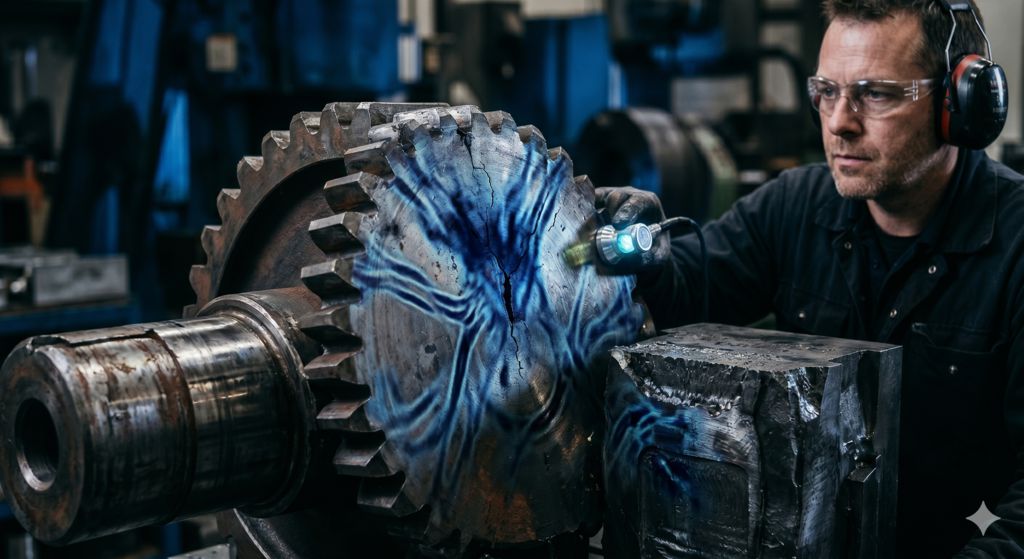
The part wasn't bent by the machine, and you didn't drop it. It deformed entirely on its own. This incredibly frustrating phenomenon is known as Spontaneous Deformation, and the invisible culprit behind it is Residual Stress.


What Exactly is Residual Stress?

To understand how a solid block of metal can bend itself, we have to look inside the material.

Residual stresses are internal tension and compression forces locked inside a material even when no external forces (like clamps or cutting tools) are acting upon it.

Think of a heavily compressed spring encased inside a solid block of ice. As long as the ice remains intact, the block just looks like a normal, peaceful piece of ice. The internal pushing force of the spring is perfectly balanced by the holding force of the ice. However, if you start chipping away at one side of the ice, the balance is destroyed. The spring will violently burst out, shattering or warping the remaining ice in the process.

This is exactly what happens in a piece of metal.


How Do These Stresses Get Locked Inside?

Metal doesn't naturally want to be stressed. These internal forces are the "scars" left behind by the material's manufacturing history. Almost every industrial process introduces some level of residual stress:

1. Thermal Gradients (Heat)

When metal is heated and cooled unevenly, it expands and contracts at different rates. In processes like welding, laser cutting, or aggressive high-speed machining, the localized surface gets incredibly hot and tries to expand, while the cold core of the metal resists. When the part eventually cools down, the surface is left in a state of severe tension.

2. Mechanical Deformation

Processes like cold rolling, forging, or bending physically crush and stretch the microscopic crystal lattice of the metal. Even the cutting action of a dull CNC end mill can plow into the surface, mechanically compressing the top layer of atoms and leaving a thin skin of high stress.

3. Phase Transformations

When certain metals (like carbon steel) are rapidly quenched, their microscopic internal structure literally changes shape. This new structure takes up a different amount of physical volume than the old structure. Because this change happens unevenly from the outside in, it locks massive physical stress inside the part.


The Unclamping Effect: Why Parts Suddenly Warp

So, why does the part wait until you take it out of the CNC machine to deform? It all comes down to equilibrium.

Before you start machining, a block of raw aluminum or steel is in a state of internal balance. The outer "skin" of the block might be pulling inward with incredible tensile force, while the deep core is pushing outward with equal compressive force.

When you clamp the part in a vise and machine away the top surface, you are literally cutting away that layer of tensile stress.

Suddenly, the compressive stress trapped in the core has nothing pushing back against it on that side. While the part is clamped, the massive steel vise forces it to stay flat. But the millisecond you loosen those jaws, the newly unbalanced internal forces take over. The material bends, twists, or bows as it physically moves to find a new state of balance.


How to Defeat the Invisible Enemy

Because we cannot completely stop residual stress from forming, manufacturing engineers use specific strategies to either eliminate the stress before machining or manage it during the cutting process.

StrategyHow It WorksBest Used For
Thermal Stress Relief (Annealing)The metal is heated to a specific temperature in a giant oven, held there so the atoms can relax and rearrange, and then cooled very slowly.Castings, heavy weldments, and severely cold-rolled materials before machining.
Vibratory Stress Relief (VSR)A motor is clamped to the part to vibrate it at its natural resonant frequency. The intense shaking gently redistributes and lowers the internal stress.Massive, heavy parts (like machine beds) that are too large to fit in a heat-treating oven.
The "Rough, Release, Finish" MethodYou machine away 90% of the material aggressively. Then, you unclamp the vise, allowing the part to warp. Finally, you re-clamp it very gently and take a tiny "finish pass" to skim the warped surface perfectly flat.Precision aerospace components, thin-walled aluminum parts, and tight-tolerance plates.

The Bottom Line

Residual stress is a harsh reminder that metal is not just a dead, static material; it is a dynamic structure holding a memory of everything that has been done to it.

By understanding the physics of spontaneous deformation, machinists can stop fighting the metal and start predicting its behavior, ensuring that a perfectly machined part stays perfect long after it leaves the shop floor.

Please visit our Machined PartsAbout for more information.

The Thermoelectric Effect and Real-Time Tool Life Prediction

In the high-stakes environment of precision CNC machining, nothing is more frustrating—or costly—than a cutting tool snapping mid-cycle. An unexpected tool failure doesn't just ruin an expensive carbide end mill; it can scrap a complex aerospace component, damage the machine spindle, and completely derail your production schedule.

For decades, machinists have relied on experience, listening to the "sound" of the cut, or relying on conservative time-based tool changes to prevent disaster. But what if the cutting tool itself could tell you exactly when it was about to die?

Welcome to the fascinating intersection of machining physics and materials science: The Thermoelectric Effect, and how it is revolutionizing real-time Tool Life Prediction without the need for complex mathematical modeling on the shop floor.

The Physics: Turning the Machine into a Giant Sensor

To understand how this works, we have to look at a fundamental principle of physics discovered in the 1820s known as the Seebeck Effect.

The concept is surprisingly straightforward: when you take two completely different conductive materials, join them together, and heat up that exact connection point while keeping the rest of the materials cool, they naturally generate a tiny electrical voltage.

In a CNC machine, you naturally have the perfect setup for this phenomenon to occur:

  1. Material A: The cutting tool (for example, Tungsten Carbide).

  2. Material B: The workpiece (such as Titanium or Steel).

  3. The Hot Junction: The exact microscopic point where the tool is violently shearing the metal. Temperatures here can easily exceed 1000°C.

  4. The Cold Junction: The rest of the massive machine structure, which remains at room temperature.

Because the tool and the workpiece are two different metals touching at a localized point of extreme heat, they generate a direct electrical signal. The beauty of this physical law is that the voltage generated rises in direct proportion to the temperature at the cutting edge. By simply wiring a highly sensitive voltmeter to the workpiece and the toolholder, we turn the entire cutting interface into a real-time, highly reactive thermometer.


Decoding the Signal: How Voltage Reveals Tool Wear

Why do we care about the exact temperature at the cutting edge? Because heat is the ultimate indicator of a dying tool.

As a tool wears down, its pristine geometry changes. The sharp edge becomes dull, the clearance angle diminishes, and the tool begins to physically plow and rub against the material rather than slicing cleanly through it. This intense rubbing drastically increases friction, which in turn causes a sharp, undeniable spike in temperature at the cutting zone.

Here is how we map that thermoelectric voltage directly to the lifespan of your tool:

  1. The Break-In Phase: When a brand-new tool enters the cut, the voltage quickly spikes and then settles into a steady baseline as the sharpest microscopic burrs on the fresh edge are smoothed out.

  2. The Steady-Wear Phase: As the tool undergoes normal, gradual wear (known as flank wear), the friction slowly increases. If you watch the monitor, you will see a steady, predictable climb in the thermoelectric voltage over time.

  3. The Critical Failure Phase: Right before a tool catastrophically fails or chips, the wear accelerates rapidly. The friction goes off the charts, causing a sudden, massive spike in the electrical signal.

By continuously monitoring this voltage, an automated machine controller can instantly stop the feed the millisecond that final voltage spike occurs—saving the part and the spindle before the tool shatters.


The Superior Sensor: Why Choose Thermoelectric?

You might be wondering: why not just use other modern sensors, like infrared cameras or force dynamometers, to monitor the tool's health?

While other Tool Condition Monitoring (TCM) systems exist, the thermoelectric approach (often called the Tool-Workpiece Thermocouple method) offers unparalleled, real-world advantages:

Sensor TypeThe DrawbacksThe Thermoelectric Advantage
Infrared (IR) CamerasThe cutting zone is usually buried under a flood of coolant and flying metal chips, completely blinding the camera.The signal travels internally through the metals themselves. Coolant and chips do not block the electrical voltage.
Dynamometers (Force)Incredibly expensive to install and often reduce the rigidity of the workholding setup.Practically free to implement. The tool is the sensor. No intrusive plates are needed under the vise.
Acoustic EmissionFactory floors are incredibly noisy. Filtering out the sound of the spindle and background vibrations is a software nightmare.The electrical signal is highly localized to the exact point of the cut, making it much cleaner and easier to isolate.

The Real-World Challenges

While the physics are elegant and the hardware is simple, translating this into a plug-and-play commercial system has proven challenging for a few key reasons:

  • Material Calibration: Because the voltage depends heavily on the specific metals touching, the system must be recalibrated every time you switch from cutting Aluminum to cutting Stainless Steel, or if you change the type of coating on your end mill.

  • Spinning Tools: Wiring a stationary lathe tool is easy. Extracting a micro-voltage signal from a milling cutter that is spinning at 15,000 RPM requires complex, low-noise slip rings or wireless telemetry systems built into the tool holder.

  • Electrical Noise: CNC machines are massive electrical beasts. Spindle motors and servo drives create heavy electromagnetic interference (EMI) that can easily drown out a tiny thermoelectric signal if the system isn't perfectly shielded.

The Future of Smart Manufacturing

As we push toward fully autonomous "lights-out" manufacturing, guessing when a tool will break is no longer acceptable. By harnessing the raw physics of the thermoelectric effect, we are giving CNC machines a nervous system. They can finally "feel" the heat of the cut, allowing them to autonomously swap out a dull tool before it ever causes a problem on the factory floor.

Please visit our Machined PartsAbout for more information.

Understanding the Size Effect and the Physics of Micro-Cutting

The manufacturing world is obsessed with getting smaller. From micro-fluidic channels used in biomedical testing to the microscopic gears inside a high-end mechanical watch, the demand for ultra-precision micro-components is skyrocketing.

It is tempting to think that micro-machining is simply traditional CNC machining scaled down. Just use a smaller end mill, spin the spindle faster, and reduce the feed rate, right?

Unfortunately, physics doesn't scale linearly. As we shrink our depth of cut to the micrometer level, the fundamental mechanics of how metal is removed completely change. Welcome to the strange and unforgiving world of Micro-cutting Physics, where a phenomenon known as the Size Effect dictates everything.


What is the Size Effect in Machining?

In conventional, macro-scale machining, the energy required to remove a specific volume of material (known as Specific Cutting Energy) remains relatively constant, regardless of how deep you cut.

However, in micro-machining, as the depth of cut (specifically, the uncut chip thickness) decreases to the scale of micrometers, the specific cutting energy suddenly and exponentially skyrockets. This non-linear increase in energy required to shear away material at microscopic scales is known as the Size Effect.

The Culprit: The Cutting Edge Radius

Why does the tool start plowing? It all comes down to the sharpness of the tool.

In traditional machining, an end mill taking a 2 mm deep cut is considered mathematically "sharp." Even if the microscopic edge of the tool is slightly rounded, that radius is negligible compared to the massive depth of cut.

In micro-cutting, however, the depth of cut might be 5 micrometers, and the sharpest diamond or carbide tool we can manufacture might have an edge radius of 2 to 3 micrometers. Suddenly, the tool is no longer a sharp knife; it is a blunt, rounded battering ram.

The Minimum Chip Thickness Phenomenon

Because the edge is rounded relative to the cut, we encounter the Minimum Chip Thickness. This is the absolute critical depth at which the tool will actually bite into the material and form a chip.

Depending on the relationship between the uncut chip thickness and the minimum chip thickness, micro-cutting falls into one of three distinct regimes:

  1. Elastic Rubbing: The tool is taking such a shallow pass that it doesn't break the surface. It simply slides over the metal, causing elastic deformation. The material squishes down and bounces right back up after the tool passes. No chip is formed, but immense friction and heat are generated.

  2. Plowing: The tool begins to indent the material. It plasticly deforms the metal, plowing it to the sides (creating heavy burrs) and pushing it downward, but it still struggles to shear a clean chip. The specific cutting energy peaks here.

  3. Shear Cutting: Finally, the depth of cut overcomes the bluntness of the edge radius. The material shears, a chip flows up the face of the tool, and traditional machining mechanics resume.

Pro Tip: As a general rule of thumb in micro-physics, the minimum chip thickness is typically between 20% and 40% of the tool's edge radius, depending on the material's yield strength and the friction at the tool interface.


The Microstructure Reality: Cutting Individual Grains

The Size Effect isn't just about tool geometry; it's also about the material itself.

When you machine a large block of steel, you treat the metal as an isotropic (uniform) material. The tool is cutting through millions of microscopic grains simultaneously, so the cutting forces average out into a smooth, predictable load.

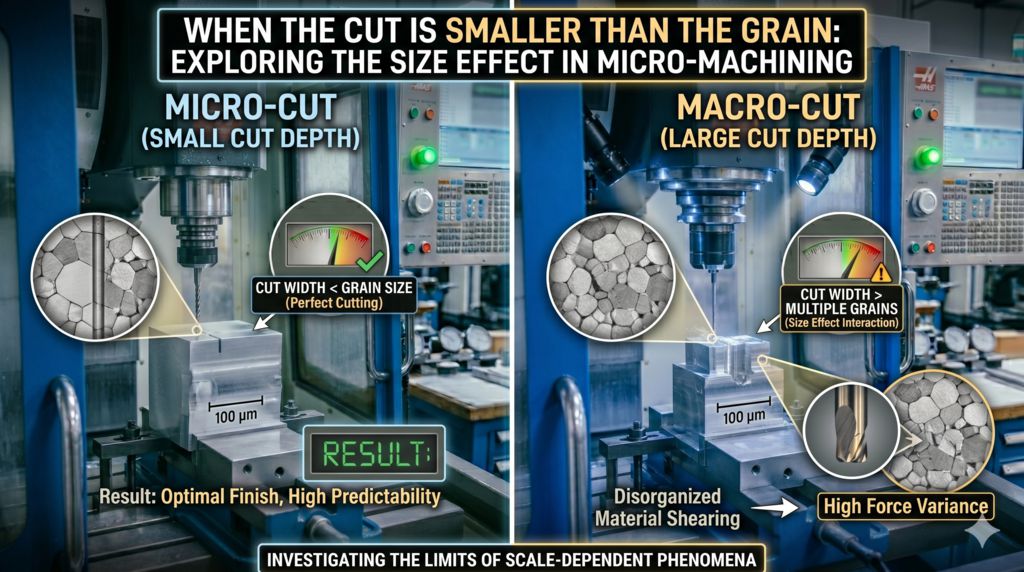
In micro-machining, the depth of cut is often smaller than the size of a single crystal grain of the metal.

  • Instead of cutting a uniform block, the micro-tool is suddenly slamming into individual, distinct grains of ferrite, then plunging into a harder grain of pearlite, and then tearing across a grain boundary.

  • The material is now anisotropic. This causes wild, high-frequency fluctuations in cutting forces, which can induce micro-vibrations, cause sudden tool breakage, and leave highly unpredictable surface finishes.


Summary: Macro vs. Micro Machining

To successfully optimize a micro-machining process, engineers must throw out the conventional rulebook.

FeatureConventional MachiningMicro-Machining
Material AssumptionHomogeneous and IsotropicHeterogeneous and Anisotropic (grain-dependent)
Tool EdgeAssumed perfectly sharpTreated as blunt/rounded (high impact on cut)
Dominant ActionShearing (chip formation)Plowing and Rubbing at low feed rates
Specific EnergyRelatively constantIncreases exponentially as depth of cut decreases

Navigating the Size Effect is the true art of micro-manufacturing. It requires a delicate balancing act: you must feed the tool hard enough to exceed and actually cut the metal, but gently enough that the fragile, hair-thin micro-tool doesn't snap under the immense plowing forces.

Please visit our Machined PartsAbout for more information.

A Deep Dive into Advanced Tool Geometry and Coating Technologies

When we talk about modern manufacturing, it’s easy to get mesmerized by the massive, multi-axis CNC machines or the highly complex CAM software driving them. However, at the very end of the spindle, doing the actual, violent work of ripping metal apart, is the unsung hero of the machine shop: the cutting tool.

You can have a million-dollar CNC machine, but if you put the wrong end mill in the spindle, you will still make bad parts. The true magic of modern subtractive manufacturing lies in the microscopic optimization of Tool Geometry and Advanced Coatings. Let's break down how engineers design these highly specialized tools to cut faster, last longer, and survive extreme environments.

Advanced Tooling & Coatings

Part 1: The Architecture of the Cut (Tool Geometry)

Tool geometry isn't just about making the tool look sharp; it's about controlling the flow of the material, managing the immense heat generated, and preventing the tool from snapping under pressure.

Here are the three fundamental pillars of cutting tool geometry:

1. The Rake Angle

The rake angle is the angle of the cutting face relative to the workpiece. It determines how aggressively the tool slices into the material.

  • Positive Rake: The tool face leans away from the cutting edge. This makes the tool incredibly sharp, allowing it to slice cleanly with less cutting force. It is ideal for soft, gummy materials like Aluminum or plastics. However, it leaves the cutting edge delicate.

  • Negative Rake: The tool face leans into the cut. This creates a much stronger, blunter edge that pushes the material away. While it requires more horsepower, it is absolutely essential for machining hardened steels or cast iron where a positive rake tool would instantly chip.

2. The Clearance Angle

If the back of the cutting tool rubs against the freshly cut surface, you get immense friction, terrible surface finishes, and rapid tool failure. The clearance angle (or relief angle) ensures that only the cutting edge touches the material.

3. The Helix Angle

Look at a standard end mill—the flutes spiral up the body. This is the helix angle. A high helix angle (e.g., 45° to 60°) wraps tightly around the tool, lifting chips up and out of deep pockets quickly, which is perfect for aluminum. A low helix angle (e.g., 30°) is stiffer and better for plowing through tough materials like steel without deflecting.

Pro Tip: Variable helix end mills (where the flutes are spaced at unequal angles) disrupt the rhythmic vibration of the cut, virtually eliminating chatter and allowing for much heavier depths of cut.


The Mathematics of Tool Life

Before we discuss coatings, it is helpful to understand how engineers calculate the survival rate of a tool. The foundational formula used to predict tool wear is Taylor's Tool Life Equation:

$$V T^n = C$$

Where:

  • $V$ is the cutting speed.

  • $T$ is the tool life.

  • $n$ is the Taylor exponent (determined by the tool material, e.g., HSS vs. Carbide).

  • $C$ is a machining constant.

This equation clearly shows that as you increase cutting speed ($V$), tool life ($T$) drops exponentially due to thermal breakdown. To push $V$ higher without destroying $T$, we must protect the carbide substrate. This is where coatings come in.


Part 2: The Armor (Advanced Coating Technologies)

When machining tough aerospace alloys like Titanium or Inconel, temperatures at the cutting edge can easily exceed 1000°C. Uncoated tungsten carbide will literally begin to dissolve into the steel chips at these temperatures through chemical diffusion.

To prevent this, tools are coated with a microscopic layer of ceramic armor—usually only 2 to 5 microns thick.

How We Apply Coatings: CVD vs. PVD

There are two primary methods for applying these microscopic layers:

  1. CVD (Chemical Vapor Deposition): The tools are placed in a reactor at very high temperatures (around 1000°C), and chemical gases react to form a thick, highly heat-resistant coating. It's excellent for turning inserts doing heavy roughing.

  2. PVD (Physical Vapor Deposition): Conducted at lower temperatures (around 500°C), this process vaporizes a solid metal (like Titanium) in a vacuum, which then condenses onto the tool. PVD preserves the sharp edges of milling cutters and is highly resistant to wear.


The Heavy Hitters: Common Tool Coatings

Not all coatings are created equal. The specific chemistry of the coating must be matched to the material being cut.

Coating TypeAppearanceBest Used ForKey Properties
TiN (Titanium Nitride)Distinctive GoldGeneral purpose, older machines.Good lubricity, prevents built-up edge (BUE).
TiAlN (Titanium Aluminum Nitride)Dark Violet/BlackHigh-speed machining of steels and superalloys.Forms an Aluminum Oxide layer under extreme heat, protecting the tool.
ZrN (Zirconium Nitride)Pale Gold/ChampagneAluminum and non-ferrous materials.Extremely slick; stops gummy aluminum from welding to the cutter.
CVD DiamondShiny Grey/BlackCarbon fiber (CFRP), ceramics, graphite.The hardest coating available; survives highly abrasive materials but reacts chemically with steel.

The Future: Nanocomposite Coatings

The industry is currently transitioning from single-layer coatings to nanocomposite coatings. Instead of just depositing a layer of TiAlN, manufacturers are embedding nanoscale grains of highly crystalline materials (like Silicon Nitride) within the coating matrix.

This structure blocks the propagation of micro-cracks. When a microscopic crack forms under the immense pressure of cutting, the nanostructure absorbs the energy and stops the crack dead in its tracks, extending tool life by up to 300% compared to traditional coatings.

By combining the perfect, material-specific geometry with advanced, heat-resistant nanotechnology, modern cutting tools can carve through hardened steel like it's warm butter, driving the incredible efficiency of modern manufacturing.

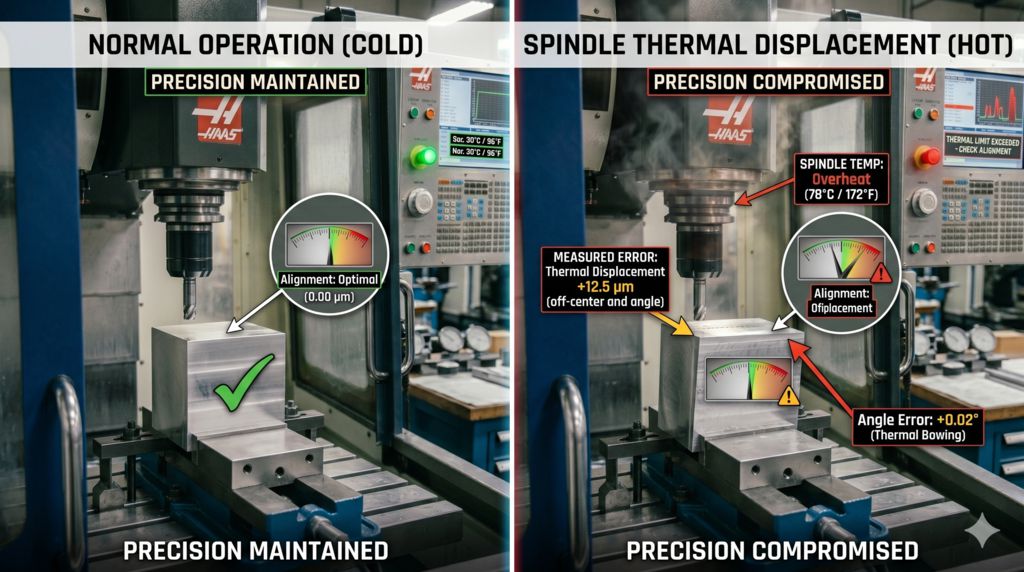
A Guide to Thermal Error Compensation in CNC Machining

Imagine this: You’ve just finished a 14-hour machining cycle on a high-value aerospace component. The surface finish is flawless, the tool paths were perfectly optimized, and the machine sounded great. But when you take the part to the CMM (Coordinate Measuring Machine) room, it fails inspection. The dimensions are out of tolerance by a few crucial microns.

What went wrong? You are likely the victim of the invisible enemy of precision manufacturing: Thermal Error.

In high-precision machining, thermal deformation can account for 40% to 70% of total machining errors. As tolerances get tighter, simply ignoring the heat is no longer an option. Enter Thermal Error Compensation (TEC)—a smart, software-driven approach to solving a deeply physical problem. boundaries of precision.

Thermal Error Compensation

The Physics of the Problem: Why Machines Warp

When a CNC machine operates, it generates a massive amount of heat. This heat comes from multiple internal and external sources:

  • Internal Heat Sources: Friction in the spindle bearings, ball screws, linear guideways, and the actual cutting action itself.

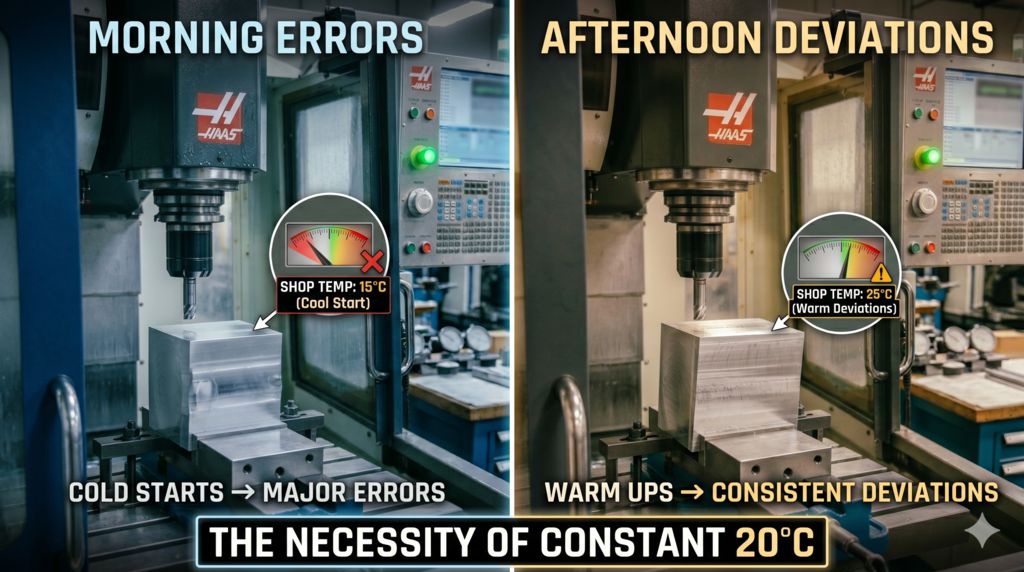
  • External Heat Sources: Fluctuations in the ambient factory temperature, changes in coolant temperature, and even direct sunlight hitting the machine enclosure.

Because CNC machines are made of metal (cast iron, steel, aluminum), they expand when they get hot. The fundamental physics at play is linear thermal expansion, described by the equation:

$$\Delta L = \alpha L \Delta T$$

Where:

  • $\Delta L$ is the change in length (the error).

  • $\alpha$ is the coefficient of thermal expansion for the specific material.

  • $L$ is the original length.

  • $\Delta T$ is the change in temperature.

Because a machine tool is a complex geometry of different metals heating up at different rates, it doesn't just expand uniformly; it twists, bends, and tilts. If the spindle expands downward by 15 microns as it warms up over two hours, your tool is cutting 15 microns deeper than your G-code commanded.


What is Thermal Error Compensation (TEC)?

Historically, manufacturers fought heat with brute-force hardware solutions: building machines out of exotic, low-expansion materials (like Invar), using massive industrial chillers to pump coolant through the ball screws, or leaving machines running in "warm-up" cycles for hours before cutting parts.

Thermal Error Compensation is a completely different approach. Instead of trying to stop the machine from physically expanding, TEC uses sensors and algorithms to predict exactly how much it is expanding, and then tells the CNC controller to dynamically offset the axes to cancel out the error in real-time.

How TEC Works: The Three-Step Process

Implementing TEC is essentially creating a bridge between the physical temperature of the machine and the digital brain of the CNC controller.

1. Temperature Measurement

The foundation of TEC is accurate data. Engineers place highly sensitive temperature sensors (PT100s, thermistors, or thermocouples) at critical points on the machine—such as the spindle housing, the nut of the ball screw, the machine bed, and the ambient air.

2. The Thermal Model (The Brains)

This is where the magic happens. The temperature data is fed into a mathematical model that calculates the resulting structural displacement. Today, these models generally fall into two categories:

  • Physics-Based Models (FEM): Using Finite Element Analysis to simulate the thermodynamics of the machine structure. This is highly accurate but computationally heavy.

  • Data-Driven Models: Using empirical data to train algorithms. By running the machine through various heat cycles and measuring the actual displacement with lasers, engineers can train Multiple Linear Regression (MLR) models or Artificial Neural Networks (ANNs) to predict the error based purely on the sensor readings.

3. Real-Time Compensation

Once the model predicts that the spindle has expanded by, say, +10 microns in the Z-axis, it sends a signal to the CNC controller. The controller immediately applies a -10 micron offset to the Z-axis drive. The cutting tool shifts imperceptibly, ensuring the tip remains exactly where the CAM software intended.


Hardware Cooling vs. Software Compensation

Why is the industry moving heavily toward TEC instead of just adding more chillers? It comes down to cost and efficiency.

FeatureHardware Cooling (Chillers, Coolant)Thermal Error Compensation (TEC)
Initial CostHigh (expensive pumps, piping, refrigeration)Low to Medium (Sensors, software integration)
Energy ConsumptionVery High (requires constant power to cool)Very Low (algorithms run on the CNC processor)
MaintenanceHigh (leaks, filter changes, fluid degradation)Low (sensor calibration)
EffectivenessGood for stabilizing extreme temperaturesExcellent for tracking and eliminating micro-deviations

Pro Tip: The most precise machines in the world don't choose between the two; they use a hybrid approach. They use hardware cooling to remove the bulk of the heat and prevent structural damage, and they use TEC to polish off the remaining few microns of non-linear thermal drift.


The Next Frontier: Smart Machining

As manufacturing leaps into Industry 4.0, Thermal Error Compensation is evolving. We are seeing a shift away from static regression models toward adaptive machine learning algorithms. These smart systems learn how a specific machine behaves on a specific factory floor over time, adjusting their compensation models based on seasonal temperature shifts and mechanical wear.

By neutralizing the chaotic variable of heat, TEC allows machine shops to hold aerospace tolerances in normal factory environments, reducing scrap rates and pushing the

The Art and Science of 5-Axis Simultaneous Machining Optimization

If you look under the hood of a modern jet engine or examine the intricate curves of a custom titanium medical implant, you are looking at geometries that defy traditional manufacturing. These aren't parts that can be cut on a standard 3-axis mill. They require the pinnacle of subtractive manufacturing: Multi-axis Simultaneous Machining, most commonly realized as full 5-axis machining.

However, owning a 5-axis CNC machine and actually optimizing a continuous 5-axis toolpath are two very different things. Let's dive into what makes simultaneous multi-axis machining the undisputed king of complex part generation, and how engineers optimize these chaotic, multi-dimensional ballets of metal and carbide.

The Crucial Distinction: 3+2 vs. Full Simultaneous 5-Axis

Before discussing optimization, we have to clear up the most common point of confusion in the industry. Not all 5-axis machining is created equal.

Machining TypeHow It WorksBest Used For
3+2 Machining (Positional)The machine rotates the part using two rotary axes, locks them in place, and then machines using standard 3-axis (X, Y, Z) movements.Multi-sided parts like engine blocks; reducing the number of setups.
Full Simultaneous 5-AxisAll five axes (X, Y, Z, plus two rotaries like A and B, or B and C) move at the exact same time in continuous motion.Impellers, turbine blades, complex molds, and deep aerospace pockets.

This article focuses on the latter. When five axes move simultaneously, the tool is practically dancing around the workpiece.


Why the Headache? The Benefits of Simultaneous Motion

Programming a machine to move in five dimensions simultaneously requires massive computational power and expensive CAM (Computer-Aided Manufacturing) software. So, why do we do it?

  • Shorter, More Rigid Tools: Because you can tilt the tool away from the walls of a deep cavity, you can use shorter cutting tools. Shorter tools mean less vibration (chatter), fewer broken end mills, and much heavier cuts.

  • Immaculate Surface Finishes: In 3-axis machining of 3D curves, you often get "stair-stepping." Simultaneous 5-axis allows the side (flute) or the very tip of the tool to remain perfectly tangent to the curved surface at all times, virtually eliminating blend marks.

  • Machining Undercuts: You can reach underneath overhanging features without needing custom-ground "lollipop" cutters.

Pro Tip: In aerospace structural components, simultaneous 5-axis machining can reduce cycle times by up to 30% simply because the tool never has to leave the part to reposition. It maintains constant, optimized engagement.


The Deep Dive: Optimizing the Multi-Axis Toolpath

When five axes move at once, the complexity scales exponentially. Optimization isn't just about cutting faster; it's about managing machine kinematics to prevent violent, jerky movements that ruin parts and destroy spindles.

1. Tool Posture Optimization (Lead and Tilt)

In 3-axis, the tool always points straight down (Z-axis). In 5-axis, you must define the Tool Axis Vector. To optimize cutting conditions and chip evacuation, programmers manipulate two angles relative to the surface normal:

  • Lead/Lag Angle: Tilting the tool forward or backward along the direction of travel (like dragging a paintbrush vs. pushing it).

  • Tilt Angle: Leaning the tool side-to-side relative to the cut direction.

Optimizing these angles ensures that the tool is actually cutting with its flutes, rather than rubbing the material with the "dead center" of a ball-nose end mill, where the rotational velocity is practically zero.

2. Avoiding "Singularities"

A kinematic singularity is the CNC equivalent of a "gimbal lock" in aerospace navigation. It happens when two rotary axes align perfectly. To make a microscopic change in the tool path, the machine might suddenly have to spin a rotary axis 180 degrees in a fraction of a second.

Optimization algorithms in advanced CAM software analyze the toolpath to predict these singularities and automatically adjust the tool tilt slightly to bypass them, ensuring smooth, continuous motion.

3. RTCP (Rotation Tool Center Point) Control

In the old days, if the part rotated, the machine didn't know where the tip of the tool was relative to the part—it only knew the axis positions. RTCP is a game-changing CNC controller feature. With RTCP active, the controller tracks the actual tip of the tool in 3D space. As the rotary axes swing the massive trunnion table around, the linear axes (X, Y, Z) automatically and instantly compensate to keep the tool tip exactly where it belongs, maintaining a perfectly constant feed rate on the surface of the part.


The Safety Net: Digital Twins and Simulation

You simply cannot press "Cycle Start" on a new, unverified simultaneous 5-axis program. The risk of the spindle violently colliding with the trunnion table is too high, and repairs can cost tens of thousands of dollars.

Optimization today relies heavily on Machine Simulation. Before a single chip is cut, the G-code is run through a "Digital Twin"—a perfect, 1:1 3D model of the specific CNC machine, the fixtures, the cutting tool, and the raw stock. The software checks for hyper-extensions (over-traveling an axis), minute collisions, and abrupt kinematic shifts, allowing the programmer to optimize the motion safely in the digital world.


The Future of Multi-Axis

We are moving away from programmers having to manually define every tilt angle. AI-driven CAM software is beginning to automate 5-axis optimization, analyzing the CAD model and generating collision-free, kinematically smooth toolpaths with a single click. As materials get harder and geometries get wilder, simultaneous machining optimization will remain the beating heart of advanced manufacturing.

A Guide to Miniaturization and MEMS Machining

Look at the smartphone in your hand. It knows when you tilt it, it tracks your daily steps, and it captures high-fidelity audio while filtering out background noise. We take these features for granted, but they rely on mechanical moving parts that are completely invisible to the naked eye.

Welcome to the microscopic world of Miniaturization and Micro-Electromechanical Systems (MEMS).

While traditional machining is about carving blocks of metal to build car engines or airplane wings, MEMS machining is the art of sculpting silicon to build microscopic sensors, gears, and actuators. It is a realm where the rules of classical physics start to blur, and precision is measured in nanometers.

Miniaturization and MEMS Machining

What Exactly are MEMS?

Micro-Electromechanical Systems (MEMS) are miniature devices that integrate both mechanical elements (like levers, springs, and vibrating membranes) and electrical elements (like microchips and sensors) on a single substrate, usually silicon.

Unlike standard microchips that only process electrons, MEMS devices interact with the physical world. They can "feel" acceleration, pressure, and sound, or they can "act" by pumping fluids, directing light, or moving tiny microscopic mirrors.


How Do We Machine the Invisible?

You can't use a microscopic CNC mill to carve out a MEMS device. The tools would be too large, and the forces would shatter the delicate structures. Instead, MEMS machining borrows its techniques from the semiconductor industry, relying on chemistry and light rather than spinning metal blades.

Here are the three primary techniques used to "machine" MEMS:

1. Bulk Micromachining: Carving the Foundation

Think of bulk micromachining as traditional subtractive manufacturing on a microscopic level. It involves aggressively etching away the bulk of a silicon wafer to create deep, 3D structures like pits, trenches, and cantilevers.

  • Wet Etching: Using liquid chemicals (like potassium hydroxide) to dissolve the silicon. Because silicon has a crystal structure, the chemicals etch at different speeds in different directions, creating precise geometric angles.

  • Dry Etching (DRIE): Deep Reactive Ion Etching uses highly energized plasma gases to blast away material straight down, creating deep, vertical walls without the slanted edges caused by wet etching.

2. Surface Micromachining: Building from the Ground Up

Instead of carving into the block, surface micromachining builds the device layer by layer on top of the silicon substrate.

  • Successive layers of structural materials (like polysilicon) and sacrificial materials (like silicon dioxide) are deposited.

  • Once the intricate layers are built, a chemical wash dissolves the "sacrificial" material, leaving the structural material freely suspended. This is how microscopic gears and moving springs are created.

3. LIGA: The Heavy-Duty Micro-Process

LIGA is a German acronym (Lithographie, Galvanoformung, Abformung) that translates to Lithography, Electroplating, and Molding. It uses powerful X-ray radiation to create incredibly precise, high-aspect-ratio molds. These molds are then filled with metal via electroplating. LIGA is used when you need microscopic parts made of tough metals rather than brittle silicon.


Comparing the Techniques

FeatureBulk MicromachiningSurface MicromachiningLIGA
MethodSubtractive (carving into the wafer)Additive (building layers on top)Additive (molding and electroplating)
MaterialPrimarily single-crystal SiliconPolysilicon, metals, polymersMetals (Nickel, Copper, Gold), plastics
Best ForPressure sensors, fluidic channelsMicro-gears, accelerometers, micro-mirrorsMicro-motors, high-durability metallic parts

The Unique Challenges of the Micro-World

When you shrink mechanical parts down to the size of a red blood cell, gravity basically stops mattering. Instead, surface forces take over, presenting unique manufacturing challenges:

  • Stiction: This is the nemesis of MEMS. Because the parts are so small and close together, capillary action from ambient humidity or static electricity can cause moving parts to stick together permanently.

  • Packaging: A MEMS device is useless if dust gets into its microscopic gears. Packaging these devices in protective vacuums or inert gases, while still allowing them to connect to the outside world, often costs more than manufacturing the chip itself.


Real-World Magic: Where are MEMS Used?

MEMS technology has quietly infiltrated almost every aspect of modern life:

  • Automotive: When a car crashes, a tiny MEMS accelerometer detects the sudden deceleration and deploys the airbag in milliseconds.

  • Medicine: Bio-MEMS are driving the "Lab-on-a-Chip" revolution, where microscopic pumps and valves can process a single drop of blood to run comprehensive diagnostics in minutes.

  • Display Technology: Many high-end projectors use Digital Micromirror Devices (DMDs). These chips contain millions of microscopic mirrors that tilt back and forth thousands of times per second to reflect light and create the image on the screen.


The Future is Nano

We are already pushing past MEMS into NEMS (Nano-Electromechanical Systems), dealing with structures measured in atoms rather than micrometers. As we continue to master the art of miniaturized machining, we open the door to targeted drug delivery via nanobots, ultra-efficient energy harvesting, and sensors that can detect a single molecule of gas.

Hybrid Manufacturing

For years, the manufacturing industry framed a debate: Additive Manufacturing (3D Printing) versus Subtractive Manufacturing (CNC Machining).

Additive was hailed as the future of complex geometries and zero waste, while subtractive remained the undisputed king of tight tolerances and pristine surface finishes.

But what if you didn't have to choose?

Enter Hybrid Manufacturing—a revolutionary approach that combines the generative power of 3D printing with the surgical precision of CNC machining, all within a single, unified system.

Hybrid Manufacturing

What is Hybrid Manufacturing?

In its most common industrial definition, Hybrid Manufacturing is the integration of an additive process (usually metal 3D printing) and a subtractive process (milling or turning) into one machine tool.

Instead of printing a "near-net shape" part on one machine, taking it off, setting it up on a lathe, and machining it to its final dimensions, a hybrid machine does it all in one setup. It builds the material up where you need it, and cuts it back where you need absolute precision.

The Mechanics: How Does It Work?

Most metal hybrid machines utilize a process called Directed Energy Deposition (DED) combined with standard multi-axis CNC milling.

  1. Deposition: A laser melts metal powder or wire as it is blown out of a nozzle onto the build plate, building up the part layer by layer.

  2. Machining: The machine automatically swaps the 3D printing head for a traditional cutting tool (like an end mill).

  3. Refinement: The cutting tool machines the newly deposited material to achieve the required surface finish and dimensional accuracy.

  4. Iteration: The process repeats. The machine can print internal structures, machine them perfectly smooth, and then print a "roof" over them—something impossible with either technology alone.


Why Go Hybrid? The Manufacturing Advantage

Combining these two distinct technologies offers benefits that far outweigh the sum of their parts.

AdvantageHow Hybrid Manufacturing Delivers
Unmatched GeometryAllows for the creation of internal cavities and complex channels that are fully machined before being sealed inside the part.
Reduced Lead TimeEliminates the need to move parts between different machines, drastically cutting down on setup times and handling.
Material EfficiencyYou only print material where it is needed, generating far less scrap than starting with a massive solid block of billet.
Multi-Material PartsSome hybrid machines can switch metal powders on the fly, allowing you to print a copper core for heat transfer and coat it in tool steel for wear resistance.

Pro Tip: One of the most lucrative uses for Hybrid Manufacturing isn't making new parts, but repairing high-value old ones. You can take a worn-out turbine blade, mill away the damaged section, 3D print fresh metal onto the exact spot, and machine it back to its original OEM specifications.


Real-World Applications

Hybrid systems are moving out of the R&D labs and onto the factory floor, particularly in high-stakes industries.

1. Injection Molding and Tooling

Toolmakers are using hybrid processes to create molds with conformal cooling channels. These are complex, curved water channels that wrap perfectly around the contours of the molded part. They cool the plastic faster and more evenly, slashing cycle times and reducing warpage.

2. Aerospace and Defense

Space components often require exotic, expensive alloys like Inconel or Titanium. Hybrid manufacturing allows aerospace engineers to build lightweight, topological-optimized brackets with minimal waste, while still guaranteeing the incredibly tight tolerances required for flight.

3. Oil, Gas, and Energy

Drill bits and large pump housings suffer from extreme wear. Hybrid machines can deposit hard-facing materials like tungsten carbide exactly where the wear occurs, extending the life of critical infrastructure.


The Roadblocks: It’s Not All Perfect

As with any cutting-edge technology, hybrid manufacturing faces hurdles that the industry is still working to overcome.

  • Software Complexity: Writing CAM (Computer-Aided Manufacturing) code for a machine that both adds and removes material is incredibly difficult. The software must prevent the milling tool from crashing into newly printed features.

  • Thermal Management: 3D printing introduces massive amounts of heat, while precision machining requires a thermally stable environment. Managing the expansion and contraction of the metal during the hybrid process is a major engineering challenge.

  • High Capital Cost: These are top-tier, complex machines. The initial investment is substantial, requiring a strong business case to justify the ROI.


The Verdict

Hybrid Manufacturing represents a shift from "how do we cut this out?" to "how do we build this best?". By leveraging the strengths of both additive and subtractive processes, manufacturers are unlocking geometries, materials, and repair capabilities that were entirely out of reach a decade ago.

A Deep Dive into Ultrasonic-Assisted Machining (UAM)

The manufacturing world is constantly chasing a "holy grail": how to cut harder, tougher materials faster, with better precision, and without destroying the cutting tools in the process. Traditional machining often hits a wall when dealing with advanced ceramics, aerospace alloys, or brittle composites.

Enter Ultrasonic-Assisted Machining (UAM)—a hybrid manufacturing process that is changing the rules of engagement for "unmachinable" materials.

A Deep Dive into Ultrasonic-Assisted Machining (UAM)

What Exactly is Ultrasonic-Assisted Machining?

At its core, UAM isn't a completely new way of cutting; it’s an evolution. It combines conventional machining (like milling, drilling, or turning) with high-frequency ultrasonic vibrations.

While a standard CNC tool simply rotates or moves against a workpiece, a UAM tool does both—it rotates and vibrates micro-scopically at frequencies typically between 20 kHz and 40 kHz.

How It Works: The Mechanics of Micro-Hammers

The magic happens at the interface between the tool and the material. By adding vibration, the tool no longer maintains continuous contact with the workpiece. Instead, it acts like a high-speed "micro-hammer."

  1. High-Frequency Oscillation: A transducer converts electrical energy into mechanical vibrations.

  2. Intermittent Contact: The tool strikes the material thousands of times per second.

  3. Reduced Friction: Because the contact is intermittent, the average friction and heat generated are significantly lower than in traditional machining.

  4. Acoustic Cavitation: In some setups using cutting fluids, the vibrations create tiny bubbles that implode, helping to flush out debris and further cool the surface.


Why Use UAM? The Competitive Edge

Why go through the trouble of adding ultrasonic components to a perfectly good milling machine? The benefits are hard to ignore:

FeatureImpact of UAM
Cutting ForceReduced by up to 30-50%, preventing tool deflection.
Tool LifeSignificant extension because the tool isn't "plowing" through heat.
Surface FinishMuch smoother (lower Ra values) with fewer micro-cracks.
Material VersatilityEnables the machining of glass, ceramics, and hardened steel.

Pro Tip: In brittle materials like glass or dental ceramics, UAM shifts the material removal mode from "brittle fracture" to "ductile-regime machining," meaning you get a polished finish straight off the machine.


Key Applications in Modern Industry

UAM has found its home in sectors where "good enough" isn't an option.

1. Aerospace and Defense

Machining CMC (Ceramic Matrix Composites) and Titanium alloys is notoriously difficult. UAM allows for faster drilling of cooling holes in turbine blades with minimal subsurface damage.

2. Medical Technology

From orthopedic implants to dental crowns made of Zirconia, UAM provides the precision needed for biological compatibility without compromising the integrity of the material.

3. Semiconductor and Optics

Grinding optical glass or silicon wafers requires extreme delicacy. UAM reduces the risk of edge chipping, ensuring that expensive components aren't scrapped at the final stage of production.


Challenges to Consider

Despite its brilliance, UAM isn't a "plug-and-play" solution for every shop.

  • Initial Investment: The specialized transducers and power supplies increase the upfront cost of the machinery.

  • System Complexity: Operators need specialized training to tune the frequency to the specific tool and material.

  • Tooling Design: Tools must be designed to withstand the fatigue of high-frequency vibration.


The Future: Smart Machining

As we move toward Industry 4.0, UAM is becoming "smarter." We are seeing the rise of adaptive ultrasonic systems that can sense the resistance of the material and adjust the vibration frequency in real-time.

Whether you are working with the next generation of carbon-fiber composites or trying to shave microns off a surgical instrument, Ultrasonic-Assisted Machining is proving that sometimes, a little vibration is exactly what you need to achieve perfection.

The Next Frontier: How Miniaturization and Intelligence Are Reshaping Precision Machining

For decades, the metric of success in the machining industry was "Horsepower and Iron." The biggest machines removing the most material in the shortest time won the contract.

Today, the paradigm has shifted. As we advance deeper into the era of Industry 4.0 (and approach Industry 5.0), the battleground for manufacturing supremacy has moved to two distinct fronts: the microscopic scale of the components and the digital intelligence of the workflow.

For OEMs and procurement leaders, understanding these trends is no longer optional—it is essential for identifying supply chain partners capable of meeting the demands of next-generation medical devices, semiconductors, and aerospace avionics.

Micro-Machining_unisontek2

Trend 1: Micro-Machining (The Race to the Bottom)

As devices shrink, the components inside them must follow suit. However, Micro-Machining is not simply "regular machining, but smaller." It is a distinct discipline that requires a fundamental rethink of physics and material science.

The Demand Drivers

  • Medical Technology: Minimally invasive surgical tools, implantable sensors, and micro-fluidic drug delivery systems.

  • Electronics: Connectors with pitch sizes under $0.3\text{ mm}$ and probe pins for semiconductor testing.

  • Optics: Mounts for fiber optics and laser collimators requiring positional accuracy in the sub-micron range.

The Technical Challenge

In traditional machining, the grain structure of the metal is negligible compared to the part size. In micro-machining, a single metal grain can be the size of the cutting tool's flute.

  • Tooling: We are now seeing end mills with diameters as small as $0.01\text{ mm}$ (smaller than a human hair). These tools cannot be seen by the naked eye and break with the slightest vibration.

  • RPM Requirements: To achieve the correct surface speed (SFM) with such small tools, spindles must run at 30,000 to 60,000 RPM with virtually zero runout.

  • The "Chip" Problem: At this scale, the cutting tool often "ploughs" the material rather than shearing it, requiring specialized cutting geometries and high-pressure coolant strategies.

Procurement Insight: When sourcing micro-parts, general machine shops often fail. Look for suppliers with specialized "Swiss-style" lathes and high-frequency milling centers dedicated solely to micro-applications.

Trend 2: Smart Manufacturing (The Digital Brain)

The modern machine shop is becoming less of a factory and more of a data center. The integration of IoT (Internet of Things) and AI is solving the industry's biggest pain points: inconsistency and downtime.

1. The Digital Twin

Before a block of expensive Titanium is ever clamped into a machine, its entire manufacturing lifecycle exists virtually.

  • What it is: A precise virtual replica of the machine tool, the fixture, the tool holder, and the raw stock.

  • The Benefit: Engineers can run the simulation to detect collisions, optimize tool paths to shave off seconds, and predict surface finish quality. This moves the "trial and error" phase from the physical world (expensive) to the digital world (cheap).

2. Predictive Maintenance (No More Surprise Breakdowns)

In the past, a spindle bearing would seize unexpectedly, halting production for weeks.

  • The Solution: Modern machines are laden with vibration sensors and thermal probes. AI algorithms analyze this data stream to detect the "signature" of a failing component weeks before it breaks.

  • The Result: Maintenance is scheduled during non-production hours, ensuring On-Time Delivery (OTD) rates remain stable for customers.

3. Closed-Loop Manufacturing

This is the holy grail of quality control.

  • The Process: A machine cuts a feature $\rightarrow$ An automated probe measures the feature inside the machine $\rightarrow$ The data is fed back to the controller $\rightarrow$ The controller automatically updates the tool offset to correct for tool wear or thermal expansion $\rightarrow$ The machine finishes the cut.

  • The Impact: This eliminates human error and manual adjustment, ensuring that the 1st part and the 1,000th part are mathematically identical.

Smart Factory_unisontek2

Trend 3: Hybrid Manufacturing

The line between "Additive" (3D Printing) and "Subtractive" (CNC Machining) is blurring.

We are seeing the rise of Hybrid Machines: 5-axis units equipped with both a milling spindle and a laser sintering head.

  1. Build: The machine prints a complex internal lattice structure (impossible to machine) using metal powder.

  2. Cut: The machine switches to a milling tool to precision-finish the critical sealing surfaces and bearing bores.

This allows engineers to design parts with the geometric freedom of 3D printing but the precision tolerances of CNC machining.


Conclusion: What This Means for the Buyer

The gap between "low-end" and "high-end" machine shops is widening.

  • Low-End Shops will continue to fight on price for simple, low-tolerance commodity parts.

  • Smart Manufacturers are investing heavily in micro-capabilities and digital integration. Their hourly rates may be higher, but their total cost of ownership is lower due to reduced scrap rates, faster NPI (New Product Introduction) cycles, and guaranteed reliability.

Hybrid Manufacturing_unisontek2