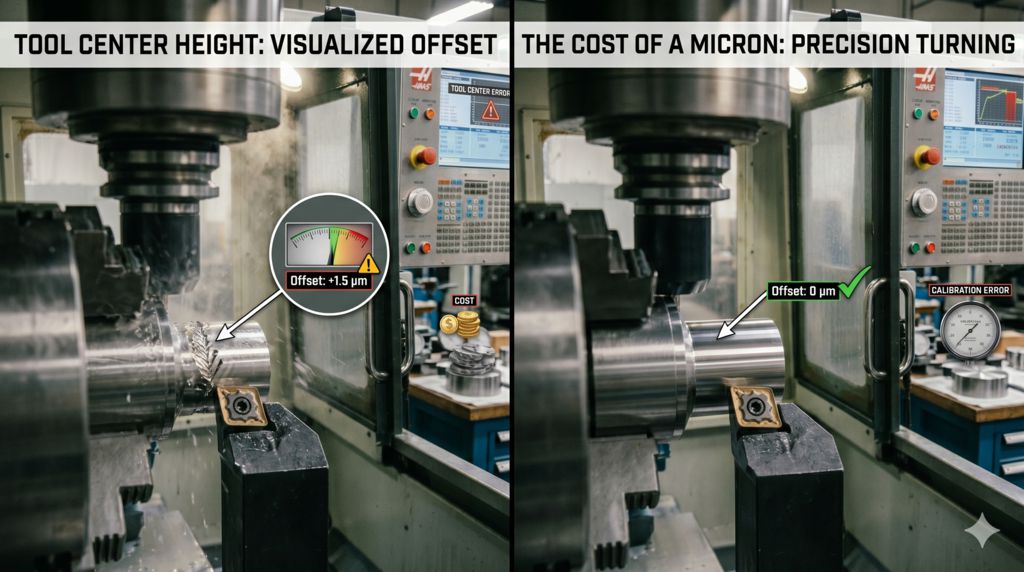
Why Tool Center Height Offset is the Silent Killer in Precision Turning

In the pursuit of sub-micron accuracy, machinists often obsess over spindle runout, thermal expansion, and high-end tool coatings. Yet, one of the most critical factors in turning operations is frequently overlooked because it is invisible to the naked eye: Tool Center Height.

When the cutting edge of a turning tool is not perfectly aligned with the horizontal centerline of the workpiece, a cascade of physical errors begins. What seems like a negligible offset—a mere “hair’s breadth”—can become the primary reason for scrapped parts, broken inserts, and baffling dimensional inconsistencies.
Why Tool Center Height Offset is the Silent Killer in Precision Turning

The Geometry of the Offset: Changing the Effective Angles

The primary “truth” of tool center height is that it fundamentally alters the tool’s geometry relative to the workpiece. A tool is designed with a specific clearance angle and rake angle to optimize chip formation and prevent friction.

If the tool is above center, the effective clearance angle decreases. In extreme cases, the flank of the tool begins to rub against the workpiece instead of cutting it. This creates immense friction, localized heat, and a poor surface finish.

Conversely, if the tool is below center, the effective rake angle becomes more negative. The tool no longer “slices” the material smoothly; instead, it “plows” into it. This increases cutting forces and can lead to the tool being pulled further into the material, causing a catastrophic “dig-in.”


The Dimensional Nightmare: The “Nipple” and Diameter Errors

One of the most obvious symptoms of a center height error occurs when facing a part to the center. If the tool is off-center, it leaves a small protrusion—often called a “nipple” or “tit”—at the center of the workpiece.

Beyond aesthetics, this offset creates a mathematical nightmare for diameter control. In precision turning, the machine assumes the tool is at $Y=0$. If the tool is actually at $Y+0.1mm$, the actual distance from the tool tip to the rotation axis is longer than the programmed coordinate.

As you approach smaller diameters, this error becomes non-linear. The smaller the part, the more significant the center height offset becomes as a percentage of the total diameter. This is why a setup might hold tolerance on a 50mm shaft but fail miserably on a 2mm pin.


The Silent Killer of Surface Integrity: Vibration and Chatter

Tool center height is a major contributor to chatter, the high-frequency vibration that leaves “tiger stripes” on a finished part.

When a tool is off-center, the cutting forces are no longer directed through the strongest part of the machine’s tool post. Instead, the force creates a moment arm that encourages the tool to deflect or “bounce.”

This instability is often misdiagnosed as a lack of machine rigidity or a dull insert. In reality, the tool is simply fighting the physics of the rotation. Aligning the tool to the exact center stabilizes the pressure, allowing the machine’s dampening characteristics to work effectively and resulting in a mirror-like surface finish.


Impact on Tool Life: Uneven Wear and Micro-Chipping

Precision inserts are engineered to distribute heat and pressure across a specific edge preparation. When the center height is incorrect, the pressure distribution shifts.

An “above center” tool experiences rapid flank wear due to increased rubbing. A “below center” tool is prone to micro-chipping of the cutting edge because of the increased mechanical shock and unfavorable rake angles.

By ignoring center height, shops unknowingly increase their tooling costs by 20% to 30%, as inserts are changed prematurely due to “unexplained” wear patterns that are actually entirely preventable through proper alignment.


Conclusion: Respecting the Centerline

In the world of precision turning, “close enough” is the enemy of excellence. Tool center height is not a secondary adjustment; it is the foundation upon which all other turning physics are built.

Whether you are using a traditional shim, an adjustable tool holder, or an optical pre-setter, the time spent ensuring the tool tip meets the workpiece at exactly $0.000$ elevation is the most profitable minute a machinist can spend. By eliminating this invisible killer, you secure the stability, accuracy, and longevity required to push machining to its absolute limits.

In addition, please visit CNC Turning Parts, Stamping Parts, Technical Data and Quality Inspection to get more information about us, if you have any question, please e-mail to Harry Yen hyen@unisontek.com.tw

Please watch our company YouTube channel Link and introduction Link
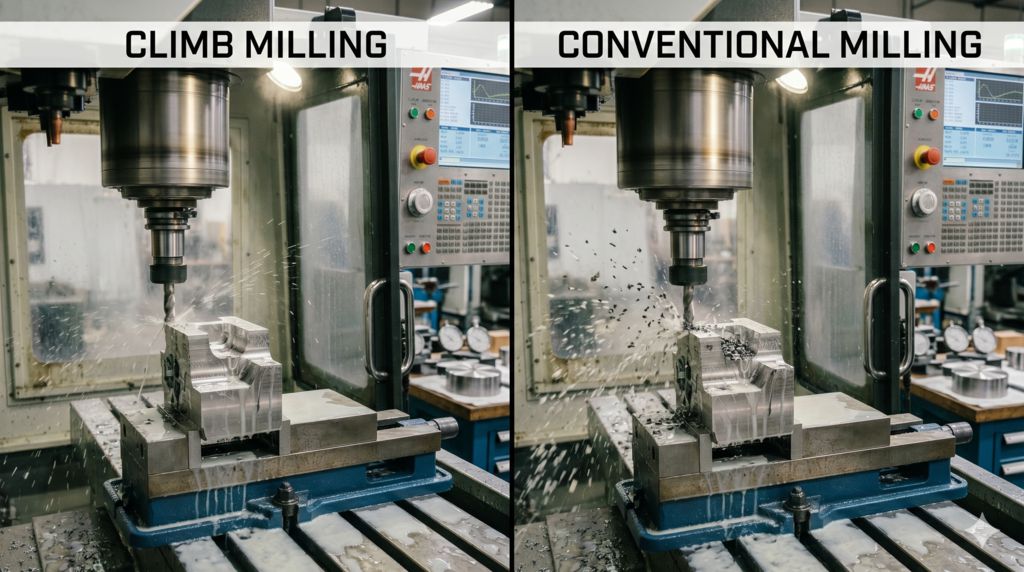
The Century-Old Choice for Efficiency, Tool Life, and Surface Quality

In the world of precision machining, few debates are as fundamental as the choice between Climb Milling and Conventional Milling. It is a decision that every machinist faces the moment a tool touches a workpiece.

While modern CNC technology has made one method the clear favorite for most applications, understanding the underlying physics of both is essential for achieving the “holy grail” of manufacturing: maximum efficiency, extended tool life, and a flawless surface finish.

The Century-Old Choice for Efficiency, Tool Life, and Surface Quality

The Fundamental Difference: Tool Rotation vs. Feed Direction

To understand the conflict, we must look at the relationship between the cutter’s rotation and the direction of the table feed.

Climb Milling (Down Milling): In this method, the cutter rotates with the feed. Imagine a wheel “climbing” over the material. The tooth engages the workpiece at the maximum thickness and exits at zero thickness.

Conventional Milling (Up Milling): Here, the cutter rotates against the feed. The tooth starts at zero thickness and accelerates to its maximum thickness at the point of exit. It is a “scooping” motion that fights against the movement of the part.


Efficiency and Chip Formation: The “Thin-to-Thick” Trap

One of the most overlooked physical truths is how chips are formed. In Conventional Milling, the tool rubs against the surface before it actually starts cutting. This “rubbing zone” creates immense friction and work-hardening.

Because the chip starts at zero thickness, the tool tip undergoes significant heat buildup before it can penetrate the material. This is inefficient; you are spending energy to create heat rather than to remove metal.

In contrast, Climb Milling starts at the maximum chip thickness. The tool bites into the material immediately, transferring the heat of the cut into the chip itself rather than the tool or the workpiece. This lead to a much more efficient evacuation of energy and allows for higher feed rates.


Tool Life: A Battle of Friction and Impact

If you want your expensive carbide end mills to last, the physics overwhelmingly favor Climb Milling.

By engaging the material at the thickest point, the tool avoids the abrasive rubbing phase found in conventional milling. Rubbing is the primary enemy of tool edges, leading to rapid dulling and “built-up edge” (BUE).

However, there is a catch. Because Climb Milling starts with a high-impact “bite,” it requires a rigid setup. On older, manual machines with high backlash (mechanical play in the lead screws), climb milling can actually pull the workpiece into the cutter, leading to broken tools or catastrophic failure. In the modern era of pre-loaded ball screws and rigid CNC frames, this risk is largely mitigated, making Climb Milling the industry standard for tool longevity.


Surface Quality: The Quest for the Mirror Finish

Surface finish is often where the choice becomes most visible. Conventional Milling tends to lift the workpiece, and because the chips are thrown in front of the cutter, the tool often “recuts” the chips. This leads to a rougher, “scalloped” texture and can mar the surface.

Climb Milling exerts a downward force, effectively “pushing” the workpiece into the fixture. This increases stability and reduces vibration. Furthermore, since the chips are evacuated behind the cutter, the finished surface remains clean and untouched by debris. The result is a significantly smoother, more professional finish that often requires less post-processing.


When to Break the Rules: The Case for Conventional Milling

Despite the advantages of Climb Milling, Conventional Milling remains a vital tool in specific scenarios.

  • Castings and Scale: If you are machining a raw casting with a hard, abrasive outer “skin” or scale, Climb Milling will ruin your tool instantly as the edge hits the hard surface first. Conventional Milling allows the tool to start under the scale in the softer material and “pop” the scale off from the inside out.

  • Thin-Walled Parts: Sometimes the downward pressure of Climb Milling can cause thin parts to deflect or vibrate. In these niche cases, the upward “lifting” force of Conventional Milling may provide a more balanced stress distribution.


Conclusion: Making the Strategic Choice

For the modern machinist aiming for peak performance, Climb Milling is the default strategy. It offers lower heat, better finishes, and longer-lasting tools.

However, true mastery of the craft lies in knowing when the physics of the material—such as surface scale or extreme lack of rigidity—demand a return to the Conventional way. By balancing these two methods, you move beyond simple metal removal and into the realm of optimized precision engineering.

In addition, please visit CNC Turning Parts, Stamping Parts, Technical Data and Quality Inspection to get more information about us, if you have any question, please e-mail to Harry Yen hyen@unisontek.com.tw

Please watch our company YouTube channel Link and introduction Link
From Shearing to the Limits: The Overlooked Physical Truths in Precision Machining

In the modern industrial landscape, precision machining is often perceived as a realm of digital perfection. We watch high-speed CNC centers and laser-guided measurements, assuming that “precision” is merely a matter of programmed coordinates.

However, beneath the sterile hum of the laboratory-grade workshop lies a violent, chaotic, and fascinating world of physics. To move from simple “cutting” to the true “limits” of manufacturing, one must confront the physical truths that governed the process long before the first line of code was written.

The Overlooked Physical Truths in Precision Machining

The Illusion of “Cutting”: A Struggle of Atomic Bonds

The term “cutting” is, in many ways, a linguistic convenience that masks a brutal reality. In precision machining, we are not slicing material like a knife through soft wax; we are intentionally inducing controlled structural failure.

At the microscopic level, the tool tip acts as a wedge that exerts massive pressure on the workpiece, forcing the metal beyond its yield strength. This creates a localized zone of plastic deformation known as the shear plane.

The “truth” here is that we are tearing the material apart. If the shear angle is not perfectly managed, the material doesn’t just fall away; it resists, creating “built-up edges” (BUE) where the workpiece atoms essentially fuse to the tool atoms under intense heat and pressure. This microscopic welding instantly ruins the intended geometry and surface finish of a high-precision component.


The Thermal Paradox: Precision is a Slave to Entropy

Precision is a slave to thermodynamics. In high-speed machining, nearly 97% of the mechanical energy used is converted directly into heat. While we use advanced coolants to manage this, the physical truth is that the “point of contact” remains a thermal frontier.

As a material heats up, it expands—a phenomenon known as thermal drift. In the realm of micron-level precision, even the heat from a technician’s hand or the friction of a spindle bearing can expand a steel component by several micrometers.

The “limit” here isn’t the machine’s ability to move; it is the environment’s inability to stay still. True precision machining is less about the tool’s sharpness and more about thermal equilibrium management. If the temperature isn’t stabilized, the dimensions are merely a snapshot in time, doomed to change as the part cools.


The Vibration Ghost: Regenerative Chatter

Perhaps the most elusive physical truth in the machine shop is harmonic resonance. Every tool, holder, and machine frame has a natural frequency. When the frequency of the tool’s impacts matches the natural frequency of the setup, a phenomenon called chatter occurs.

This isn’t just a noise issue. Chatter is a self-exciting vibration that creates invisible “waves” on the surface of the part. In a cruel twist of physics, these waves influence the next pass of the tool, causing the vibration to grow exponentially.

To reach the “limit” of precision, engineers must navigate these “stability lobes,” choosing speeds and feeds that essentially play the machine like a tuned instrument, ensuring the physics of vibration work for the finish rather than against it.


Elasticity: The Metal That Bends

We often treat steel and titanium as “rigid” bodies, but at the scale of precision machining, every material behaves like a stiff spring. This is the truth of tool deflection.

When a tool pushes against a workpiece, the workpiece pushes back with equal force (Newton’s Third Law). Even a solid carbide end mill—one of the stiffest materials available—will flex by a few microns under load.

If a programmer ignores this elasticity, the part will always be “out of spec,” not because the machine missed its mark, but because the material physically retreated from the tool during the cut. Compensating for this “spring-back” or “push-off” is what separates a standard technician from a master of precision.


Tribology and the Chemistry of the Cut

Finally, we must consider the chemistry of the interface. The interaction between the tool coating (such as AlTiN or Diamond) and the workpiece is a study in tribology.

At the limit of precision, the lubricant is not just “grease”; it is a chemical barrier that prevents atomic diffusion. Without this invisible layer, the carbon in a diamond tool might dissolve into a ferrous workpiece at high temperatures, causing the tool to literally evaporate into the part it is trying to shape.

Modern coatings are designed to manage these chemical truths, creating a microscopic environment where physics and chemistry cooperate to maintain an edge.


Conclusion: Respecting the Material

The journey from “cutting” to the “limit” is a transition from being a programmer to being a physicist. It requires an acknowledgment that we are operating in a world of friction, heat, atomic bonds, and kinetic energy.

The ultimate truth of precision machining is that the machine is never in total control. The material—with its grain structures, its thermal expansion coefficients, and its stubborn elasticity—always has the final say.

Only by understanding and respecting these physical realities can we hope to push the boundaries of what is humanly possible to build.

In addition, please visit CNC Turning Parts, Stamping Parts, Technical Data and Quality Inspection to get more information about us, if you have any question, please e-mail to Harry Yen hyen@unisontek.com.tw

Please watch our company YouTube channel Link and introduction Link

How Thermal Shock is Secretly Destroying Your Carbide Tools

Walk into any traditional machine shop, and you will hear the familiar roar of spindles accompanied by the splashing of white, milky fluid. For over a century, the golden rule of machining has been simple: cutting metal makes things hot, heat destroys cutting tools, so you must flood the cutting zone with as much liquid coolant as possible.

It makes intuitive sense. But in the modern era of high-performance manufacturing, relying on this old intuition can be a very expensive mistake.

If you are using premium solid carbide end mills and finding that the cutting edges are suddenly flaking off or chipping prematurely, your problem probably isn’t the feeds and speeds. You might actually be drowning your tools to death. Welcome to the invisible, destructive world of Thermal Shock and Micro-chipping.

How Thermal Shock is Secretly Destroying Your Carbide Tools

The Misunderstood Nature of Modern Carbide

To understand why coolant can be dangerous, we have to look at what modern tools are made of.

In the old days of High-Speed Steel (HSS) tooling, flood coolant was absolutely mandatory. If HSS gets too hot, it literally softens like warm plastic and melts away.

But today, we use Tungsten Carbide coated with advanced, microscopic layers of ceramics (like Titanium Aluminum Nitride – TiAlN).

Here is the secret your tooling rep might not have emphasized enough: Coated carbide doesn’t just tolerate heat; it actually needs it.

Advanced coatings are designed to undergo a chemical reaction when they get incredibly hot (often around 800°C). When exposed to high heat and oxygen, the coating forms a microscopic, super-slick aluminum oxide layer.

This ceramic shield protects the raw carbide underneath from wear. If you blast the tool with cold fluid, it never gets hot enough to form this protective shield.

But preventing the coating from working is only the minor crime of coolant. The major crime is physical destruction.


The Interrupted Cut: A Recipe for Disaster

The problem with milling (unlike turning on a lathe) is that it is an interrupted cut.

Imagine a 4-flute end mill spinning at 10,000 RPM. A single flute bites into the solid steel. Friction and shearing forces instantly superheat the cutting edge. Because it is hot, the metal of the tool physically expands.

A fraction of a second later, that same flute exits the cut and spins out into the open air. If you have the flood coolant turned on, that superheated flute is instantly blasted by a jet of 20°C liquid.

What happens when you take a hot glass out of the dishwasher and immediately run it under freezing water? It shatters.

The exact same physics apply to your cutting tool. The sudden blast of cold liquid causes the expanded carbide to violently and instantly contract. A millisecond later, the flute slams back into the steel, heating up and expanding again. Expand, contract, expand, contract—thousands of times every single minute.


The Symptom: Comb Cracks and Micro-Chipping

Carbide is incredibly hard, but it is also brittle. It cannot survive this endless, violent cycle of thermal expansion and contraction. This phenomenon is known as Thermal Shock (or thermal fatigue).

If you put a tool suffering from thermal shock under a microscope, you will see a very distinct wear pattern. Tiny, hairline fractures begin to form perpendicular to the cutting edge. Machinists often call these comb cracks because they look like the teeth of a comb.

As the milling process continues, the metal chips sliding up the face of the tool catch on these microscopic cracks. Eventually, the cutting forces rip those cracked sections right off the tool. This is micro-chipping.

Once the edge chips, the tool is no longer slicing the metal; it is tearing it. Friction skyrockets, heat goes out of control, and the tool will catastrophically shatter shortly after.


The Solution: Predictability Over Refrigeration

If flood coolant causes thermal shock, how are we supposed to clear the metal chips and keep the tool from welding to the part? The answer lies in changing our goal. We don’t want the tool to be cold; we want the tool’s temperature to be consistent.

Here are the modern strategies to defeat thermal shock:

1. Go Dry with High-Pressure Air

For milling hardened steels, cast iron, and many stainless steels with coated carbide, the best coolant is often no liquid at all. A strong blast of compressed air is all you need to blow the chips out of the way so the tool doesn’t re-cut them. The tool stays very hot, but it stays consistently hot. Without the sudden cold shock, the comb cracks never form, and tool life can often double or triple.

2. Minimum Quantity Lubrication (MQL)

If you are machining a gummy material like aluminum that tends to stick to the tool, dry machining won’t work. Instead of a flood, modern shops use MQL. This system sprays a highly pressurized blast of air mixed with just a microscopic mist of specialized oil. The air clears the chips, the tiny amount of oil provides extreme lubricity so the metal doesn’t stick, but there is no heavy mass of cold liquid to cause a thermal shock.

3. Know When to Flood

Flood coolant isn’t dead. It is still absolutely vital for certain operations.

  • Turning Operations: Because a lathe tool stays continuously buried in the cut, there is no “interrupted” heating and cooling cycle. The temperature stays stable, making flood coolant perfectly safe.

  • Drilling: Deep hole drilling traps heat and chips. You need high-pressure coolant blasting through the center of the drill to flush the hole out.

  • Heat-Resistant Superalloys (HRSA): Materials like Titanium and Inconel generate so much intense, localized heat that they will literally ignite or melt standard tools without heavy liquid cooling.

The Bottom Line

The next time you set up a milling job, take a moment to think about the microscopic battle happening at the cutting edge. Ask yourself: does this tool really need to be cold, or does it just need to be clear of chips?

By turning off the coolant valve and letting your coated carbide tools run hot, you might just save them from a shattering death.

From Torn to Flawless: The Magic of Hydrostatic Pressure in Fineblanking

Take a close look at a standard stamped metal part—perhaps a cheap washer or a basic bracket. If you look at the cut edge, you will notice a distinct, ugly pattern. The top half of the edge might look smooth and shiny, but the bottom half looks like a microscopic cliff face: violently torn, rough, and jagged, usually finishing with a sharp burr at the bottom.

For everyday items, that jagged edge is perfectly fine. But what if you are manufacturing a critical safety latch for a car door, or a high-precision gear for a medical device? A torn, rough edge creates weak points, causes premature wear, and simply isn’t acceptable.

Historically, manufacturers had to stamp the part and then spend time and money shaving, milling, or grinding that torn edge smooth. That is, until the manufacturing world perfected a process called Fineblanking.

Fineblanking achieves what seems impossible: punching through solid steel and leaving a flawless, 100% smooth, mirror-like edge straight out of the press. The secret to this magic trick isn’t just a sharper tool; it is the mastery of a fascinating physical phenomenon called Hydrostatic Pressure.

The Magic of Hydrostatic Pressure in Fineblanking

The Anatomy of a Tear: Why Metal Breaks

To understand how fineblanking fixes the problem, we first have to understand why metal tears in the first place.

During conventional stamping, a punch presses down on a sheet of metal resting on a die. As the punch pushes deeper, the metal begins to shear and slide against itself, creating that smooth, shiny area known as the burnish zone.

However, metal has its limits. Eventually, the pushing force exceeds the metal’s ability to stretch and slide. Microscopic cracks form at the corners of the punch and the die.

These cracks rapidly connect, and the remaining metal suddenly snaps and gives way. This violent snapping creates the fracture zone—the ugly, torn section of the cut.

Metal tears because it wants to escape the pressure, and cracking is the path of least resistance.


The Core Concept: What is Hydrostatic Pressure?

If tearing is caused by the metal giving up and cracking, how do we force it to keep sliding? We trap it. We put the metal under so much pressure from every conceivable direction that a crack physically cannot form.

This state is known as Hydrostatic Pressure.

Imagine holding a handful of wet sand. If you poke it with your finger, the sand simply crumbles and breaks apart. But what if you take that same wet sand, put it inside a strong rubber balloon, and submerge it at the bottom of the Mariana Trench? The intense, crushing pressure of the ocean pushes inward on the balloon from every single direction equally.

If you could magically poke the sand now, it wouldn’t crumble. The surrounding pressure is holding every grain so tightly together that cracks cannot propagate. Instead of crumbling, the sand would behave almost like a thick, viscous liquid. It would flow.

This is exactly what we do to solid steel during fineblanking. We create an artificial “deep ocean” pressure zone right at the cutting edge.


The Mechanics: Creating the Squeeze

To achieve this state of hydrostatic pressure, a fineblanking press acts very differently from a standard stamping press. It utilizes a three-part clamping system designed to trap the metal completely:

1. The V-Ring (The Stinger)

Before the punch even touches the metal, a heavy guide plate clamps down on top of the sheet. But this isn’t a flat plate. It features a sharp, continuous, V-shaped ridge (the stinger) that bites deeply into the metal just millimeters outside of the cutting line. This V-ring creates a physical barrier. It locks the metal in place, stopping it from flowing outward away from the punch.

2. The Counterpunch

In standard stamping, the metal falls freely into a hole below the die. In fineblanking, there is no free fall. A counterpunch pushes up from the bottom, pressing firmly against the underside of the metal.

3. Near-Zero Clearance

Finally, the gap between the cutting punch and the receiving die is incredibly tight—often less than half a percent of the material’s thickness.


The Result: Cold Extrusion

Let’s look at the physics in action. The V-ring is biting down, preventing outward movement. The counterpunch is pushing up from the bottom. The main punch begins to push down from the top.

The metal trapped exactly on the cutting line is now in a state of immense hydrostatic pressure. Because it is squeezed so fiercely from the top, bottom, and sides, its physical properties temporarily change. Its plasticity skyrockets. The metal “forgets” that it is a solid and begins to behave like a highly viscous fluid.

As the punch moves through the material, the metal cannot crack. The microscopic voids that would normally form into tears are instantly squeezed shut by the surrounding pressure.

With cracking eliminated, the metal is forced to smoothly shear and extrude along the side of the punch for its entire thickness.

When the part is finally pushed out, the edge is 100% burnished. It is perfectly smooth, dimensionally flawless, and completely free of tear marks.


The Bottom Line

Fineblanking is a beautiful example of how engineering can outsmart the stubborn nature of raw materials.

By understanding the micro-mechanics of how metal cracks, and deploying the immense power of hydrostatic pressure to change the rules of physics, manufacturers can produce incredibly complex, ready-to-use parts in a single stroke of a machine. It is less about “cutting” metal, and entirely about forcing it to flow.

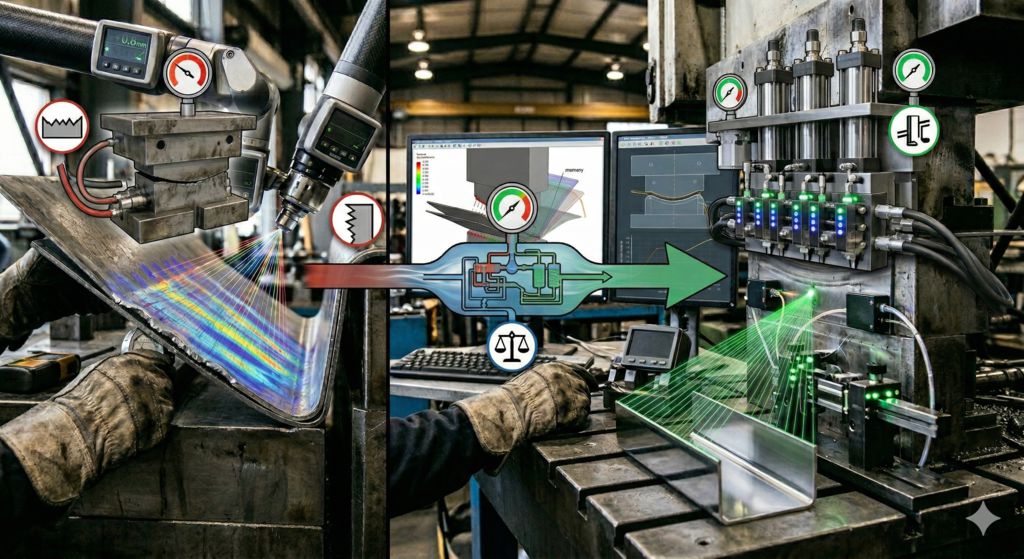
Mastering the Art of Springback Prediction and Compensation

Look around you. From the sleek curves of your car’s door panel to the crisp edges of your smartphone chassis, and even the simple casing of your washing machine—our modern world is held together by formed sheet metal.

To the untrained eye, the process of shaping these metal parts seems incredibly straightforward. You place a flat sheet of metal over a mold, a massive multi-ton hydraulic press slams down, and voilà—you have a perfectly shaped part. It looks like a giant, industrial cookie cutter.

But if you ask any manufacturing engineer, they will tell you a very different story. Metal is stubborn. It has a memory. And when you try to bend it to your will, it fights back.

This hidden battle on the factory floor is governed by a fascinating and deeply frustrating physical phenomenon known as Springback.

Mastering the Art of Springback Prediction and Compensation

What Exactly is Springback?

Imagine taking a plastic ruler and bending it just a tiny bit. When you let go, it snaps right back to being perfectly straight. That is elastic behavior.

Now, imagine taking a wire coat hanger and bending it completely in half. When you let go, it stays bent—but if you look closely, it doesn’t stay exactly as tightly bent as when your hands were holding it. It opens up just a fraction of an inch.

That slight unbending, that tiny opening of the angle after the physical force is removed, is springback.

In the world of CNC manufacturing and metal stamping, springback is the difference between the shape of the metal when the heavy press is holding it down, and the final shape of the metal after the press lifts up. If an engineer designs a tool to bend a piece of steel exactly 90 degrees, and the press bends it exactly 90 degrees, the metal might “spring back” to 92 degrees once the tool is removed.

In an industry where tolerances are measured in fractions of a millimeter, a 2-degree error is a catastrophic failure. Parts won’t fit together, seams will have ugly gaps, and the entire assembly line could grind to a halt.


The Physics Inside the Bend: A Microscopic Tug-of-War

Why doesn’t the metal just stay where you put it? To understand this, we have to look inside the metal itself during the bending process.

When a press bends a flat sheet of metal over a sharp corner, the metal experiences two completely different extreme forces at the exact same time:

  • The Outside is Stretching: The outer curve of the bend is pulled apart. This is called tension.

  • The Inside is Squishing: The inner curve of the bend is pushed together. This is called compression.

But right in the dead center of the thickness of that metal sheet, there is a neutral zone. This core area isn’t being stretched, and it isn’t being squished.

When the press comes down, the extreme forces on the outside and inside layers push the metal past its “yield point.” This means you have permanently deformed those outer layers. However, that inner core never got pushed quite hard enough to forget its original flat shape.

The moment the heavy press lifts off the metal, a microscopic tug-of-war begins. The permanently deformed outer layers want to stay bent. But the inner, elastic core acts like a tightly wound spring, trying to pull the entire sheet of metal back to being flat. The elastic core can’t completely unbend the tough outer layers, but it manages to pull them back just a little bit. That resulting compromise is the springback.


The Variables: Why Springback is So Hard to Predict

If metal always sprang back exactly 2 degrees, engineers wouldn’t lose sleep over it. They would just build all their molds to 88 degrees. Unfortunately, springback is a chaotic variable that changes based on several factors:

  • The Type of Material: Not all metals are created equal. Soft aluminum or low-carbon steel are very “plastic.” They surrender easily to the press and have very little springback. On the other hand, Advanced High-Strength Steels (AHSS) and aerospace titanium are incredibly strong and elastic. They fight back fiercely, resulting in massive, highly unpredictable springback.

  • The Thickness of the Material: Counter-intuitively, thinner metal often experiences more springback (in terms of angle change) than thicker metal. A thick piece of steel has a massive amount of permanently deformed material on the outside to overpower the elastic core, locking the bend in place.

  • The Radius of the Bend: If you bend metal over a very sharp, tight corner, you force almost all the material to deform permanently, leaving very little springback. If you bend metal over a large, sweeping curve, much of the metal remains elastic, resulting in a huge amount of springback.


The Art of the Fix: Predicting and Compensating

Since metal insists on playing this game, manufacturing engineers have developed clever strategies to outsmart the material and guarantee perfect parts.

1. The Digital Crystal Ball (Prediction)

Before a single piece of steel is ever cut to make a mold, engineers use incredibly powerful computer programs to run Finite Element Analysis (FEA).

The software simulates the bend, predicting exactly how the microscopic grains of the metal will stretch, compress, and ultimately spring back. This allows engineers to see the future of the part before it physically exists.

2. Overbending (Compensation)

Once the software predicts the springback, engineers employ the most common trick in the book: Overbending.

If the computer knows a specific batch of high-strength steel will spring back by exactly 4 degrees, the engineer designs the mold to bend the metal to 86 degrees. When the tool lifts, the metal relaxes perfectly into the desired 90-degree shape.

3. Bottoming and Coining

If overbending isn’t accurate enough, engineers use brute force. Instead of just folding the metal, the press comes down with so much terrifying tonnage that it literally crushes the metal at the tip of the bend.

This physical crushing destroys that stubborn elastic core we talked about earlier, essentially erasing the metal’s memory and stopping springback dead in its tracks.

4. Hot Stamping

You can’t have springback if the metal is too hot to act like a spring. By heating high-strength steel until it is glowing red and then stamping it, the metal flows like warm butter and freezes into the exact shape of the mold as it cools.

The Bottom Line

The next time you open your car door or admire the smooth metal chassis of a high-end laptop, take a moment to appreciate the invisible battle that took place to create it. Metal stamping is not simply about brute force.

It is a delicate dance between the unstoppable power of a hydraulic press and the microscopic, stubborn elasticity of nature. By mastering the memory of metal, engineers turn chaotic physics into everyday perfection.

Does a Faster CNC Machine Guarantee a Smoother Surface?

Whether you are a hobbyist just starting out in your garage or a seasoned CNC programmer running aerospace parts, there is a temptation we all face when we want a perfect, mirror-like finish on a machined part. Human intuition whispers a very convincing lie: If I just spin the cutting tool faster, it will take smaller, gentler bites, and the surface will be perfectly smooth.

So, you reach for the control panel, crank the spindle RPM override dial up to 120%, and hit cycle start. But when the coolant clears and you inspect the part, the surface is cloudy, smeared, or covered in tiny, ugly vibration ripples.

What just happened? Physics just punished you for ignoring the most important balancing act in subtractive manufacturing.

Welcome to the RPM and Feed Rate Seesaw. In the world of machining, faster is definitely not always smoother. Let’s break down exactly why cranking up the dial can actually destroy your surface finish, and how to find the perfect mechanical balance.

Does a Faster CNC Machine Guarantee a Smoother Surface

The Anatomy of a Cut: The “Bite” Matters

To understand why high RPMs can ruin a part, we have to talk about how a cutting tool actually removes metal.

Instead of thinking in engineering terms, think of your cutting tool like a person taking bites out of an apple.

  • Spindle Speed (RPM) is how many bites you take per minute.

  • Feed Rate is how fast you are pushing the apple into your mouth.

The combination of these two factors dictates the exact size of the chunk you remove with every single pass of the cutting flute. In machining, this “chunk” is called the Chip Load (or feed per tooth).

When you increase the RPM but leave the Feed Rate exactly the same, you are forcing the tool to take significantly more bites over the same physical distance. The size of each individual bite becomes incredibly thin. Intuitively, a thinner chip sounds like it would leave a finer finish. But metal doesn’t like to be tickled; it needs to be cleanly cut.


Reason 1: The “Rubbing” Phenomenon

Cutting tools, even the most expensive solid carbide end mills, are not infinitely sharp. If you look at the very tip of a cutting edge under a microscope, you will see it is actually slightly rounded.

If you crank the RPM so high that the chip load becomes thinner than that microscopic rounded edge, the tool can no longer physically bite into the metal.

Instead of slicing, the blunt bottom of the tool violently rubs, skids, and plows across the top of the workpiece. This rubbing phenomenon causes massive issues for your surface finish:

  • Smearing: The metal is plastically deformed and smeared around rather than cleanly sheared away. This leaves a cloudy, dull, and inconsistent finish.

  • Work Hardening: The intense pressure of the rubbing crushes the molecular structure of the metal, making the surface skin harder and more brittle. When the next flute comes around to cut, it hits this hardened crust, accelerating tool wear.


Reason 2: Built-Up Edge (BUE) and The Heat Trap

When a tool rubs instead of cutting, it generates a massive amount of friction. Friction, as we know, creates extreme heat.

Normally, when a tool takes a healthy, thick chip, that physical chip acts as a heat sink. It absorbs the thermal energy and carries it away from the part as it flies into the machine enclosure. But when you are rubbing at high RPMs, there is no chip to carry the heat away. The heat goes straight into the tool and the workpiece.

If you are machining a gummy material like aluminum or low-carbon steel, this extreme heat causes the metal to literally melt and micro-weld itself onto the cutting edge of your tool. This is called Built-Up Edge (BUE).

Once you have BUE, you are no longer cutting metal with a precisely ground carbide tool. You are essentially bludgeoning your part with a molten, jagged lump of aluminum. The result is a deeply gouged, torn, and ripped surface finish that looks completely ruined.


Reason 3: Hitting the Resonance Wall (Chatter)

Sometimes, a poor surface finish isn’t caused by heat or rubbing; it is caused by sound.

Every physical object in the universe has a natural resonant frequency—including your massive CNC machine, your tool holder, and your end mill. When you increase the spindle RPM, you are changing the frequency at which the tool’s flutes repeatedly strike the metal.

If you randomly crank the RPM up, you might accidentally hit the exact resonant frequency of your tool setup. When this happens, the tool acts like a tuning fork and begins to violently vibrate. This is known as Chatter.

Chatter leaves highly visible, rhythmic diagonal lines or “ripples” across the surface of your part. Ironically, the fastest way to fix chatter is often to slow the RPM down to break the harmonic resonance, or to increase the feed rate to put more physical pressure on the tool to stabilize it.


How to Balance the Seesaw for a Mirror Finish

Getting a pristine surface finish isn’t about pushing your machine to its maximum limits; it’s about staying in the “Goldilocks Zone” where the tool is doing exactly what it was designed to do.

Here is how to approach the machining seesaw:

  • High RPM + Low Feed: The tool rubs, generates extreme heat, melts material, and causes cloudy, smeared, or torn finishes (BUE).

  • Low RPM + High Feed: The tool takes massive bites, leaving distinct “stair-step” tool marks and a rough physical texture (and risks breaking the tool).

  • Balanced RPM & Feed: The tool shears cleanly, the chips carry away heat, and you are left with a smooth, predictable, shiny finish.

The Golden Rule: Always start with the tooling manufacturer’s recommended cutting data. They have spent millions of dollars testing exactly how thick of a bite their specific tool needs to take to cut cleanly without rubbing.

If you want to speed up your cycle time by increasing the RPM, you must push the feed rate up proportionally to keep the seesaw perfectly balanced.

The next time you are tempted to crank the spindle speed override dial to get a shinier part, stop and think about the physics. Give the tool enough material to actually bite into, and let the mechanics of a clean shearing action do the polishing for you.

Why CNC Machines Make That Ear-Piercing Screech

If you have ever stepped onto the floor of a manufacturing plant, you know that it is not a quiet place. But among the general hum of motors and the clatter of chip conveyors, there is one sound that makes every machinist in the room instantly cringe: a high-pitched, deafening, ear-piercing screech.

To the untrained ear, it might just sound like “loud cutting.” But to a professional, that scream is the sound of physics actively destroying their cutting tool and ruining their part.

Why does cutting metal sometimes sound like a healthy, aggressive hum, and other times sound like a banshee wailing through a megaphone? The answer lies in the invisible, chaotic world of harmonic resonance and machining chatter.

Why CNC Machines Make That Ear-Piercing Screech

The Baseline Hum: The Mechanics of the Cut

To understand the screech, we first have to understand the normal hum. When a CNC milling machine is cutting metal, it isn’t slicing it like a hot knife through butter. It is violently ripping microscopic chunks of metal away using a rotating tool called an end mill.

If you have a tool with four cutting flutes spinning at 10,000 Revolutions Per Minute (RPM), that tool is striking the solid metal 40,000 times every single minute.

Every single strike creates a tiny impact. These rapid-fire impacts vibrate the air, creating a sound wave. Under perfect conditions, this rapid sequence of impacts blends together to create a low, consistent, and somewhat satisfying humming noise. It is the sound of thousands of tiny chips being sheared away perfectly.

But what happens when that normal vibration gets out of control?


The Real Enemy: Harmonic Resonance

Everything in the physical universe has a natural resonant frequency—a specific pitch at which it “wants” to vibrate. Your cutting tool, the tool holder, the spindle, and the metal part itself all have their own natural frequencies.

Think of pushing a child on a playground swing. If you push them at random times, they don’t go very high. But if you push them at the exact right moment—matching the natural rhythm of the swing—they go higher and higher with very little effort.

This is exactly what happens during a bad machining cut.

If the rate at which the tool’s flutes strike the metal perfectly matches the natural resonant frequency of the tool itself, the vibrations amplify. The first impact bends the tool backward slightly. Just as the tool snaps back forward, the next flute hits the metal, pushing it even harder. The vibration feeds on itself, growing exponentially in milliseconds.


The Vicious Cycle: Regenerative Chatter

When a tool starts to resonate, it doesn’t just make a bad sound; it physically bounces off the material. This bouncing creates a phenomenon known as Regenerative Chatter, which is responsible for the absolute worst, ear-bleeding screeches in the shop.

Here is how the cycle spirals out of control:

  1. The First Pass: The vibrating tool cuts a slightly wavy, microscopic pattern into the surface of the metal instead of a flat line.

  2. The Second Pass: The next flute comes around to cut. But instead of hitting a flat surface, it hits those waves.

  3. The Amplification: Hitting the peaks of those waves causes the tool to bounce even harder, digging deeper troughs and leaving even bigger waves behind it.

  4. The Scream: Within a fraction of a second, the tool is violently jackhammering into the part. The air is violently displaced by the vibrating metal, resulting in that agonizing, high-pitched screech.


The Casualties of the Screech

Chatter isn’t just an annoyance; it is a mechanical disaster. When a machine starts screaming, several things are going wrong simultaneously:

  • Ruined Surface Finish: Those microscopic waves become highly visible chatter marks. The surface looks like a rippled potato chip and will likely fail quality inspection.

  • Shattered Tools: Solid carbide end mills are incredibly hard, but they are also brittle like glass. The violent bouncing of chatter can snap a brand-new, expensive tool in half instantly.

  • Spindle Damage: The worst-case scenario. The violent vibrations travel up the tool and into the machine’s spindle, hammering the ultra-precise ceramic bearings. Over time, chatter will destroy a machine’s spindle, leading to massive repair bills.


Silencing the Beast: How Machinists Fight Back

Since you cannot change the laws of physics, how do machinists stop the screaming? They use clever strategies to break the rhythm and disrupt the resonance.

1. Choking Up (Increasing Rigidity)

The longer a tool sticks out of its holder, the more flexible it is, and the easier it is to make it vibrate. Imagine holding a long plastic ruler at the very edge of a desk and flicking it—it vibrates easily. If you pull it back so only a short piece hangs off, it is stiff and hard to flick. Machinists always keep the tool “stick-out” as short as physically possible.

2. Variable Geometry Tools

This is a brilliant engineering trick. Instead of spacing the four flutes of a tool exactly 90 degrees apart, toolmakers will space them unevenly (for example, 88 degrees, 92 degrees, 89 degrees, 91 degrees). Because the flutes hit the metal at irregular intervals, they never establish a rhythmic pattern. The tool acts like a person pushing the swing at the wrong times, killing the resonance before it starts.

3. Finding the Sweet Spot

Sometimes, the answer isn’t slowing down; it’s actually speeding up. By carefully adjusting the spindle RPM up or down by just a few percentage points, a machinist can move the impact frequency completely out of the tool’s natural resonance zone. It is like tuning a radio—suddenly, the static screech disappears, and you are left with the beautiful, smooth hum of perfect machining.

The next time you hear that terrifying screech from a machine shop, you will know exactly what is happening: a chaotic, invisible battle of frequencies, vibrations, and physics.

How to Punch Metal Without Tear Marks

If you have ever looked closely at a freshly punched piece of sheet metal, you have likely noticed that the cut edge is rarely a perfectly smooth, mirror-like surface. Instead, it usually looks like a microscopic cliff face: smooth at the top, but violently torn, jagged, and rough at the bottom.

Those jagged areas are known as tear marks (or the fracture zone), and in high-precision manufacturing, they are the enemy. They create weak points, cause premature wear on mating parts, and look terrible on cosmetic finishes.

So, how do you punch a hole or blank a part and get a flawless, 100% smooth edge? Achieving a perfect sheared surface without tear marks is one of the ultimate challenges in metal stamping. It requires a deep understanding of what happens when tool steel meets sheet metal.

How to Punch Metal Without Tear Marks

The Anatomy of a Punched Edge

To fix the tear marks, we first have to understand the four distinct zones created during a standard punching operation:

  1. Rollover (The Dip): As the punch first pushes into the metal, the material bends downward before it actually starts to cut.

  2. Burnish Zone (The Smooth Part): The punch begins to shear the material against the die. This section is essentially ironed smooth by the friction of the tool. This is the “perfect” edge we want to maximize.

  3. Fracture Zone (The Tear Marks): The punch doesn’t cut all the way through. At a certain depth, the pressure becomes too immense, and the remaining material suddenly snaps and breaks away. This is where your ugly tear marks live.

  4. Burr: The sharp, microscopic hook of metal left at the very bottom edge where the fracture occurred.

Our goal is simple: Maximize the burnish zone and eliminate the fracture zone.


Strategy 1: Mastering Punch-to-Die Clearance

The single most critical factor in edge quality is the clearance—the microscopic gap between the outside of the cutting punch and the inside of the receiving die.

If you get this gap wrong, you will always have terrible tear marks.

  • Too Loose (The Giant Tear): If the gap is too large, the metal bends too much before shearing. The punch irons a very small burnish zone, and the metal tears violently for the rest of the thickness. You get a massive fracture zone and a huge burr.

  • Too Tight (Secondary Shear): Intuition says a tighter gap means a cleaner cut. This is a trap. If the gap is too tight, the cracks forming from the punch and the die don’t meet in the middle. The metal tears, gets ironed again, and tears a second time. This leaves a double tear mark (secondary shear) and destroys your tooling rapidly.

  • The Optimal Gap: The perfect clearance allows the crack initiated by the punch to perfectly meet the crack initiated by the die. This minimizes burrs and creates a clean, predictable ratio of smooth burnish to clean fracture.


Strategy 2: Tool Sharpness and Surface Finish

You cannot expect a flawless edge if your tools are dull or degraded.

  • Razor Sharp Edges: The punch and die cutting edges must be expertly ground. A dull edge increases the rollover and forces the material to tear earlier in the stroke, expanding the fracture zone.

  • Polished Tooling: The burnish zone is created by the metal sliding against the side of your punch. If the sides of your punch are rough, your burnish zone will be rough. Highly polished tooling with specialized coatings reduces friction and helps iron out a cleaner edge.


Strategy 3: The Ultimate Fix — Fine Blanking

If you are tweaking clearances and sharpening tools but still cannot accept any tear marks, you have hit the limit of conventional stamping. To get a 100% smooth, tear-free edge, you must upgrade your process to Fine Blanking.

Fine blanking is a specialized stamping technology designed specifically to eliminate the fracture zone entirely. Here is how it forces the metal to behave:

  1. The V-Ring Stinger: Before the punch even touches the metal, a heavy pressure plate clamps down on the sheet. This plate has a sharp V-shaped ridge (the stinger) that bites into the metal just outside the cutting line. This locks the metal in place and stops it from flowing outward.

  2. Counter-Pressure: Unlike standard punching where the metal drops freely into a hole, fine blanking pushes up from the bottom with a counter-punch. The metal is now completely trapped under immense pressure from top and bottom.

  3. Zero Clearance: Fine blanking uses an incredibly tight clearance—almost zero.

  4. Extrusion, Not Tearing: Because the metal is trapped under such extreme pressure, it cannot crack or fracture. As the punch slowly moves down, the metal is essentially extruded or squeezed out of the sheet, rather than snapped.

The result? A part with a 100% smooth, shiny burnish zone from top to bottom, with absolutely zero tear marks.


Strategy 4: Superior Lubrication

When you are trying to iron metal into a smooth surface, friction is your enemy. Extreme friction causes heat, and heat causes the metal to microscopically weld itself to your cutting tool (galling). When this welded metal breaks off, it leaves deep tears and scratches in your part’s edge.

Using a high-quality, extreme-pressure (EP) stamping lubricant ensures the metal slides cleanly over the tool, preserving the shiny burnish zone and preventing premature tool wear.


Quick Troubleshooting Guide

What You See on the EdgeThe Likely CulpritThe Fix
Massive rough tear, huge burrClearance is too large.Tighten the punch-to-die clearance.
Double tear marks (Secondary shear)Clearance is too tight.Open up the clearance slightly.
Deep vertical scratches in burnish zoneTooling is galled or rough.Polish the punch; improve lubrication.
Need 100% smooth edge (No fracture)Conventional stamping limits.Switch to Fine Blanking technology.

Achieving a perfect sheared edge is a balancing act of tooling geometry, material science, and pure mechanical force. By controlling your clearances and understanding how the metal wants to move, you can push the boundaries of conventional stamping—or leverage fine blanking to eliminate tear marks for good.

The Hidden Battle of "Springback" in Metal Stamping

Look around you. From the sleek curves of your car’s door panel to the crisp edges of your smartphone case, and even the simple casing of your washing machine—our modern world is held together by sheet metal.

To the untrained eye, the process of shaping these metal parts, known as metal stamping or pressing, seems incredibly straightforward. You put a flat sheet of metal over a mold, a massive multi-ton press slams down, and voilà—you have a perfectly shaped part. It looks like a giant industrial cookie cutter.

But if you ask any manufacturing engineer, they will tell you a different story. Metal is stubborn. It has a memory. And when you try to bend it to your will, it fights back.

This hidden battle on the factory floor is governed by a fascinating physical phenomenon known as Springback.

Springback-in-Metal-Stamping2

What Exactly is Springback?

Imagine taking a plastic ruler and bending it just a tiny bit. When you let go, it snaps right back to being perfectly straight. Now, imagine taking a wire coat hanger and bending it completely in half. When you let go, it stays bent—but if you look closely, it doesn’t stay exactly as tightly bent as when you were holding it. It opens up just a fraction of an inch.

That slight unbending, that tiny opening of the angle after the physical force is removed, is springback.

In the world of CNC manufacturing and metal stamping, springback is the difference between the shape of the metal when the heavy press is holding it down, and the final shape of the metal after the press lifts up. If an engineer designs a tool to bend a piece of steel exactly 90 degrees, and the press bends it exactly 90 degrees, the metal might “spring back” to 92 degrees once the tool is removed.

In a world where tolerances are measured in fractions of a millimeter, a 2-degree error is a catastrophic failure. Parts won’t fit together, seams will have gaps, and the entire assembly line could grind to a halt.


The Physics Inside the Bend: A Microscopic Tug-of-War

Why doesn’t the metal just stay where you put it? To understand this, we have to look inside the metal itself during the bending process.

When a press bends a flat sheet of metal over a sharp corner, the metal experiences two completely different extreme forces at the exact same time:

  • The Outside is Stretching: The outer curve of the bend is pulled apart. This is called tension.

  • The Inside is Squishing: The inner curve of the bend is pushed together. This is called compression.

But right in the dead center of the thickness of that metal sheet, there is a neutral zone. This core area isn’t being stretched, and it isn’t being squished.

When the press comes down, the extreme forces on the outside and inside layers push the metal past its “elastic limit.” This means you have permanently deformed those outer layers. However, that inner core never got pushed quite hard enough to forget its original shape.

The moment the heavy press lifts off the metal, a microscopic tug-of-war begins. The permanently deformed outer layers want to stay bent. But the inner, elastic core acts like a tightly wound spring, trying to pull the entire sheet of metal back to being flat.

The elastic core can’t completely unbend the tough outer layers, but it manages to pull them back just a little bit. That resulting compromise is the springback.


The Variables: Why Springback is So Hard to Predict

If metal always sprang back exactly 2 degrees, engineers wouldn’t lose sleep over it. They would just build all their molds to 88 degrees. Unfortunately, springback is a chaotic variable that changes based on several factors:

1. The Type of Material

Not all metals are created equal.

  • Soft Aluminum or Low-Carbon Steel: These materials are very “plastic.” They surrender easily to the press and have very little springback.

  • Advanced High-Strength Steel (AHSS) and Titanium: These aerospace and modern automotive materials are incredibly strong and elastic. They fight back fiercely. Stamping high-strength steel is notoriously difficult because the springback can be massive and unpredictable.

2. The Thickness of the Material

Counter-intuitively, thinner metal often experiences more springback (in terms of angle change) than thicker metal. A thick piece of steel has a massive amount of permanently deformed material on the outside to overpower the elastic core, locking the bend in place.

3. The Radius of the Bend

If you bend metal over a very sharp, tight corner, you force almost all the material to deform permanently, leaving very little springback. If you bend metal over a large, sweeping curve, much of the metal remains elastic, resulting in a huge amount of springback.


How Engineers Fight Back

Since metal insists on playing this game, manufacturing engineers have developed clever strategies to outsmart the material and guarantee perfect parts.

  • Overbending: This is the most common trick. If the engineer knows a specific batch of steel will spring back 3 degrees, they design the mold to bend the metal to 87 degrees. When the tool lifts, the metal relaxes perfectly into the desired 90-degree shape.

  • Bottoming and Coining: Instead of just folding the metal, the press comes down with so much terrifying force that it literally crushes the metal at the tip of the bend.

    This physical crushing destroys the elastic core, essentially erasing the metal’s memory and stopping springback dead in its tracks.

  • Hot Stamping: You can’t have springback if the metal is too hot to act like a spring. By heating high-strength steel until it is glowing red and then stamping it, the metal flows like butter and freezes into the exact shape of the mold as it cools.

  • Simulation Software: Before a single piece of steel is ever cut to make a mold, engineers use incredibly powerful computer programs to simulate the bend.

    The software predicts exactly how the metal will stretch, compress, and spring back, allowing the engineers to design the “overbend” into the digital model before manufacturing begins.


The Art Behind the Iron

The next time you open your car door or look at the smooth metal chassis of a high-end laptop, take a moment to appreciate the invisible battle that took place to create it.

Metal stamping is not simply about brute force. It is a delicate dance between the unstoppable power of a hydraulic press and the microscopic, stubborn elasticity of nature.

It is a testament to modern engineering that we can tame the springback and force cold, hard steel into shapes of flawless, everyday perfection.